Will we put data centers in space?: Comments
Orbital data centers could match terrestrial costs within three to five years if SpaceX Starship cuts launch costs to $250 per kilogram for solar arrays.
By Dillip Chowdary • Nov 15, 2026 • Source: forethought.org
Major technology companies are accelerating initiatives to build artificial intelligence computing clusters in low Earth orbit to bypass multi-year electrical grid interconnection queues on the ground. In a detailed economic and technical analysis, forethought.org's report evaluated whether orbital data centers can realistically compete with terrestrial facilities facing power constraints and manufacturing backlogs for onsite natural gas turbines.
This review examines the engineering hurdles, launch pricing thresholds, and structural trade-offs of deploying compute beyond the atmosphere. The findings directly affect infrastructure planners, artificial intelligence developers, and hardware architects tracking alternatives to land-based power scaling.
01Grid bottlenecks and orbital hardware programs
Terrestrial data center buildouts face increasing resistance from utility connection queues, prompting leading artificial intelligence laboratories to adopt onsite generation methods such as gas turbines in places like Memphis and Texas. In response, Google announced Project Suncatcher in November 2025 to place Tensor Processing Unit satellites into dawn-dusk sun-synchronous orbits. SpaceX subsequently filed with the Federal Communications Commission in early 2026 to operate an orbital constellation of up to one million compute satellites.
Hardware suppliers and international operators are actively building dedicated platforms for the orbital compute tier. Nvidia announced its Space-1 Vera Rubin Module at its GTC conference in March 2026 to provide a dedicated space-rated graphics processor platform. In China, the Three-Body Computing Constellation launched 12 operational satellites and ran Alibaba's Qwen3 model in orbit, joining corporate projects from Blue Origin, Ramon.Space, Starcloud, and Aetherflux.
02Starship economics and solar crossover thresholds
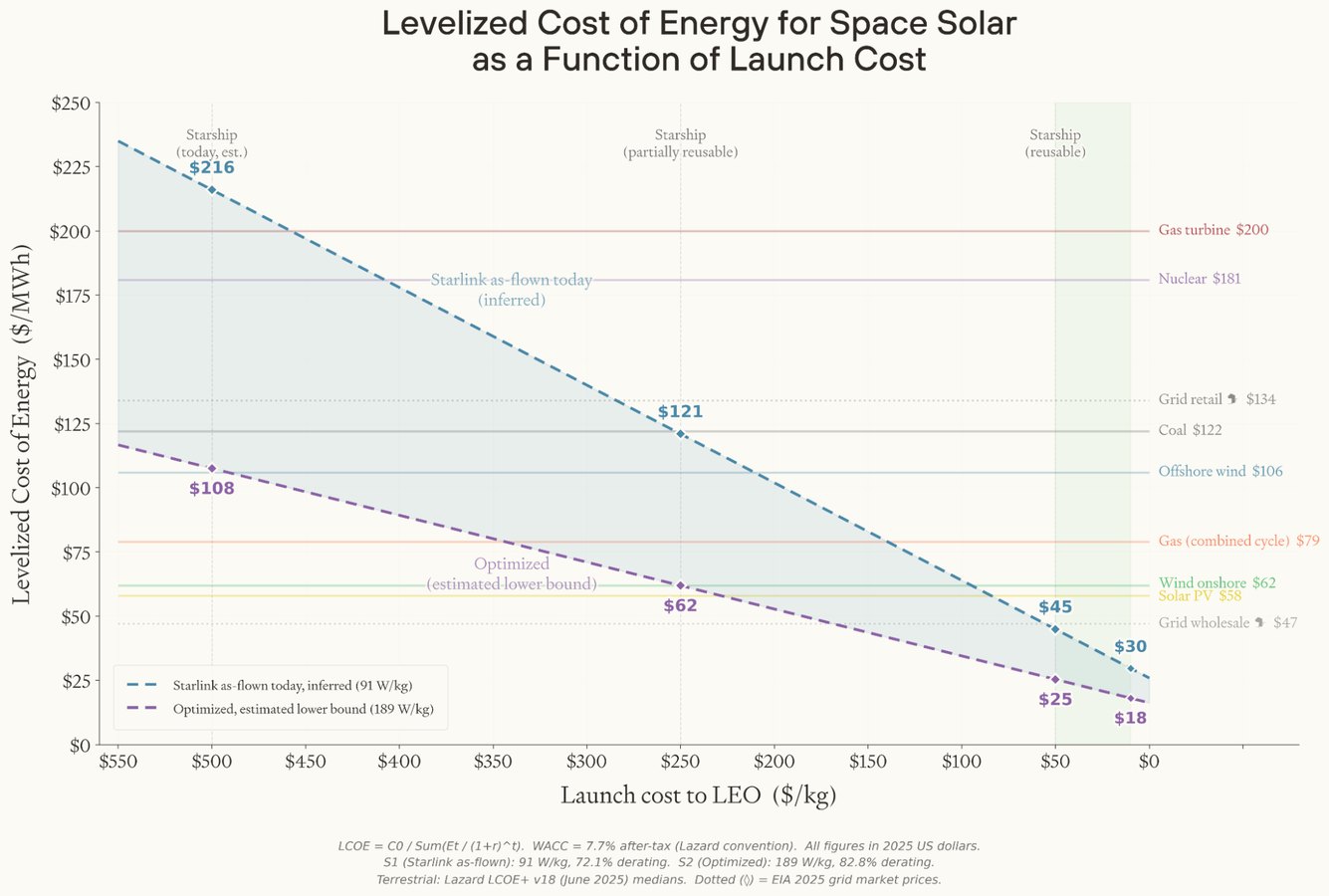
The financial viability of orbital compute depends heavily on SpaceX completing Starship development by late 2026 and achieving high-cadence reusability comparable to the Falcon architecture. Present-day launch costs hover around $1,500 per kilogram, which renders large-scale orbital facilities uneconomic against ground installations. Space-based solar arrays achieve parity with off-grid terrestrial power when launch costs fall to roughly $250 per kilogram.
If launch costs decrease further to around $100 per kilogram alongside modest reductions in server mass, orbital facilities can match bullish land-based projects. At $50 per kilogram, orbital solar power could drop to between $25 and $45 per megawatt-hour, beating any current terrestrial energy option. Once launch costs reach this level, the dominant expense shifts from launch fees to semiconductor fabrication, whereas terrestrial installations remain burdened by recurring operational expenditures.
Advertisement
Tech Pulse Daily
Get tomorrow's pulse first
Join engineers who read Tech Pulse before stand-up. Free, weekday mornings.
03Radiator thermal systems and heat dissipation
Heat rejection in a vacuum relies purely on radiative dissipation rather than convective airflow or water evaporative cooling loops. Modern passive radiators utilizing selective surface coatings and lightweight carbon fiber panels achieve system-level dissipation between 163 and 346 watts per kilogram. This marks a 13 to 28-fold efficiency improvement over International Space Station radiators, which delivered roughly 13 watts per kilogram.
Although large-scale data center arrays have not yet deployed these radiators, prototype high-conductivity carbon composite panels have demonstrated the required thermal properties in testing. Thermal management systems at these specifications represent just 2 to 5 percent of the total data center capital expenditure. Over a standard operational lifecycle, this radiative hardware footprint costs less than the cooling infrastructure required by comparable facilities on Earth.
04Maintenance constraints and maintenance hardware penalties
Orbital deployment introduces severe operational penalties because technicians cannot swap out damaged processors or degraded boards after deployment. Operating without physical servicing means any hardware failure permanently removes that silicon from service while leaving the supporting solar panels and cooling capacity unutilized. Modeling an annual failure rate requires data centers to launch significant surplus non-compute equipment to sustain targeted computing capacities over time.
To offset this lack of servicing, an orbital data center requires roughly 38 percent extra non-compute hardware, including excess solar arrays, racks, and radiator surfaces across a five-year lifecycle. Additionally, inter-satellite bandwidth bottlenecks restrict early orbital platforms primarily to model inference workloads rather than distributed training runs. These hardware penalties offset some of the cost advantages gained from high-intensity solar exposure in orbit.
05Power concentration and regulatory jurisdictions
Operating compute infrastructure in orbit bypasses traditional land-use permitting, national zoning laws, and grid environmental regulations. This absence of direct oversight allows operators to skirt terrestrial rules, creating jurisdictional ambiguities around AI governance and safety standards. However, relying on space infrastructure funnels the entire sector through a single launch provider, SpaceX, which also owns the frontier laboratory xAI.
Orbital data centers are unlikely to represent a meaningful share of global compute capacity before 2030 due to current deployment cycles. If Starship development reaches its targets within the next three to five years, orbital data centers will become cost-competitive with ground facilities. At that stage, silicon manufacturing output, rather than rocket payload volume, could emerge as the binding bottleneck for further orbital expansion.
Will we put data centers in space? FAQ
What launch cost makes orbital data centers cheaper than terrestrial power?
Space-based solar achieves cost parity with off-grid terrestrial power at roughly $250 per kilogram and becomes cheaper than any current terrestrial energy source at around $50 per kilogram.
How do orbital data centers dissipate server heat in a vacuum?
They use passive radiative cooling panels made from high-conductivity carbon composites and selective coatings, achieving thermal dissipation between 163 and 346 watts per kilogram.
Why are early orbital data centers primarily limited to inference workloads?
Inter-satellite bandwidth limitations make distributed training clusters difficult to coordinate across orbit, while the inability to repair failed chips requires roughly 38 percent extra non-compute hardware over five years.
Sources

Author
Dillip Chowdary
Writes Tech Bytes coverage of AI, engineering, and the tools that actually ship. Editor of Tech Pulse Daily.
Related on Tech Bytes
Advertisement