Work to replace old copper wire led to the FAA’s ground stop
A routine copper wire upgrade at an FAA remote facility flooded air traffic control routers with 1,000 requests per burst, grounding departures nationwide.
By Dillip Chowdary • Nov 14, 2026 • Source: The Verge
A routine infrastructure upgrade intended to replace aging copper wire with a modern fiber optic line triggered a nationwide Federal Aviation Administration ground stop that halted thousands of departing flights across the United States. Transportation Secretary Sean Duffy confirmed the source of the disruption during a press conference following the incident, explaining the sequence detailed in The Verge's report. The outage stemmed from network equipment installed at an isolated flight control installation rather than a comprehensive system overhaul.
This report details the technical chain of events behind the nationwide departure pause, the contractor network equipment involved, the operational fallout at major hubs, and the regulatory debate over aviation infrastructure funding. It provides aviation systems engineers, infrastructure analysts, airline operators, and transit planners with an unpadded account of the outage based on official agency statements. Readers will find exact figures regarding connection spikes, hardware configurations, and federal maintenance schedules.
01Remote facility copper wire replacement work
The physical disruption originated during scheduled maintenance at a remote Federal Aviation Administration facility. Field technicians were actively replacing legacy copper cabling with high-capacity fiber optic lines to preserve basic connectivity. Transportation Secretary Sean Duffy stated that the maintenance became urgent because the legacy copper wire was scheduled for total discontinuation, which would have severed communications without an immediate upgrade.
Secretary Duffy emphasized to reporters that the installation was classified as routine maintenance rather than an expansive technical overhaul. The service provider operating the older copper circuit intended to shut down the physical line entirely. Federal authorities moved to complete the fiber switchover before the legacy circuit became permanently inaccessible to air traffic personnel.
Because the copper line faced mandatory shutdown by telecommunications providers, agency technicians could not postpone the physical transition. The replacement process required installing new networking equipment alongside the fiber run to route communications back to regional centers. That routine hardware exchange ultimately served as the point of failure for the broader air traffic network.
02Network router connection flood mechanics
Once technicians activated the replacement infrastructure, the newly installed router began broadcasting abnormal traffic across connected federal facilities. Secretary Duffy confirmed that the device began flooding peer routing equipment throughout the Air Traffic Control environment. The continuous burst generated over 1,000 connection attempts every 4 to 5 seconds, overwhelming available networking capacity.
The high-frequency transmission storm quickly degraded critical data pipelines that support national airspace tracking. The connection barrage disrupted active radar feeds shared between control centers and interrupted direct communications links with aircraft in flight. Core routing hardware inside the Air Traffic Control system was unable to filter the burst while preserving standard telemetry.
Faced with degraded radar visibility and unstable radio channels, federal managers initiated contingency protocols to protect airborne aircraft. The rapid spike in connection requests saturated network queues, preventing air traffic controllers from receiving reliable data updates. Halting departures prevented new aircraft from entering an airspace operating with unstable telemetry channels.
Advertisement
Tech Pulse Daily
Get tomorrow's pulse first
Join engineers who read Tech Pulse before stand-up. Free, weekday mornings.
03Hardware configuration and contractor accountability
During the public briefing, Secretary Duffy stated that technical investigators had not yet finalized the root cause of the router failure. The transportation secretary pointed to three primary possibilities under review, including defective hardware, an erroneous router configuration, or contractor error. He explicitly raised the question of potential incompetence on the part of defense contractor L3Harris during the installation.
Federal investigators are inspecting the physical router and its onboard firmware to verify whether manufacturing defects caused the communication loops. Technicians are also reviewing the baseline routing tables and port configurations applied to the unit prior to deployment. If configuration rules were improperly authored, the router would have automatically initiated continuous reconnect loops across the system.
Contractor oversight remains central to the ongoing federal inquiry. L3Harris holds service responsibilities across parts of the civil aviation telecommunications infrastructure, making its engineering protocols a key focus of investigators. Federal officials have indicated that determining whether technician error or equipment defects caused the incident is critical before resuming similar upgrades.
04Terminal departure halts and airport operations
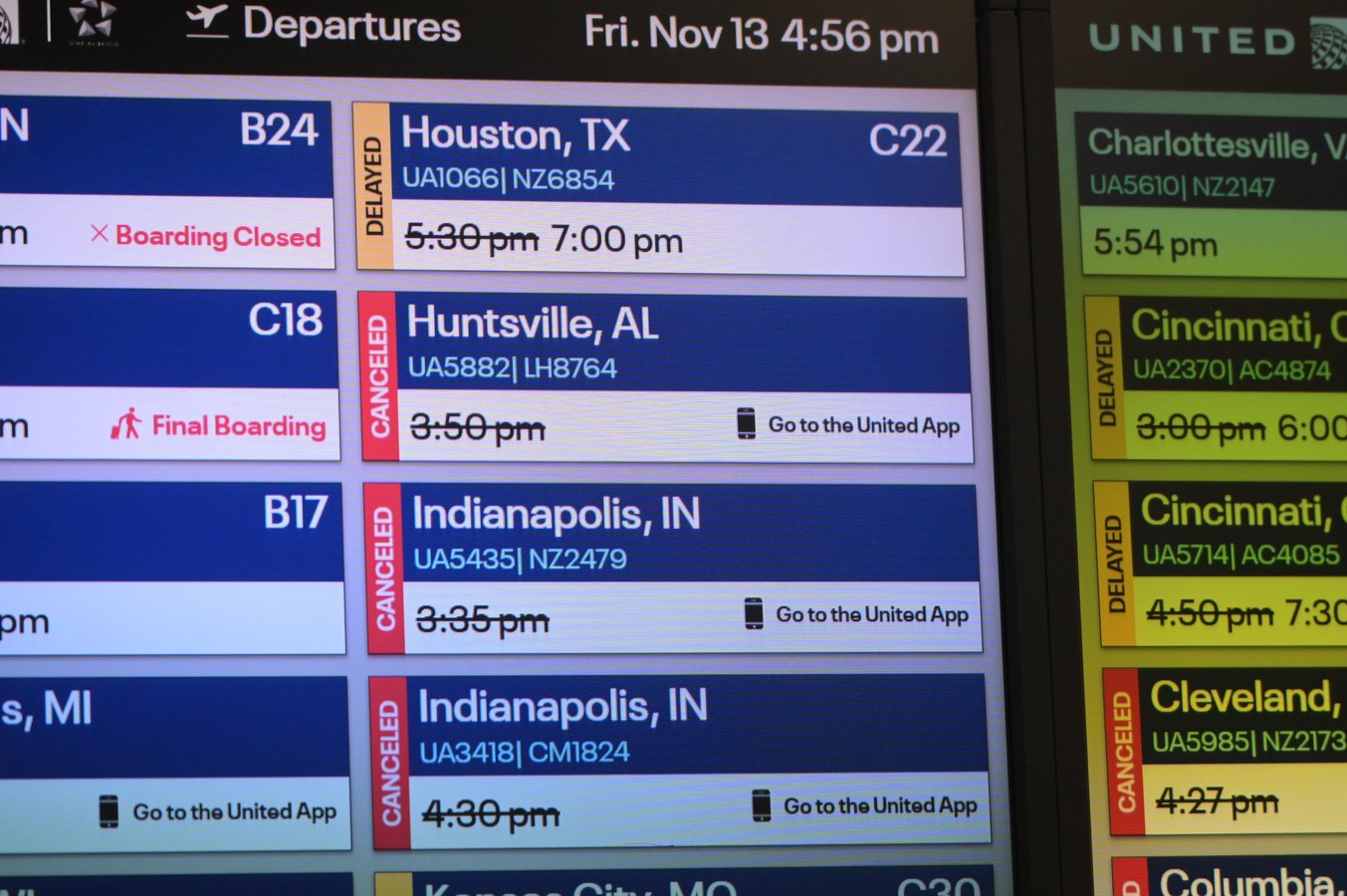
The communication breakdown forced the Federal Aviation Administration to order a nationwide ground stop on all domestic departures on Friday, November 13, 2026. Thousands of scheduled commercial flights remained grounded at terminal gates across the country as regional control centers lost stable communication feeds. Transportation officials held outgoing flights indefinitely until technicians could isolate the flooded routing nodes.
Major transit hubs experienced immediate operational backlogs as departure gates filled with delayed aircraft. At Chicago O’Hare International Airport, waiting passengers packed concourses as information boards showed widespread departure cancellations and holds. Ground crews were instructed to keep aircraft parked while air traffic controllers managed the backlog safely.
While departures remained strictly halted, the Federal Aviation Administration allowed arriving airborne flights to land normally at destinations nationwide. Controllers prioritized flights already aloft, utilizing functional local systems to guide incoming aircraft to runways without incident. The selective hold isolated risk on the ground while technicians restored stability to the core network routers.
05Congressional funding and modernization schedule
Following the resolution of the ground stop, Secretary Duffy used the briefing to petition federal lawmakers for comprehensive infrastructure funding. The secretary argued that sustained capital investment from Congress is mandatory to replace brittle legacy communication systems across the aviation network. Without complete funding packages, federal agencies remain constrained to piecemeal component swaps.
Secretary Duffy informed reporters that Congress had previously provided only a partial payment toward modernizing the national Air Traffic Control architecture. He insisted that partial appropriations force the agency to perform urgent patchwork repairs on obsolete infrastructure instead of executing structured upgrades. Duffy maintained that full modern financing is required to ensure systemwide stability.
Defending the federal workforce, Duffy stated that the agency is building safely while attempting to build fast under difficult technical conditions. He asserted that accelerating modern network deployments is essential to retire aging copper connections before supplier discontinuations force emergency interventions. The transportation department continues to press congressional committees for the remainder of the modernization budget.
Work to replace old copper wire led FAQ
What caused the FAA nationwide ground stop?
The ground stop occurred when a newly installed router flooded air traffic control networks with over 1,000 connection attempts every 4 to 5 seconds during a copper wire replacement.
Which contractor was cited in connection with the router issue?
Transportation Secretary Sean Duffy cited contractor L3Harris as the entity involved in the facility equipment upgrade under review.
Did the FAA ground stop prevent incoming flights from landing?
Arriving flights were permitted to land normally across the country, while departures remained grounded until air traffic communications stabilized.
Why was the copper wire being replaced during routine maintenance?
The legacy copper line at the remote facility was scheduled for permanent discontinuation by the service provider, requiring an urgent upgrade to fiber optic cabling.
Sources

Author
Dillip Chowdary
Writes Tech Bytes coverage of AI, engineering, and the tools that actually ship. Editor of Tech Pulse Daily.
Related on Tech Bytes
Advertisement