Zen Browser is the Arc replacement I was looking for
Zen Browser offers an open-source, AI-free alternative to Arc with vertical tabs and glance pop-overs as Atlassian prepares to sunset the original app.
By Dillip Chowdary • Oct 25, 2026 • Source: The Verge
Arc is heading toward retirement following its acquisition by Atlassian last year, which shifted engineering priorities to Dia, its artificial intelligence browser. As detailed in The Verge's report, open-source project Zen Browser has emerged as an alternative, replicating Arc's core visual architecture while deliberately omitting AI agents, data collection, and corporate bloat.
This report details Zen Browser's layout, customization features, and technical constraints for displaced Arc users seeking an organized, vertical-tab workspace. It examines how the Firefox-based application operates, where media playback limitations currently exist, and how its community-funded model compares to commercial options.
Zen Browser is the Arc replacement I was: what actually changed
The shift away from Arc reflects changing priorities following Atlassian's buyout and its redirection of resources toward Dia. While Arc introduced a fresh approach to browser design, its later roadmap emphasized embedded artificial intelligence agents and integrated data pipelines that drove away users seeking basic privacy. Zen Browser strips out those automated assistants entirely, functioning strictly as a clean, responsive web browser. Developed as an open-source project supported by community donations and volunteers, Zen explicitly rejects training large language models on user browsing history.
Visually, the browser adopts the core interface concepts popularized by Arc without carrying over its proprietary overhead. Users find a launcher-like pinned tab grid, a persistent vertical tab bar along the left edge, and siloed spaces to segment tasks. Customization is handled through Zen Mods, which allow people to overhaul picture-in-picture video behavior, restyle active tabs, and adjust the user interface. Instead of feeling locked into a commercial business plan reliant on user data, users retain modern tab ergonomics inside a transparent, independent environment.
Zen Browser is the Arc replacement I was: how it works
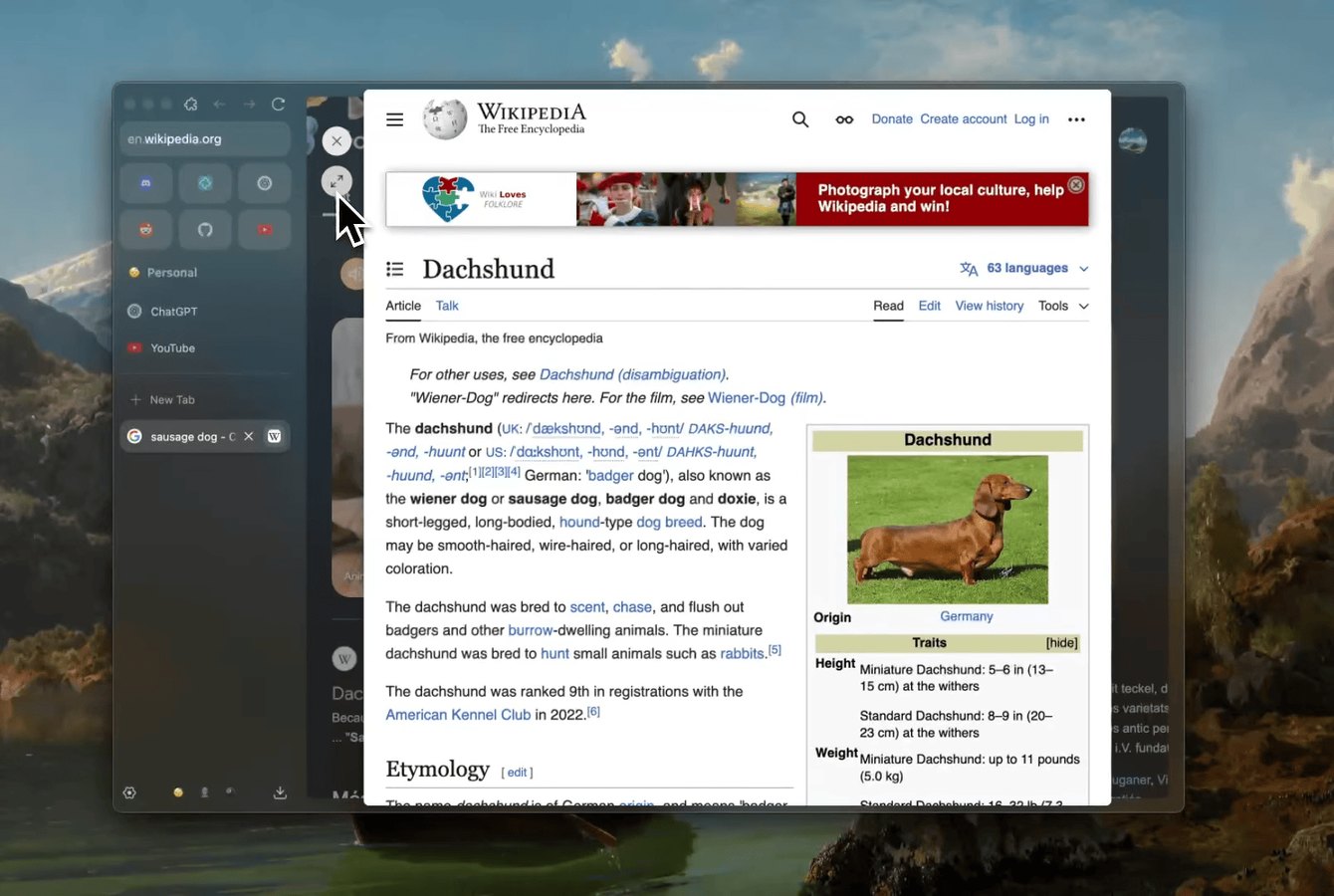
Navigation within Zen Browser centers on rapid window manipulation and modular page isolation powered by Firefox underpinnings. The platform implements a glance view mechanism that opens hyperlinks inside a temporary pop-over window, enabling users to perform quick research or inspect listings without cluttering their main workspace. Clicking once converts any pop-over into a standard tab. A floating search bar invoked via Command+T or Control+T lets users launch tabs, switch open pages, run queries across custom search engines, and trigger extensions from a single keystroke.
Extensions and interface scripts operate through Mozilla's add-on repository, providing versatility alongside custom style injection. Although Arc relied on Chrome extensions, Zen provides more consistent UI workarounds for display behaviors caused by vertical tab arrangements. In May, developers implemented a site customization tool similar to Arc's Boosts, allowing users to alter individual site presentations directly. While the browser lacks an easily browsable public repository for installable Boosts, requiring manual per-site adjustments, the native modding framework and Firefox extension support grant users granular control over their web display.
Advertisement
Tech Pulse Daily
Get tomorrow's pulse first
Join engineers who read Tech Pulse before stand-up. Free, weekday mornings.
Zen Browser is the Arc replacement I was: why it matters now
The timing of Zen Browser's maturation coincides with the impending retirement of Arc, leaving vertical-tab users without an official long-term home. Atlassian's pivot to Dia signaled an industry push to embed artificial intelligence agents directly into web navigation bars, subordinating manual control to automated workflows. Zen offers a direct counter-narrative, declaring a commitment to user experience rather than data harvesting. Built on an open-source framework financed by voluntary contributions, the platform eliminates corporate incentives to monetize browsing telemetry or train large language models on web activity.
The project also demonstrates that experimental browser interfaces can flourish outside the Chromium monoculture. Because Zen is constructed upon Firefox, it preserves rendering engine diversity while insulating workflows from uniform tracking standards. Early iterations of Zen suffered from unstable builds and software bugs, which initially turned away prospective adopters. However, ongoing community development has smoothed out performance defects, producing a stable daily application capable of managing multiple distinct spaces, customized tab layouts, and active multitasking routines without introducing unnecessary interface bloat or stability crashes.
Zen Browser is the Arc replacement I was: who is affected
The primary group impacted by these shifts consists of Arc loyalists facing an abrupt transition as their daily tool approaches its end-of-life status. Professionals who integrated left-sided vertical tabs, segregated spaces, and quick launcher interfaces must migrate to new software before Arc shuts down permanently. For users drawn to Arc's design aesthetics rather than its conversational AI tools, Zen Browser delivers a drop-in alternative that preserves muscle memory while eliminating intrusive sidebars, though individuals seeking automated agent features will find Zen intentionally devoid of them.
Media consumers and audio creators face operational hurdles when migrating to Zen Browser in its current form. Because the application lacks digital rights management decryption, subscribers cannot stream protected media from services like Netflix, Disney+, HBO, or Spotify. Furthermore, because Zen is derived from Firefox, it inherits weak Web MIDI protocol support, complicating setups for musicians connecting hardware synthesizers to browser interfaces. Consequently, users relying on commercial video streaming or Web MIDI tools must maintain secondary browsers like Google Chrome alongside Zen to handle those tasks.
Zen Browser is the Arc replacement I was: what to watch
The most urgent milestone on Zen's technical roadmap is securing a Widevine digital rights management license from Google. The Zen development team is actively pursuing this agreement to enable native decoding of encrypted video streams across platforms like Netflix and Disney+. Obtaining Widevine approval will determine whether general users can adopt Zen as their sole primary browser or if they must keep secondary browsers installed for entertainment. Resolving this media limitation represents the primary hurdle to matching the functional capabilities of mainstream competitors.
Community observers are also monitoring Zen's site customization tooling and general extension reliability. Following the introduction of site-tweaking features in May, users await an official browsable directory for sharing community Boosts, which would eliminate manual CSS coding. As Atlassian prepares the final retirement of Arc and accelerates Dia's development, the volunteer project's ability to provide timely updates, resolve extension edge cases, and sustain community donations will dictate whether Zen Browser expands beyond power-user circles to capture mainstream web users seeking stability.
Developer Action Items
- ☐ Map where Framework sits in your stack (SDK, API key, billing, data-processing addendum).
- ☐ Hold non-urgent migrations until the integration or use-of-proceeds roadmap is public — day-one coverage is not a ship signal.
- ☐ If you are mid-contract or mid-POC, ask the vendor what changes for existing customers this quarter.
- ☐ Write the single decision this forces: stay, dual-source, or exit.
Zen Browser is the Arc replacement I was FAQ
Why are users leaving Arc for Zen Browser?
Users are switching because Atlassian acquired Arc last year and plans to shut it down in favor of its AI browser Dia. Zen provides Arc's vertical tabs, spaces, and launcher UI without AI agents, telemetry, or bloat.
Can Zen Browser play Netflix and Spotify streams?
No, Zen currently cannot stream DRM-protected media from services like Netflix, Disney+, HBO, and Spotify because it lacks a Widevine license. The volunteer team is actively working to obtain Widevine certification from Google.
Does Zen Browser support extensions and site customizations?
Yes, Zen supports Firefox extensions and features Zen Mods for interface tweaks like picture-in-picture adjustments. It also introduced a Boost feature in May for styling specific websites, though it lacks an official public repository.
Is Zen Browser free and open source?
Yes, Zen Browser is an open-source project funded by volunteer contributions and donations. It runs on Firefox without artificial intelligence models trained on user browsing activity.
Sources

Author
Dillip Chowdary
Writes Tech Bytes coverage of AI, engineering, and the tools that actually ship. Editor of Tech Pulse Daily.
Related on Tech Bytes
Advertisement