A Newly Discovered Trail of Cosmic Debris Illustrates How the End
ESO astronomers found two gas rings around white dwarf J1328−1450, showing how surviving planetary bodies shape cosmic debris 1,600 light-years away.
By Dillip Chowdary • Nov 01, 2026 • Source: Wired

Astronomers at the European Southern Observatory discovered an unusual debris disk around the white dwarf J1328−1450, situated roughly 1,600 light-years from Earth. As detailed in Wired's report, observations taken with the Very Large Telescope revealed two distinct rings of gas separated by an unexplained gap, preserving remnants of the star's former planetary system.
This report details the structure of the newly detected rings, the surviving planetary bodies thought to shape them, and what the system reveals about the future demise of our solar system. It is written for astrophysicists, astronomical researchers, and space technology observers monitoring planetary evolution.
A Newly Discovered Trail of Cosmic Debris: what actually changed
The white dwarf star J1328−1450 was already cataloged in baseline astronomical star maps, but its local circumstellar environment had never been resolved in detail until recent observations with the European Southern Observatory's Very Large Telescope. The new imaging revealed that the star is enveloped in an organized debris disk composed of gas and dust. This finding changed astronomical assumptions about the system, proving that substantial remnants of the original planetary architecture survived the star's transition into a compact white dwarf remnant.
The critical structural discovery is that this disk contains two distinct rings of gas parted by a noticeable gap. Most known debris disks surrounding collapsed stellar cores present as continuous, diffuse fields of pulverized rock and dust. Finding two defined concentric rings separated by an empty lane indicates that active physical clearing is occurring within the system. The observation establishes that planetary debris can organize into discrete, durable orbital bands rather than simply scattering across space after a host star dies.
A Newly Discovered Trail of Cosmic Debris: how it works
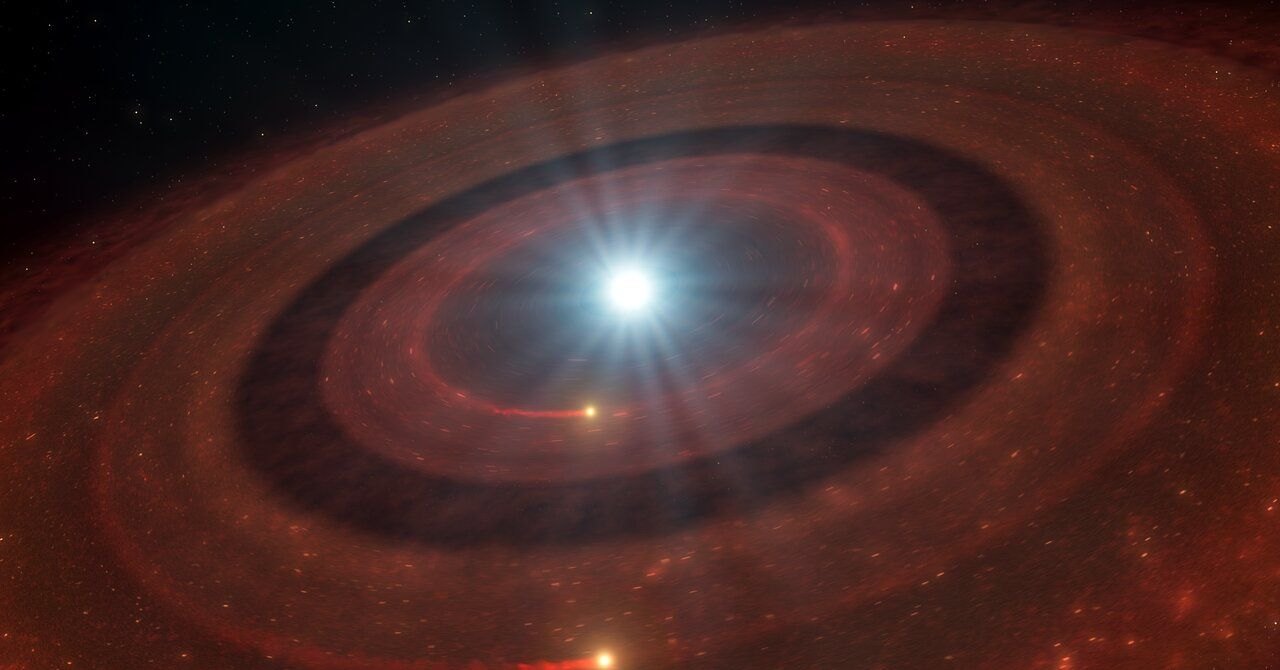
The physical formation of this circumstellar structure began when J1328−1450 depleted its fuel supply, expanded outward into a red giant, and eventually shed its outer layers to leave a white dwarf. During that expansion, the star destroyed several of its closest planets and subjected any surviving rocky bodies to an extreme radiation and gravitational environment. The destroyed and abraded planetary material was pulverized into gas and dust, settling into an orbiting disk around the remaining dense stellar core over millions of years.
Astronomers conclude that the gap between the two rings is carved by at least two surviving planetary bodies orbiting unseen within the system. The closer object measures only a few kilometers in diameter, whereas the distant object could rival the size of Pluto or Earth's moon. Their gravitational interactions with surrounding gas explain the two distinct rings. Alternatively, researchers hypothesize that this dual-ring structure could originate from the segregated remnants of a single planetary body, such as its stripped rocky crust separating from its dense core.
Advertisement
Tech Pulse Daily
Get tomorrow's pulse first
Join engineers who read Tech Pulse before stand-up. Free, weekday mornings.
A Newly Discovered Trail of Cosmic Debris: why it matters now
The discovery matters because it provides observational evidence of what will happen to our solar system. In roughly 5 billion years, our sun will exhaust its hydrogen fuel, swell into a red giant, and engulf its innermost planetary neighbors. After expelling its outer atmosphere, the sun will collapse into a cooling white dwarf. Any outer rocky bodies that survive this expansion will be exposed to severe environmental conditions, fracture, and form a debris disk analogous to the dual rings orbiting J1328−1450 today.
Beyond confirming theoretical predictions of solar death, the dual-ring system proves that post-stellar debris disks do not always collapse into homogeneous chaos. Instead, planetary bodies as small as a few kilometers or as large as Pluto or the moon can endure the transformation and dynamically shepherd the surrounding gas. This empirical case confirms that planetary remnants can actively sculpt debris fields around dead stars, offering researchers an actual astrophysical reference for how planetary architecture survives post-main-sequence stellar evolution across our wider galaxy.
A Newly Discovered Trail of Cosmic Debris: who is affected
Observational astronomers using deep-space facilities like the Very Large Telescope are directly affected by the need to re-examine cataloged white dwarf systems. Because J1328−1450 was previously identified only as an ordinary point source in standard star-mapping catalogs, observatories must now question how many other nearby dead stars harbor undetected debris rings. Teams at the European Southern Observatory and global research institutions must revisit baseline survey catalogs to schedule targeted spectrographic observations capable of identifying faint gas rings and structural gaps around other cooling stellar remnants.
Theoretical astrophysicists studying planetary survival and orbital dynamics must also adjust their computational frameworks in response to the data. Previous models assumed that the intense thermal expansion of a red giant would completely obliterate intermediate-sized planetary bodies or disperse gas evenly. The existence of a kilometer-wide fragment alongside a possible Pluto-sized survivor in J1328−1450 forces dynamicists to update their simulations. Researchers must now account for multi-body gravitational interactions that preserve distinct gas rings and gaps following catastrophic, late-stage stellar transformations.
A Newly Discovered Trail of Cosmic Debris: what to watch
The next step for astronomers at the European Southern Observatory is attempting direct identification of the surviving bodies suspected of maintaining the disk's structure. Researchers have not yet directly confirmed whether the system contains two distinct planetary fragments or whether the rings represent the separated core and crust of a single fractured planet. Follow-up observations with the Very Large Telescope will search for optical signatures and gravitational perturbations that could conclusively identify the physical nature of these proposed orbiting planetary remnants.
Astronomers will also analyze the gas and dust composition within the two rings to evaluate their long-term orbital stability around J1328−1450. Future spectrographic campaigns will monitor whether material from the inner ring gradually falls onto the white dwarf surface or if the outer ring maintains its shape over time. Comparative studies of other white dwarf systems will determine whether dual-ring formations are rare anomalies or standard evolutionary milestones that illustrate the final chapter of dying planetary systems across the broader cosmos.
Developer Action Items
- ☐ Verify the claim on the official Newly Discovered Trail Cosmic page (or Wired), not from this recap alone.
- ☐ Name the surface that moved — API, policy, model, hardware, or commercial terms — before you Slack the thread.
- ☐ Assign one owner a day to read the primary material and decide: this-sprint, this-quarter, or noise.
- ☐ Do not change production on day-one coverage. Watch the vendor changelog and one independent write-up first.
A Newly Discovered Trail of Cosmic Debris FAQ
What is white dwarf J1328−1450 and where is it located?
White dwarf J1328−1450 is a collapsed stellar remnant located approximately 1,600 light-years from Earth. It was analyzed by astronomers at the European Southern Observatory using the Very Large Telescope.
What makes the debris disk around J1328−1450 unusual?
The disk consists of two distinct concentric rings of gas separated by an empty gap rather than a uniform cloud of matter. Astronomers believe this structure is composed of pulverized planetary remnants from the star's former solar system.
What mechanisms explain the gap between the two gas rings?
Researchers believe the gap is maintained by at least two surviving planetary bodies, with the inner body measuring a few kilometers across and the outer body reaching the size of Pluto or the moon. Another possibility is that the rings formed from separated layers of a single destroyed body, such as its crust and core.
How does this system illustrate the end of our own solar system?
In about 5 billion years, our sun will expand into a red giant, engulf its closest planets, and shed its outer layers into a white dwarf. Surviving rocky bodies could then shatter into a ringed debris disk similar to J1328−1450.
Sources

Author
Dillip Chowdary
Writes Tech Bytes coverage of AI, engineering, and the tools that actually ship. Editor of Tech Pulse Daily.
Related on Tech Bytes
Advertisement