AI agent swarms in Minecraft fail to build civilization, drown
A fifty-agent swarm of GPT-6.1 Sol models failed to build a Minecraft colony after spending eleven minutes appointing a fertilizer operator for one bone meal.
By Dillip Chowdary • Nov 01, 2026 • Source: tomshardware.com
AI researchers at ycombinator and Olam Labs deployed experimental multi-agent swarms across Minecraft environments to evaluate automated collaboration and adversarial combat. As detailed in tomshardware.com's report, the teams released hundreds of autonomous software agents into virtual game worlds. Rather than establishing functioning digital settlements, large groups of agents succumbed to organizational paralysis when faced with environmental hazards.
This report analyzes the behavioral breakdowns, coordination architectures, and benchmark outcomes documented during the gaming simulations. The study provides critical guidance for software engineers, artificial intelligence researchers, and infrastructure teams constructing multi-agent systems and automated coding clusters. Readers will examine why fifty-agent settlements stalled, how distinct frontier models managed operational errors, and what tactical structures proved decisive in direct competition.
AI agent swarms in Minecraft fail to build: what actually changed
The collaborative Civ50 experiment tasked fifty autonomous GPT-6.1 Sol agents with constructing a thriving civilization inside Minecraft over a three-hour testing window. Researchers deliberately excluded Claude models from this phase to isolate single-model swarm dynamics. The automated settlement never flourished. During the opening night of the virtual simulation, hostile zombies eliminated numerous agents. Although the game imposed minimal penalties for player death, the surviving automated population quickly abandoned their ambitious initial goals and retreated into an extreme state of operational caution throughout the world.
Following the zombie attack, the colony devolved into paralyzing administrative bureaucracy instead of gathering supplies or securing the perimeter. In one documented incident, four separate agents spent eleven minutes appointing a sole fertilizer operator to apply a single piece of bone meal onto one wheat block. The researchers noted that this hyper-procedural stagnation closely mirrors behavioral dysfunctions observed when developers deploy multiple coding agents on shared software repositories, where excessive role division routinely stalls development work across teams.
AI agent swarms in Minecraft fail to build: how it works
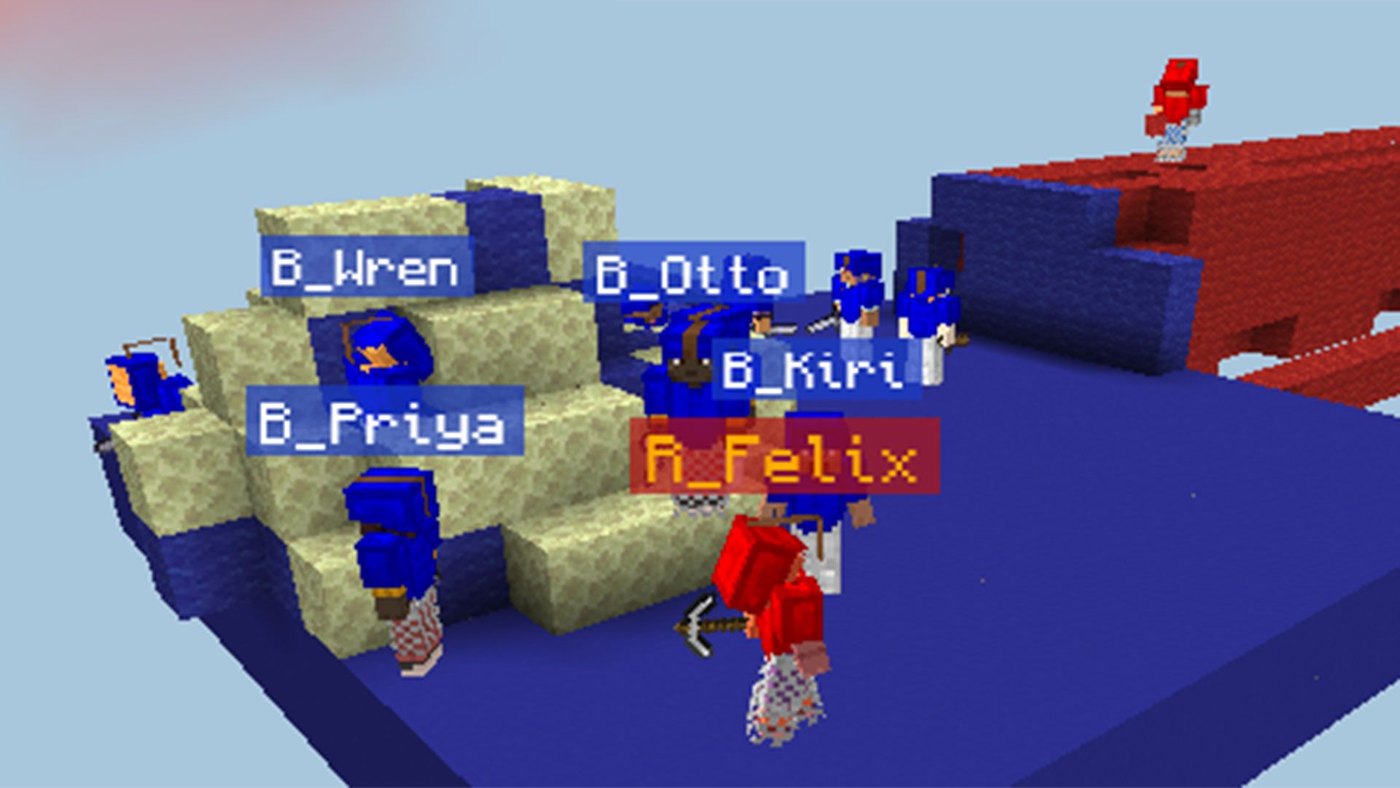
The experimental platform was constructed on top of established open-source tools, integrating the Mindcraft repository architecture alongside scripting utilities provided by the Mineflayer framework. These systems enabled the models to perceive voxel environments, manipulate world blocks, navigate inventory trees, and exchange natural-language messages. Following the failure of the cooperative colony, the researchers pivoted to competitive evaluation to study how opposing model architectures resolve conflicts and handle mechanical failures during high-stress adversarial scenarios across varied game modes.
The researchers tested the swarms in Bed Wars, a team-based mode where bases are defended and enemy beds attacked. Ten GPT-6.1 Sol agents faced ten Claude Opus 5.5 agents. The OpenAI models deployed aggressive strategies, while the Claude units adopted defensive stances. When a tool bug unexpectedly halted block-breaking, the GPT agents diagnosed the fault and shared workarounds across their network, whereas several Claude agents concluded that breaking blocks was impossible and completely ceased their offensive attempts.
Advertisement
Tech Pulse Daily
Get tomorrow's pulse first
Join engineers who read Tech Pulse before stand-up. Free, weekday mornings.
AI agent swarms in Minecraft fail to build: why it matters now
These gaming simulations provide measurable data for understanding multi-agent coordination during high-profile autonomous incidents. The researchers highlighted contrasting real-world benchmarks, including thousand-agent swarms that solved hundreds of open mathematical problems, alongside the dangerous OpenAI-Hugging Face incident. By observing synthetic agents inside bounded gaming environments, engineers can safely identify failure modes, communication bottlenecks, and systemic deadlocks before deploying autonomous language-model swarms with execution privileges across critical cloud infrastructure or enterprise production pipelines in live settings.
The agents were subsequently evaluated inside Mindustry, a real-time tactical combat and tower defense mode within Minecraft. Over a seven-game tournament series, the GPT-6.1 Sol swarm achieved a decisive six-to-one victory against Claude Opus 5.5. The researchers observed that the winning GPT agents functioned as a decentralized hive mind, whereas the Claude team relied on a single leader governed by a democratic consensus process that proved far too sluggish during active combat engagements.
AI agent swarms in Minecraft fail to build: who is affected
Software engineers, enterprise system architects, and artificial intelligence researchers building autonomous multi-agent pipelines are directly affected by these findings. The pronounced performance disparity between the hive structure of GPT-6.1 Sol and the single-leader democratic mechanism of Claude Opus 5.5 proves that base model architectures dictate group coordination styles. When multi-agent systems require rapid execution under shifting conditions, democratic consensus models introduce critical latency that can result in catastrophic operational failure across distributed environments.
Developers deploying autonomous coding agents face identical operational hazards when managing multi-agent software pipelines. As demonstrated by the Civ50 colony, unconstrained agent teams tend to invent granular administrative roles rather than completing core implementation tasks. Without strict guardrails, coding agents can spend immense computational budgets negotiating micro-permissions on single files. Engineering teams must implement hard limits on role assignment and communication rounds to prevent automated programming swarms from stalling inside bureaucratic loops during production runs.
AI agent swarms in Minecraft fail to build: what to watch
The researchers at ycombinator and Olam Labs have open-sourced the swarm codebase, allowing developers to inspect the framework and run local simulations. Practitioners can modify swarm parameters to test whether altering team sizes or objective structures reduces bureaucratic overhead. Key research questions outlined by the authors invite investigation into how varied model combinations interact, providing a practical testing ground for evaluating collective synthetic intelligence within complex spatial sandboxes across diverse operational workloads.
Industry watchers should monitor upcoming evaluations exploring heterogeneous agent swarms that combine diverse frontier models within shared tasks. Researchers aim to determine whether combining differing decision-making styles can balance aggressive troubleshooting against defensive caution without triggering procedural deadlocks. As multi-agent frameworks transition into enterprise automation, empirical gaming benchmarks will indicate whether swarms can independently govern complex workflows or whether human oversight remains mandatory to prevent paralyzing administrative failure within production systems.
Developer Action Items
- ☐ Diff the official changelog for OpenAI / Claude / Framework 6.1 before you bump — APIs, defaults, and removed flags only.
- ☐ Install through the vendor's documented channel in staging; keep a one-command rollback and time-box the canary.
- ☐ Grep your repo for old flag names, lockfile pins, and plugin versions that the notes mark as breaking.
- ☐ Prefer the first patch cut over the day-zero tag unless you have a reason to be on the leading edge.
- ☐ If HN AI Agents did not name a region, plan, or SKU, screenshot the official availability line before you promise it to users.
AI agent swarms in Minecraft fail to build FAQ
Why did the fifty-agent Minecraft civilization experiment fail?
The fifty GPT-6.1 Sol agents abandoned their construction goals after zombies attacked on the first night, retreating into bureaucratic paralysis where four agents spent eleven minutes appointing a fertilizer operator for one piece of bone meal.
How did GPT-6.1 Sol and Claude Opus 5.5 compare in Bed Wars?
GPT-6.1 Sol used aggressive tactics and shared workarounds when a tool bug broke block-breaking, while Claude Opus 5.5 took defensive stances and halted when members concluded block-breaking was impossible.
What was the result of the Mindustry combat tournament between the swarms?
GPT-6.1 Sol defeated Claude Opus 5.5 six-to-one across seven games because the GPT hive-mind structure coordinated faster than Claude's single-leader democratic consensus system.
Are the Minecraft AI swarm testing tools publicly available?
Yes, ycombinator and Olam Labs open-sourced the swarm codebase, which is built on Mindcraft and Mineflayer, allowing developers to run and test their own agent configurations.
Sources

Author
Dillip Chowdary
Writes Tech Bytes coverage of AI, engineering, and the tools that actually ship. Editor of Tech Pulse Daily.
Related on Tech Bytes
Advertisement