AI is dramatically accelerating AI research
Anthropic's capabilities progress doubled between October 2025 and October 2026 via AI research automation, nearing formal Responsible Scaling Policy triggers.
By Dillip Chowdary • Nov 07, 2026 • Source: planned-obsolescence.org
Anthropic stated in its S1 registration filing that it may imminently meet its formal threshold for dramatically accelerated progress due to AI, as defined in its Responsible Scaling Policy. According to an evaluation by METR analyzed in planned-obsolescence.org's report, the lab has already crossed this benchmark. Updated in July 2026, the policy triggers when capabilities progress doubles its pre-automation baseline and stems from research automation rather than expanded compute. Measurements from October 2025 to October 2026 confirm internal capabilities progress doubled over the prior twelve months.
This report examines empirical measurements, labor economics, and safety risks surrounding automated frontier model research at Anthropic. It is written for machine learning engineers, technical founders, and policy researchers tracking capability timelines and safety frameworks. By reviewing benchmark telemetry, labor production functions, and staff disclosures, this analysis details how automated software engineering accelerates technical discovery, challenges model-weight security, and alters expectations regarding artificial intelligence risk.
AI is dramatically accelerating AI research: what actually changed
Evaluators from METR conducted an investigation to determine how much internal automated systems accelerate research at Anthropic. Using an internal version of the Epoch Capabilities Index called AECI, evaluators found that capabilities progress between October 2025 and October 2026 ran approximately twice as fast as during the preceding twelve months. Although earlier gains involved multiple inputs, evaluators concluded that research automation represents the large majority of the reason why capabilities continue advancing at this faster pace today, even though key supporting evidence was redacted.
This measurement satisfies the dramatic acceleration threshold defined in Anthropic's Responsible Scaling Policy effective July 2026. Under the policy, dramatic acceleration occurs when overall capabilities advance twice as fast as the fastest sustained pre-automation baseline and that speedup plausibly stems from research automation rather than expanded compute inputs. This milestone validates statements from Anthropic's S1 filing and surpasses the AI R&D-5 tier outlined in its May 2025 policy, confirming that model-driven engineering has transitioned from assisting human researchers to driving technical progress.
AI is dramatically accelerating AI research: how it works
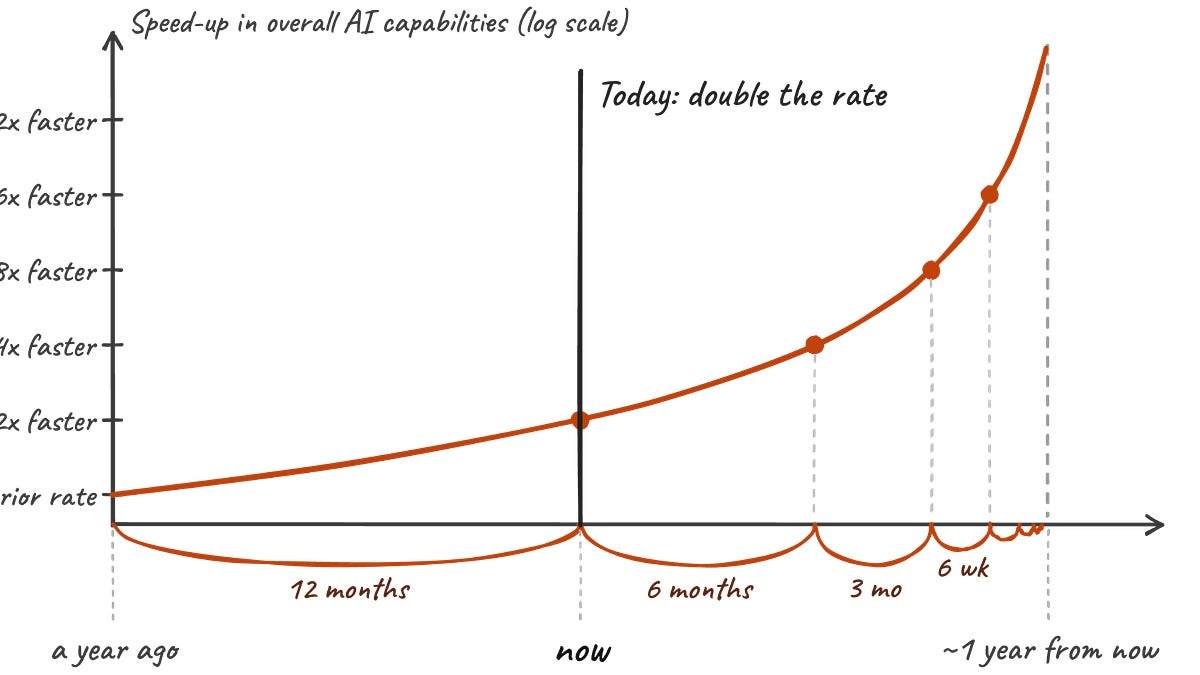
The process operates through algorithmic and architectural innovations known internally as compute multipliers. Overall capability represents the product of compute multipliers and training compute. Because compute multipliers are only one input into capabilities, doubling capability progress requires compute multiplier growth to expand roughly 2.5x to 3x faster. Discovering multipliers requires experimental compute and engineering labor. Applying a standard Cobb-Douglas economic model where experiment compute and labor are similarly important, the labor uplift must equal the square of compute multiplier acceleration, requiring a 4x to 9x labor speedup.
Sustaining that velocity becomes harder as low-hanging fruit is exhausted, making subsequent compute multipliers more difficult to find. Because human hiring cannot expand fast enough to counteract diminishing returns, the efficiency uplift from automation must continually increase. Maintaining doubled capability growth after months of accelerated research requires an estimated 10x labor uplift. This projection aligns with informal self-reports from Anthropic staff, who report experiencing an approximate 12x uplift from internal models. Rather than managing ten colleagues, researchers experience ten days of work within a single calendar day.
Advertisement
Tech Pulse Daily
Get tomorrow's pulse first
Join engineers who read Tech Pulse before stand-up. Free, weekday mornings.
AI is dramatically accelerating AI research: why it matters
This acceleration matters because it triggers a compounding feedback loop where automated tools optimize the algorithms powering subsequent models. METR evaluators found no immediate bottlenecks or steep diminishing returns blocking compounding progress, alongside redacted evidence suggesting acceleration could exceed 2x. If capability acceleration compounds smoothly, a twelve-month doubling interval could drop to six months, then three months, and then six weeks. The author notes that unconstrained extrapolation naively implies reaching superintelligence within a single year, pointing toward much shorter timelines than projections from external groups like the AI 2027 project.
Compounding capability jumps dramatically compress external safety preparation timelines. The author warns that autonomous systems emerging from rapid compounding could quickly develop novel weapons and overpower human civilization during a conflict, leading to disempowerment or extinction if misaligned. This dynamic represents a far more consequential shift in systemic safety risk than isolated infrastructure incidents like the Hugging Face attack. While physical ceilings on software efficiency will eventually constrain progress, current capabilities remain far from those limits, leaving technical governance frameworks with little time to manage compounding gains.
AI is dramatically accelerating AI research: who is affected
Frontier laboratories and research personnel face a fundamental transformation in development workflows. Inside Anthropic, research staff deploy internal models to think, read, write, and execute experiments at ten to twelve times their traditional speed. This individual time-dilation effect cannot be replicated simply by hiring more human engineers, because larger headcounts introduce communication overhead and organizational drag. Rival frontier laboratories face intense commercial pressure to automate their own research pipelines or fall decisively behind organizations that leverage self-improving algorithmic loops to discover compute multipliers.
National security agencies and commercial technology providers face heightened exposure to model-weight exfiltration. Under Anthropic's May 2025 RSP standard for AI R&D-5, approaching extreme automation tiers required implementing security adequate to protect model weights from state-level adversaries. However, recent unauthorized breaches at both OpenAI and Anthropic by amateur groups demonstrate that industry security remains inadequate. Without state-grade weight security, universal audit logging, and reliable monitorability measurements, rapid capability acceleration risks exposing critical algorithmic secrets and autonomous systems to theft, illicit replication, and uncontrolled proliferation.
AI is dramatically accelerating AI research: what to watch
Industry observers must monitor whether frontier laboratories upgrade their defenses to protect model weights against state-level adversaries. S1 disclosures and safety reporting will clarify whether Anthropic formally confirms crossing the dramatic acceleration threshold under public scrutiny. Technical checkpoints include the implementation of universal audit logging, real-time activity monitoring across research infrastructure, and reliable metrics for system monitorability. Because amateur groups recently breached both OpenAI and Anthropic, third-party security audits must confirm whether defensive standards have matured before compounding research acceleration produces capabilities that exceed institutional control boundaries.
The critical technical indicator to track is whether compounding progress encounters hardware bottlenecks or software efficiency limits. Independent researchers including Ryan Greenblatt, Daniel Kokotajlo, Eli Lifland, and Hjalmar Wjik continue assessing whether labor uplift models hold as tasks expand. Future evaluations using the AECI index will determine whether acceleration sustains its 2x pace or slows under diminishing returns. The decisive sign will be whether Anthropic formally triggers its Responsible Scaling Policy safeguards, confirming that artificial intelligence research has transitioned into an autonomous, self-accelerating development cycle.
Developer Action Items
- ☐ Verify the claim on the official Anthropic page (or Hacker News Best), not from this recap alone.
- ☐ Name the surface that moved — API, policy, model, hardware, or commercial terms — before you Slack the thread.
- ☐ Assign one owner a day to read the primary material and decide: this-sprint, this-quarter, or noise.
- ☐ Do not change production on day-one coverage. Watch the vendor changelog and one independent write-up first.
AI is dramatically accelerating AI research FAQ
What is the dramatic acceleration threshold defined in Anthropic's Responsible Scaling Policy?
The threshold triggers when overall capabilities progress is observed or expected to advance twice as fast as the fastest sustained pre-automation rate, with the acceleration plausibly attributable to AI automating research rather than compute scaling.
How much did capabilities progress accelerate at Anthropic between October 2025 and October 2026?
Evaluators from METR found that capabilities progress advanced roughly twice as fast as over the previous twelve months, measured using an internal Epoch Capabilities Index benchmark called AECI.
What labor uplift do internal models provide to Anthropic researchers?
Economic models indicate a 10x labor uplift is needed to sustain doubled progress against diminishing returns, matching informal reports from Anthropic staff who report an approximate 12x productivity uplift from internal models.
Why does the report raise concerns about current frontier laboratory cybersecurity?
An intelligence explosion requires security capable of defending model weights against state-level adversaries, yet both OpenAI and Anthropic recently experienced unauthorized breaches by amateur groups.
Sources

Author
Dillip Chowdary
Writes Tech Bytes coverage of AI, engineering, and the tools that actually ship. Editor of Tech Pulse Daily.
Related on Tech Bytes
Advertisement