Amazon’s new basic Kindle proves you don’t need all the bells and whistles
Amazon launched its redesigned six-inch basic Kindle starting at $169.99 with a 140-gram body that is 14 percent thinner and features a flush screen.
By Dillip Chowdary • Nov 07, 2026 • Source: TechCrunch

Amazon released its redesigned entry-level Kindle e-reader alongside a broader hardware overhaul featuring edge-to-edge screens and price increases. As detailed in TechCrunch's report, the basic six-inch device starts at $169.99 for the ad-free plastic version, driven by an industry-wide $40 to $50 increase that Amazon attributed to global memory-chip shortages during the artificial intelligence boom. The updated reader eliminates traditional raised bezels in favor of a modern flush-front aesthetic across its entry lineup.
This analysis details the physical measurements, software changes, and component trade-offs of the 2026 Kindle. It is intended for prospective buyers deciding whether Amazon's most compact reader fits their daily habits or if upgrading to the Paperwhite or Colorsoft is necessary. Although the base model lacks waterproofing and warm lighting, its lightweight design and pocket-friendly dimensions make it a compelling choice for everyday reading.
All the bells and whistles: what actually changed
The physical profile of the standard Kindle features significant cuts to mass and thickness. The plastic 2026 edition weighs 140 grams and measures 6.85 millimeters thick, making it 11 percent lighter and 14 percent thinner than the 2024 model, which weighed 158 grams and measured 8 millimeters. That 18-gram reduction improves one-handed comfort during lengthy reading sessions. Amazon also added an aluminum variant costing $189.99 with 32 gigabytes of storage in Seagrass and Alpine Sky colors, weighing 162 grams. The $169.99 plastic version offers 16 gigabytes of storage in Graphite or Ube purple.
Comparing the 2026 device to the 2019 Kindle Basic reveals substantial technical advancements. Display sharpness doubled from 167 pixels per inch to 300 pixels per inch, while base storage climbed from 4 or 8 gigabytes to 16 or 32 gigabytes. The older micro-USB port has been replaced by USB-C, and battery endurance lasts weeks longer. Software responsiveness has improved as well, with Amazon stating that opening books is 30 percent faster than on the 2024 model. A new flush-front screen design replaces the indented reading surface found on earlier generations.
All the bells and whistles: how it works
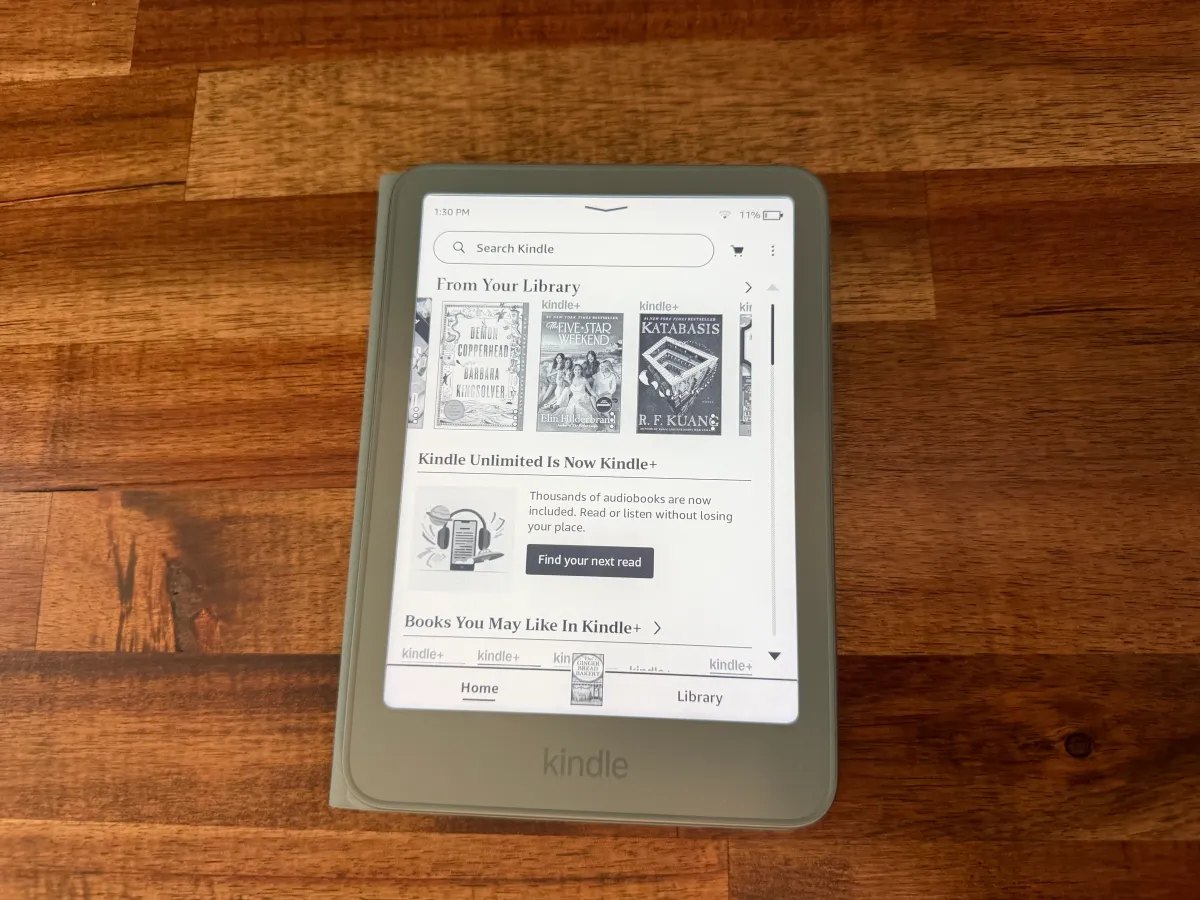
The edge-to-edge flush glass alters how users hold the device without triggering accidental page turns. Amazon introduced a dead zone in the capacitive touch layer that recalibrates to detect when fingers rest on the outer colored border. Readers can rest thumbs along the display perimeter without initiating unwanted page turns or text lookups. However, pressing firmly onto the primary text area registers normally, allowing users to highlight passages or search definitions. This touch-filtering algorithm compensates for the removal of physical bezels while maintaining standard navigation responsiveness across the reading canvas.
Page turns can also be controlled using the Kindle Click Bluetooth remote, which pairs wirelessly with the entry reader. While the basic model supports this wireless controller, it cannot use Amazon's magnetic cover with physical page-turn buttons. Power management provides roughly six weeks of battery life per charge, trailing the Paperwhite's 12 weeks and the Colorsoft's 8 weeks. This runtime reflects the compact battery required to keep total weight at 140 grams while powering the 300 ppi e-paper screen during daily reading.
Advertisement
Tech Pulse Daily
Get tomorrow's pulse first
Join engineers who read Tech Pulse before stand-up. Free, weekday mornings.
All the bells and whistles: why it matters
Pricing increases across Amazon's e-reader portfolio reshape where the entry device stands in the market. The $40 to $50 increase, caused by memory-chip shortages linked to artificial intelligence infrastructure demand, pushes the basic model to $169.99. Because the Paperwhite now begins at $199.99 for a 16-gigabyte Graphite unit and reaches $249.99 for a 32-gigabyte Seaglass model, the basic Kindle serves as the last relatively affordable option for buyers entering Amazon's ecosystem. Consumers must now weigh whether a basic e-reader justifies an investment approaching $170 without offering water resistance or warm front lighting.
The refreshed dimensions demonstrate that physical convenience remains a deciding factor for readers. Measuring 6.85 millimeters thin and weighing 140 grams, the base Kindle fits inside a back jeans pocket, purse, or small bag. That form factor allows readers to hold the unit comfortably for extended reading periods without hand fatigue. Even without premium features like color displays or auto-adjusting brightness, the combination of 300 ppi text clarity, faster page turns, and minimal weight shows that focused, distraction-free hardware continues to deliver practical utility for dedicated book consumers.
All the bells and whistles: who is affected
Commuters and frequent travelers stand to gain the most from the reduced bulk of the plastic model. At 140 grams, it is significantly lighter to hold on public transit than heavier e-readers. Readers who care about device appearance can choose between the standard Graphite finish, the new Ube purple plastic shell, or step up to the $189.99 aluminum version in Seagrass or Alpine Sky hues. The aluminum option adds 32 gigabytes of storage while weighing 162 grams, remaining four grams heavier than the 2024 plastic model yet benefiting from the slimmer 6.85-millimeter profile.
In contrast, readers who read in dark rooms or around water face clear trade-offs. The basic Kindle lacks warm light, which shifts the front-lit screen from a cool bluish-white to a soft amber glow designed to reduce eye strain in low-light environments. Readers who read nightly in bed may prefer spending $199.99 for the 16-gigabyte Paperwhite in Graphite or $249.99 for the 32-gigabyte Paperwhite in Seaglass. Furthermore, because the basic unit is not waterproof, users reading near pools, bathtubs, or beaches must pay for the Paperwhite to avoid moisture damage.
All the bells and whistles: what to watch
The commercial reception of this hardware will test whether readers accept $169.99 as an appropriate entry price for a basic reading device. Analysts will monitor whether buyers embrace the smaller, 140-gram form factor or choose to spend $30 more for the waterproof Paperwhite with warm lighting. In addition, real-world testing of Amazon's capacitive dead-zone algorithm will show whether touch-screen border filtering consistently prevents accidental highlights during varied reading grips, proving whether flush-front displays can fully succeed without traditional physical bezels on compact e-readers.
The adoption of specialized accessories like the Kindle Click Bluetooth remote will also highlight shifting reading behaviors. Because the 6-inch Kindle cannot connect to the magnetic cover with built-in page buttons, the Bluetooth remote serves as its only external navigation accessory. Observers will track whether remote-controlled reading gains traction among basic Kindle owners, or if the device's lighter, pocketable body makes handheld reading the preferred method. Future hardware revisions will reveal how Amazon balances rising memory costs against demand for entry-level devices.
Developer Action Items
- ☐ Map where Amazon sits in your stack (SDK, API key, billing, data-processing addendum).
- ☐ Hold non-urgent migrations until the integration or use-of-proceeds roadmap is public — day-one coverage is not a ship signal.
- ☐ If you are mid-contract or mid-POC, ask the vendor what changes for existing customers this quarter.
- ☐ Write the single decision this forces: stay, dual-source, or exit.
All the bells and whistles FAQ
How much does the new basic Kindle cost?
The ad-free plastic version starts at $169.99 with 16GB of storage, while the aluminum version with 32GB of storage costs $189.99.
Is the new basic Kindle waterproof?
No, the 6-inch basic Kindle is not waterproof. Readers needing water resistance must upgrade to the Kindle Paperwhite, which starts at $199.99.
Does the basic Kindle have a warm light for night reading?
No, the basic Kindle lacks an adjustable warm light and features only standard front lighting. Readers seeking an amber glow to reduce low-light eye strain must step up to the Paperwhite.
How does the 2026 Kindle compare in size and weight to the 2024 model?
The 2026 plastic model weighs 140 grams and measures 6.85 millimeters thick, making it 11 percent lighter and 14 percent thinner than the 2024 model's 158 grams and 8-millimeter thickness.
Sources

Author
Dillip Chowdary
Writes Tech Bytes coverage of AI, engineering, and the tools that actually ship. Editor of Tech Pulse Daily.
Related on Tech Bytes
Advertisement