Analyze your Stripe data directly with your agent
Stripe launched direct agent access to its analytics data for Claude and Cursor, making its Queries API free for all active users through January 31, 2027.
By Dillip Chowdary • Nov 07, 2026 • Source: Stripe Blog
Stripe launched structured data access for artificial intelligence assistants, allowing businesses to query, analyze, and visualize their payment and financial records directly through external software agents. According to Stripe Blog's report, the company rolled out native integration support for compatible coding and conversational agents, including Claude and Cursor. The capability relies on Stripe's Model Context Protocol implementation alongside its Queries API and Reports API, opening direct access to transaction logs, subscription metrics, and balance sheets. Teams can now issue natural language instructions to generate investor presentations showing quarterly performance, pinpoint revenue fluctuations, and build customized analytics dashboards without writing manual database extraction scripts.
This release covers technical infrastructure, pricing schedules, schema architecture, and cross-application workflows designed for finance teams, software engineers, and business operators. Organizations that rely on Stripe for billing and merchant services can now connect automated workflows directly to payment ledgers, fraud reports, and invoice tracking pipelines. The setup eliminates the need to export recurring CSV files or manually format billing extracts across disconnected internal spreadsheets. By bringing payment intelligence into conversational interfaces, the update allows managers, data analysts, and engineering leaders to inspect transactional health, reconcile multi-currency balances, and diagnose operational bottlenecks across their entire revenue stack.
Analyze your Stripe data directly with your: what actually changed
Stripe opened structured analytics access to all merchant accounts worldwide, enabling AI agents to interact with underlying financial records rather than operating on isolated manual exports. Users can connect agents such as Claude and Cursor directly using Stripe's Model Context Protocol or by calling the Queries API and Reports API. This shift replaces static dashboard navigation with dynamic natural language querying. Instead of relying solely on the preconfigured charts inside the Stripe Dashboard, operators can ask an agent to assemble custom revenue summaries, calculate cohort retention, or review specific balance adjustments directly inside their daily developer tools and chat applications.
The integration also introduces programmatic query generation backed by real-time schema awareness. Rather than guessing column names or hallucinating database definitions, connected agents receive structured guidance directly from Stripe. An engineer using Cursor or a financial analyst working in Claude can prompt an agent to build an investor slide deck that highlights quarterly outperformance, or direct the system to isolate the exact drivers behind recent revenue variations. The platform makes these programmatic querying endpoints available across all Stripe merchant accounts immediately, providing full data connectivity across production billing environments without requiring custom integration middleware.
Analyze your Stripe data directly with your: how it works
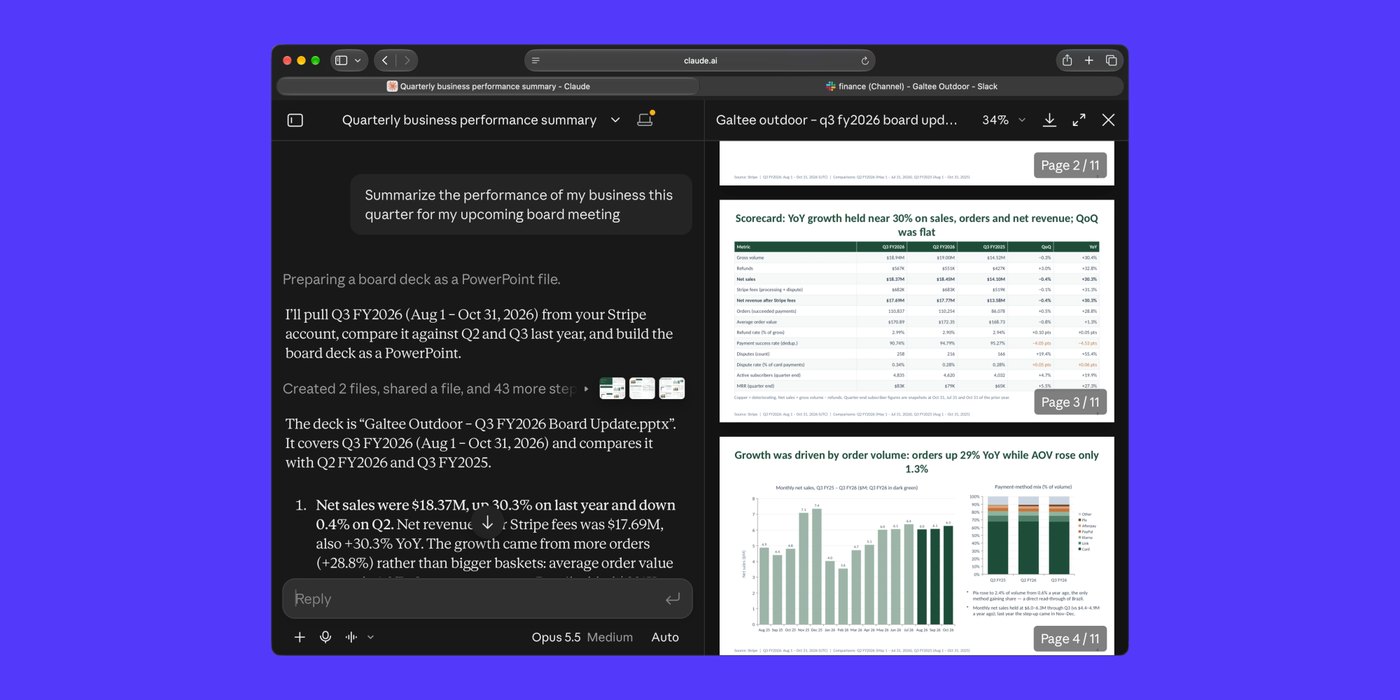
To generate dependable analytical summaries, an automated agent must identify proper database relationships, interpret metric definitions, and build compliant database queries. Stripe addresses this challenge inside the Reports API, which exposes a modeled data schema spanning more than 300 distinct tables alongside built-in semantic guidance. When a user requests subscription metrics, the system directs the connected agent to track monthly recurring revenue over time, isolating the specific financial impact of plan upgrades, downgrades, customer cancellations, and reactivations so operators can isolate underlying operational causes.
Once an agent pulls the necessary data from Stripe, it can combine those transaction figures with context from other operational software and historical conversations. For instance, an operator working inside Claude can integrate user interaction data from a PostHog connector, merge it with Stripe subscription tables, and reference previous chat discussions about a marketing campaign to isolate customers who clicked a specific button but later churned. Because financial decisions require strict verification, every query processed through these endpoints exposes the underlying SQL syntax, allowing users to inspect formula logic, verify calculation accuracy, and edit queries as analytical requirements evolve.
Advertisement
Tech Pulse Daily
Get tomorrow's pulse first
Join engineers who read Tech Pulse before stand-up. Free, weekday mornings.
Analyze your Stripe data directly with your: why it matters
Financial operations require absolute precision, making raw language model generation unsuitable when numbers cannot be audited against underlying ledger records. By supplying explicit schema definitions for over 300 tables and exposing the underlying SQL behind every calculation, Stripe removes ambiguity from AI-assisted financial reporting. Finance leaders and executives can review the exact logic used to compile churn figures, dispute tallies, or net revenue totals before presenting findings to board members, auditors, or external investment partners, ensuring that automation does not sacrifice compliance standards or numerical integrity.
The integration also accelerates complex investigative workflows across accounting, growth tracking, fraud prevention, and payment operations. Users can prompt an agent to reconcile three months of payouts against payments, refunds, disputes, fees, and transfers, instantly flagging unbalanced amounts and their root transactions. Teams can generate Excel workbooks containing open and past-due invoices sorted by customer and aging bracket, establish automated Slack alerts when fraud rates exceed specific thresholds, review payment decline patterns across the previous 30 days, or analyze payment performance trends across regional markets and payment methods.
Analyze your Stripe data directly with your: who is affected
This release affects every organization using Stripe for payment processing, billing, invoicing, or marketplace operations. Technical teams and developers using Cursor can now audit transaction flows, query fee structures, and verify webhook delivery behaviors directly inside their integrated development environments without interrupting active programming sessions. Engineering teams building autonomous finance assistants can also connect directly to the Queries API and Reports API to power customized backend analytics pipelines, automated ledger sweeps, and internal business intelligence bots without relying on fragile web scrapers.
Non-technical executives, accounting professionals, and product managers who interact with conversational models like Claude also gain direct operational access. New users can connect by issuing the prompt to pull Stripe data in directly within their chosen agent interface, initiating the Model Context Protocol connection flow. Once connected, support representatives and risk analysts can assess chargeback trends over 90 days, audit customer collection failures, evaluate the direct revenue effect of newly introduced promotional pricing campaigns, and track expansion metrics across distinct product tiers without requiring intervention from dedicated database administrators.
Analyze your Stripe data directly with your: what to watch
Stripe structured its pricing model to encourage early adoption while establishing a metered commercial structure for heavy programmatic use. The Queries API is free for all Stripe users through January 31, 2027. Following that promotional period, Stripe will transition the Queries API to a usage-based billing model based on purchased API credits, operating without recurring monthly subscription fees. Meanwhile, the Reports API will remain free permanently, giving businesses predictable access to standard schema guidance and structured reporting definitions regardless of how frequently their automated agents interrogate underlying table collections.
Teams adopting the integration should monitor query performance, credit utilization planning ahead of the 2027 cutoff, and multi-source connector reliability. While Stripe allows agents to combine payment records with third-party tool contexts like PostHog, operators must maintain rigorous validation standards when synthesizing data across multiple vendor APIs. Organizations should establish baseline monitoring for automated reconciliation queries, test recurring Slack alert thresholds for payment disputes, and routinely inspect generated SQL code to confirm that conversational interfaces accurately reflect changes in billing rules, refund schedules, and international payment methods.
Developer Action Items
- ☐ Diff the official changelog for Claude / Stripe / Cursor before you bump — APIs, defaults, and removed flags only.
- ☐ Install through the vendor's documented channel in staging; keep a one-command rollback and time-box the canary.
- ☐ Grep your repo for old flag names, lockfile pins, and plugin versions that the notes mark as breaking.
- ☐ Prefer the first patch cut over the day-zero tag unless you have a reason to be on the leading edge.
- ☐ If Stripe Blog did not name a region, plan, or SKU, screenshot the official availability line before you promise it to users.
Analyze your Stripe data directly with your FAQ
Which AI agents currently support direct connection to Stripe data?
Stripe confirmed support for compatible agents including Claude and Cursor through the Stripe Model Context Protocol implementation and direct API integrations.
How much does it cost to use the Stripe Queries API and Reports API?
The Queries API is free for all Stripe users through January 31, 2027, after which it will charge per credit of API usage without monthly subscriptions, while the Reports API remains free.
Can users review the database queries generated by connected agents?
Yes, for each analysis completed through the APIs, users can inspect the underlying SQL, confirm how the calculation was completed, and edit the query as requirements change.
How do new users establish a connection through the Stripe Model Context Protocol?
Users with compatible agents can initiate setup by opening their agent interface and submitting the prompt to pull their Stripe data in to connect.
Sources

Author
Dillip Chowdary
Writes Tech Bytes coverage of AI, engineering, and the tools that actually ship. Editor of Tech Pulse Daily.
Related on Tech Bytes
Advertisement