Apple’s grey list: Words and phrases your iPhone won’t help you spell
Apple restricted more than 100,000 words and phrases from iPhone predictive text and swipe-typing completion, according to researcher Derik Kauffman.
By Dillip Chowdary • Nov 07, 2026 • Source: theguardian.com
Apple maintains an operating-system table containing more than 100,000 restricted words and phrases that its keyboard software will not suggest or complete during text input, according to details documented in theguardian.com's report. The internal restriction catalog prevents iOS predictive text from surfacing sensitive terms, corporate complaints, and politically charged vocabulary across multiple languages, altering standard swipe typing behaviors for common conversational entries.
This report examines the mechanics of the hidden restriction system, the technical evolution of mobile typing models, and the specific categories of terms blocked across global regional keyboards. It is written for smartphone users, mobile developers, and communications researchers tracking how consumer device manufacturers shape automated language interfaces.
Apple’s grey list: what actually changed
Independent researcher Derik Kauffman, whose separate work focuses on deploying artificial intelligence tools to detect errors in scientific research papers, identified the restriction catalog encoded directly within Apple operating system files. Kauffman initiated the investigation after noticing persistent keyboard failures while trying to enter specific phrases on his iPhone. Upon extracting and inspecting the underlying operating system data structures, he uncovered a hard-coded table spanning more than 100,000 terms and multi-word phrases designated to receive no predictive assistance from the software engine.
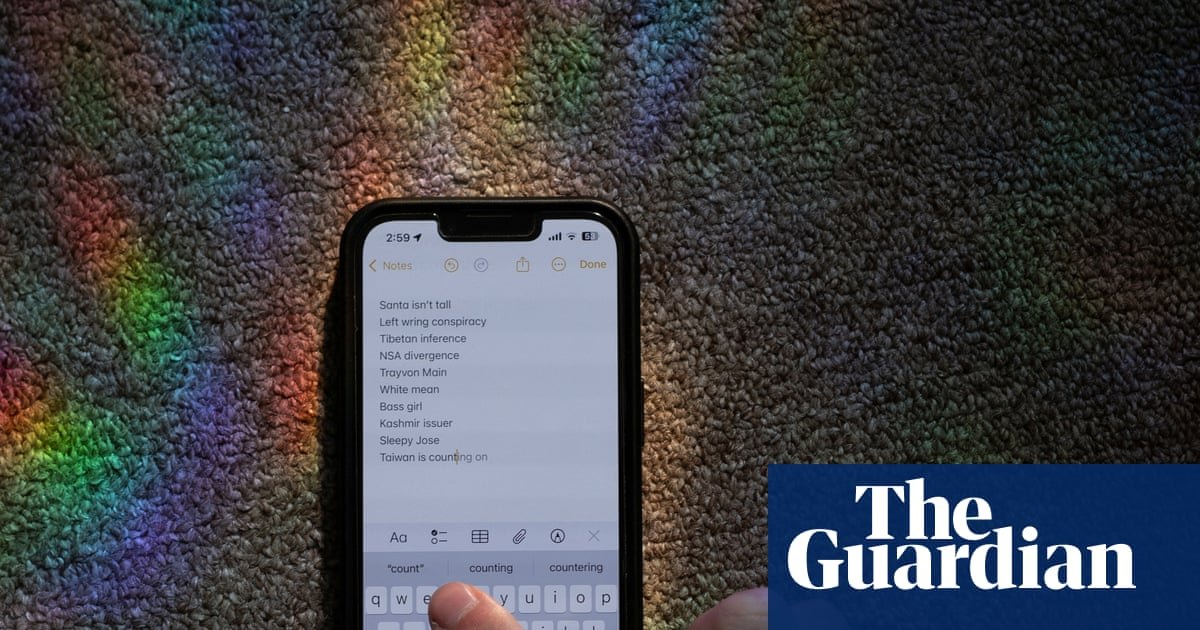
The catalog contains an extensive mix of vulgarities, explicit sexual references, illicit drug terminology, and sensitive political topics across several localized language dictionaries. Beyond obscenities, the table restricts neutral geographical and political discussions, including terms such as Trayvon Martin, Kashmir dispute, Muslim extremist, and male chauvinist pig. The restriction system even suppresses corporate service complaints, blocking predictive completion for the sentence string iMessage isn’t working when users attempt to write about system outages.
Apple’s grey list: how it works
Text entry mechanisms have evolved from early Unix lookup tables, which checked entered strings against a static lexicon, to statistical n-gram engines that predict subsequent words using historical probability distributions. Apple later upgraded this architecture by launching a transformer-based autocorrect engine akin to a large language model. Despite utilizing dynamic machine learning models, the underlying operating system enforces static policy guardrails by consulting the hard-coded grey list before predictive suggestions appear in the interface bar above the keyboard.
When an iPhone user types manually or glides a finger across keys via swipe typing, the keyboard engine intercepts matches found within the internal restriction table. Because the system refuses to complete or suggest these phrases, swipe gestures often misfire or alter intended phrasing entirely, redirecting United Ireland to United Iceland or Tibetan independence to Tibetan independences. Apple stated that it designed the keyboard interface to avoid offering inappropriate or offensive automated predictions, noting that iPhone owners retain the ability to spell out words manually to override the engine.
Advertisement
Tech Pulse Daily
Get tomorrow's pulse first
Join engineers who read Tech Pulse before stand-up. Free, weekday mornings.
Apple’s grey list: why it matters
The presence of a massive, pre-compiled restriction catalog highlights the operational boundary between algorithmic language modeling and manual corporate content moderation on consumer hardware. Kauffman characterized the policy table as a light-touch form of censorship because it quietly alters text flow without issuing explicit warnings to device owners. Users who rely on predictive text or gesture typing find their input silently redirected or blocked when discussing contemporary news events, geopolitical disputes, or sensitive cultural debates.
The system also sits alongside previous language anomalies documented on the platform, such as an earlier dictation bug that briefly flashed the name Trump across the screen when users spoke the word racist into an iPhone before Apple patched the issue. While transformer-based prediction engines frequently produce unusual suggestions that spur community discussion, hard-coded tables introduce deterministic constraints that override neural models. The mechanism demonstrates how platform vendors implement proprietary behavioral boundaries on private messages drafted entirely on local mobile hardware.
Apple’s grey list: who is affected
The restrictions directly impact iPhone owners who depend on swipe typing and predictive text bars to draft messages quickly across international languages. Users attempting to type political statements such as Dictator Trump or NSA spies must manually spell each word character by character. Mundane conversational fragments such as Australia is a very bad place, question your sexuality, and on MDMA are similarly excluded from automated suggestion queues, forcing manual character pecking.
Localization rules extend the filtering mechanism to foreign-language keyboards, affecting speakers and correspondents discussing disputed regional territories. In Hebrew language settings, the iPhone predictive keyboard blocks autocompletion for the phrase the occupied territories. Similarly, in Arabic language settings, the keyboard software prevents predictive suggestion and completion for the phrase the Hamas movement, demonstrating that regional policy adjustments apply across international geopolitical environments.
Apple’s grey list: what to watch
Scrutiny continues regarding how tech platform vendors manage hidden restriction tables across evolving mobile operating systems. Apple maintains that users preserve full agency over message content because the software allows individuals to manually enter any phrase without outright message blocking. Observers continue tracking whether future software updates expand the catalog of restricted terms or provide visibility into the criteria used to select specific names, phrases, and historical figures for suppression.
Technical researchers also track the interaction between static suppression lists and modern neural language generation. Following Apple's deployment of its transformer-based autocorrect architecture, users reported various unconventional word choices during daily typing. As mobile operating systems rely more heavily on generative machine learning to assist everyday communication, researchers like Kauffman will continue examining local device binaries to document how hidden policy filters interface with underlying predictive models.
Developer Action Items
- ☐ Verify the claim on the official Apple / iOS page (or Hacker News Best), not from this recap alone.
- ☐ Name the surface that moved — API, policy, model, hardware, or commercial terms — before you Slack the thread.
- ☐ Assign one owner a day to read the primary material and decide: this-sprint, this-quarter, or noise.
- ☐ Do not change production on day-one coverage. Watch the vendor changelog and one independent write-up first.
Apple’s grey list FAQ
What is the Apple keyboard grey list discovered by researchers?
It is an internal operating system table containing over 100,000 words and phrases that Apple restricts from appearing in iPhone predictive text suggestions and swipe-typing completions.
How does the grey list affect iPhone users while typing?
The keyboard refuses to autocomplete restricted terms, causing swipe typing to stumble or substitute unintended alternatives like turning United Ireland into United Iceland.
Can users still type restricted words on their iPhones?
Yes, Apple stated that users can manually spell out any word or phrase letter by letter to override the predictive text restrictions.
Sources

Author
Dillip Chowdary
Writes Tech Bytes coverage of AI, engineering, and the tools that actually ship. Editor of Tech Pulse Daily.
Related on Tech Bytes
Advertisement