Chatty – Open-source autonomous AI chat agent with tool calling
PersonaliAI launched Chatty, an open-source AI customer support agent featuring an 81-tool FastMCP server, WooCommerce sync, and seven-channel messaging.
By Dillip Chowdary • Nov 07, 2026 • Source: github.com
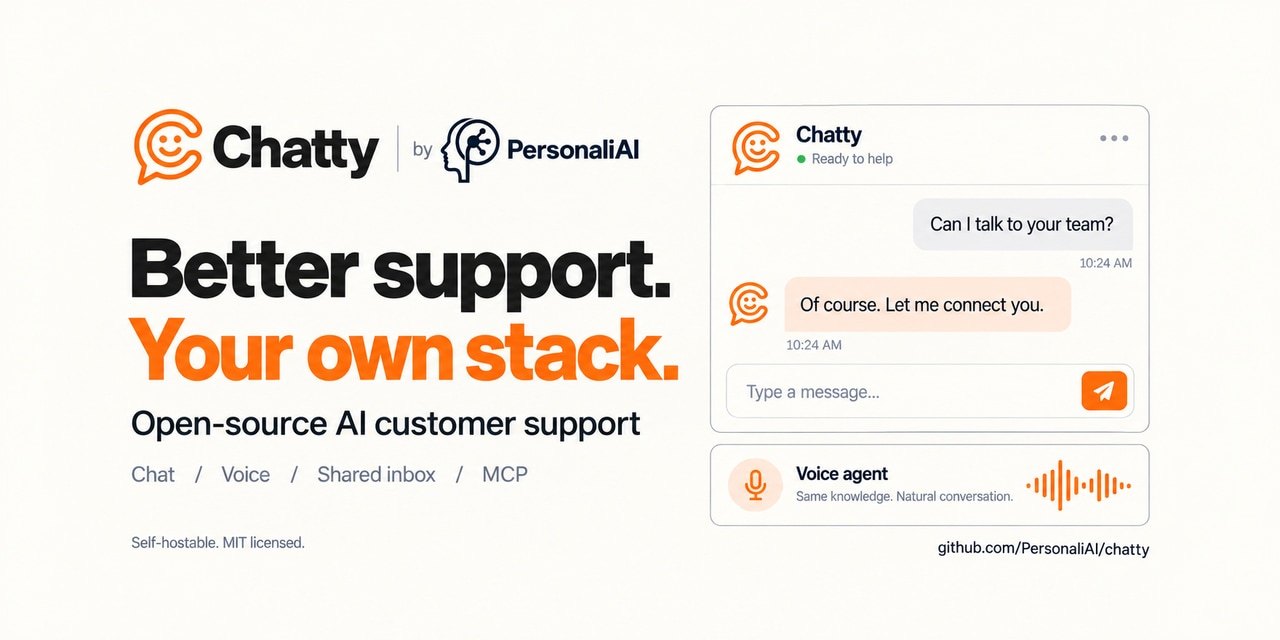
PersonaliAI released Chatty, an open-source autonomous customer support agent built as a self-hostable alternative to Zendesk and Intercom. According to github.com's report, the software carries an MIT license, offering free self-hosting alongside a fourteen-day hosted cloud trial. The system automates support across seven messaging channels, schedules meetings, and syncs with WooCommerce stores. By pairing Docker containers with managed Supabase infrastructure, Chatty lets businesses automate support while retaining complete ownership of conversations and data.
This teardown covers Chatty's system architecture, deployment requirements, channel integrations, and dashboard automation features. The software serves engineering teams and e-commerce merchants seeking to eliminate recurring per-seat fees and per-message support tolls. Below, readers will find operational analyses of the eighty-one-tool Model Context Protocol server, the visual conversation flow engine, multimodal retrieval, one-click human takeover workflows, five-pillar deflection scorecards, and sub-five-hundred-millisecond WebRTC voice agents.
Chatty –: what actually changed
PersonaliAI shifted conversational customer support from closed software into an open-source architecture running on standard Docker infrastructure. Deployments introduce twenty-two dashboard modules visible in a Retina web console, monitoring deflection rates and five-pillar health metrics across operational categories. The system ships native communication adapters for seven channels: the WhatsApp Cloud API, Instagram Direct, Facebook Messenger, TikTok Business Messaging, Telegram bots, Twilio SMS with automated TCPA opt-outs, and inbound support email. These direct integrations replace disjointed messaging bots with a consolidated inbox backed by live presence indicators.
The platform also incorporates an official eighty-one-tool FastMCP server with eight resources, letting developers control the entire dashboard from environments like Claude Desktop, Cursor, Codex, and Antigravity. Operators authenticate programmatic workflows via OAuth 2.0 PKCE or scoped API keys. In parallel, PersonaliAI introduced a WebRTC voice studio powered by LiveKit that delivers bidirectional audio at sub-five-hundred-millisecond latency. The voice stack includes five dynamic visualizers and ships software development kits for React, iOS, Android, Flutter, and React Native, giving development teams direct voice embedding capabilities.
Chatty –: how it works
Chatty runs on host servers using Docker Compose while delegating relational storage, authentication, and realtime websocket events to a managed Supabase project. For knowledge retrieval, the engine relies on PostgreSQL pgvector with Hierarchical Navigable Small World indexing, conducting hybrid lexical and semantic search across ingested PDF, DOCX, CSV, TXT files, and crawled websites. The multimodal pipeline also processes product images alongside textual data. When configuring models, administrators supply encrypted API keys for Google Gemini, OpenAI GPT-4o, Anthropic Claude, Groq, OpenRouter, or local models, securing secrets with AES-128 encryption.
Client interactions operate through an embeddable chat widget injected via a single script tag, rendering inside a Shadow DOM container to prevent host stylesheet bleed while passing WCAG contrast audits. The widget streams conversational replies using Server-Sent Events and executes autonomous tool calls to check calendars or qualify incoming leads. Behind the widget, a visual flow canvas built on xyflow react applies conditional logic, including time-of-day branches that present dynamic offers before or after six in the evening. When conversations require human intervention, staff pause automation with a single click.
Advertisement
Tech Pulse Daily
Get tomorrow's pulse first
Join engineers who read Tech Pulse before stand-up. Free, weekday mornings.
Chatty –: why it matters
Closed SaaS helpdesk platforms impose compounding expenses through per-seat subscription tiers, conversation volume fees, and proprietary data lock-in. Chatty eliminates these operational costs by publishing its codebase under the MIT license, allowing organizations to self-host for zero dollars forever. Deploying the application locally guarantees complete ownership of customer conversation data, vector stores, and visitor identities, avoiding vendor terms that expose sensitive enterprise data to model training. For compliance oversight, Chatty includes immutable append-only audit trails logging actor emails and IP addresses, accompanied by automated personally identifiable information scrubbing routines.
The combination of an eighty-one-tool Model Context Protocol server with automated meeting booking turns passive chat interfaces into active operational engines. Rather than merely quoting documentation, the agent connects to Google Calendar via two-way OAuth synchronization, verifies open slots, and generates Google Meet, Zoom, or Microsoft Teams invitations. Lead acquisition pipelines capture visitor locations using interactive Leaflet maps, record GeoIP metadata, and log event telemetry in a campaigns ledger. Support administrators evaluate these automated workflows through an objective five-pillar scorecard that assigns letter grades across conversion, deflection, accuracy, reliability, and satisfaction.
Chatty –: who is affected
E-commerce businesses running WooCommerce storefronts represent a primary group impacted by this release. The agent synchronizes directly with WooCommerce catalogs to verify real-time inventory, inspect order fulfillment status, and generate custom cart checkout links without manual staff involvement. Customer service representatives managing inquiries across fragmented channels gain a consolidated helpdesk that unifies WhatsApp, SMS, email, and social networks into one view. When high-priority inquiries trigger service level agreement breach timers, human support staff can instantly take over the conversation thread, chatting directly to customers without disconnecting active sessions.
System administrators and software engineers benefit from flexible deployment mechanics that run on virtual private servers, Railway, Render, or local staging systems without altering production Supabase configurations. Developers utilizing AI coding environments like Cursor or Claude Desktop can manage bot settings and conversation flows programmatically through the FastMCP server. However, adopting self-hosted instances requires technical teams to manage host uptime, container updates, and language model API expenditure independently. Companies choosing not to handle server administration can opt for the hosted Chatty Cloud tier, which guarantees zero data usage for model training.
Chatty –: what to watch
Industry observers should monitor the adoption rate between free self-hosted installations and paid Chatty Cloud subscriptions as businesses test the platform in production. Key performance indicators will emerge from the twenty-two dashboard modules, particularly the audience suggestion tools and campaign telemetry endpoints that track visitor conversion rates. As retail stores implement proactive exit-intent announcements and scroll-triggered campaigns, tracking event traffic via POST endpoints will determine how reliably the containerized architecture handles high-volume shopping traffic. Analysts should also watch database scaling within Supabase instances as document indexing expands across multi-format knowledge bases.
Future developments will indicate how quickly the open-source platform expands beyond its initial integration boundaries. Observers should watch whether PersonaliAI extends store synchronization beyond WooCommerce to competing e-commerce platforms like Shopify, and whether calendar integrations add direct Microsoft Exchange support alongside Google Calendar. The practical usage of the eighty-one-tool FastMCP server will also demonstrate how effectively external AI coding assistants can automate helpdesk administration in live enterprise environments. Furthermore, cross-platform voice performance will reveal whether sub-five-hundred-millisecond WebRTC voice agents can consistently replace proprietary telephony solutions in mobile applications and high-concurrency retail environments.
Developer Action Items
- ☐ Diff the official changelog for OpenAI / Anthropic / Claude 2.0 before you bump — APIs, defaults, and removed flags only.
- ☐ Install through the vendor's documented channel in staging; keep a one-command rollback and time-box the canary.
- ☐ Grep your repo for old flag names, lockfile pins, and plugin versions that the notes mark as breaking.
- ☐ Prefer the first patch cut over the day-zero tag unless you have a reason to be on the leading edge.
- ☐ If HN AI Agents did not name a region, plan, or SKU, screenshot the official availability line before you promise it to users.
Chatty – FAQ
What is Chatty and who develops it?
Chatty is an open-source, MIT-licensed autonomous AI customer support platform developed by PersonaliAI as an alternative to Zendesk and Intercom. It handles customer inquiries, lead capture, meeting scheduling, and WooCommerce store synchronization.
How can teams deploy Chatty on their own infrastructure?
Teams deploy Chatty using a Docker Compose configuration on a virtual private server, Railway, Render, or another container host. The application containers connect to a managed Supabase project for authentication, PostgreSQL storage, pgvector search, and realtime events.
Which messaging channels and third-party tools does Chatty support?
Chatty supports seven messaging channels including WhatsApp Cloud API, Instagram Direct, Facebook Messenger, TikTok Business Messaging, Telegram, Twilio two-way SMS, and email. It also includes an eighty-one-tool FastMCP server and schedules meetings through Google Calendar, Google Meet, Zoom, and Microsoft Teams.
Which language models can operators use with Chatty?
Operators can bring their own encrypted API keys to run Google Gemini, OpenAI GPT-4o, Anthropic Claude, Groq, OpenRouter, or locally hosted language models.
Sources

Author
Dillip Chowdary
Writes Tech Bytes coverage of AI, engineering, and the tools that actually ship. Editor of Tech Pulse Daily.
Related on Tech Bytes
Advertisement