Copilot code review: API management and review overview updates
Enterprise administrators can activate or disable code review across every subordinate organization or delegate the decision down to organization managers.
By Dillip Chowdary • Nov 07, 2026 • Source: GitHub Changelog
GitHub expanded Copilot code review management across its REST and GraphQL APIs, rolled out a more compact review overview interface, and introduced fixes across billing, model failover, and rule bypasses, according to GitHub Changelog's report. The changes cover administrators and developers using Copilot Pro, Pro+, Max, Business, and Enterprise tiers.
This report details how team leads and platform engineers can programmatically govern automated reviews, configure custom tooling, interpret updated summary cards, and avoid known token authentication restrictions.
What Copilot code review shipped
GitHub delivered programmable management controls that let engineering organizations audit, enable, and tune automated pull request evaluations through both REST and GraphQL interfaces. The platform added structured metadata attribution fields to review payloads, allowing developers to programmatically identify which comments originated from Copilot rather than human peers. API responses now expose the specific review effort level assigned to an evaluation, along with an audit trail identifying the exact skills, Model Context Protocol servers, and custom instructions Copilot referenced while generating its suggestions.
Administrative governance operates across three distinct levels of hierarchy. Enterprise administrators can activate or disable code review across every subordinate organization or delegate the decision down to organization managers. Organization leaders can establish default review effort thresholds, toggle team-wide enablement, and manage custom runner infrastructure without overriding locked enterprise-level policies. At the repository tier, project maintainers can independently configure review effort and designate whether Copilot reviews should execute custom repo instructions or tap connected MCP server tools.
What changed for builders in Copilot code review
The pull request interface underwent layout consolidation to display high-priority review findings directly at the top of pull requests. Secondary details, including review effort badges and feedback surveys, now reside in a compact footer beneath findings. Excluded items and skipped paths now share a unified section titled Files not reviewed, which groups files beside linked exclusion reasons while omitting empty sections and displaying overflow counters for extensive file listings. Pull request reviews also introduce a downvote workflow where developers can submit categorized negative feedback targeting incorrect findings, excessive verbosity, nitpicky suggestions, or inaccurate approval decisions.
| Feature Area | Previous Implementation | Updated Implementation |
|---|---|---|
| Interface layout | Multiple scattered sections and full lists | Compact footer with combined Files not reviewed section |
| Feedback tracking | Basic rating collection without categorization | Targeted 👎 flow specifying verbosity, accuracy, or approval |
| Multi-model synthesis | Single-model review evaluation | Three reviewer models with a fourth combining findings |
| Attribution payload | Opaque review origin metadata | Explicit API fields for skills, MCP servers, and instructions |
| Follow-up reviews | Full finding list repeated across commits | Outdated findings from earlier commits collapsed and hidden |
| Bypass rule list | Rigid automatic review triggers | Repository rules honor bypass lists for exempt actors |
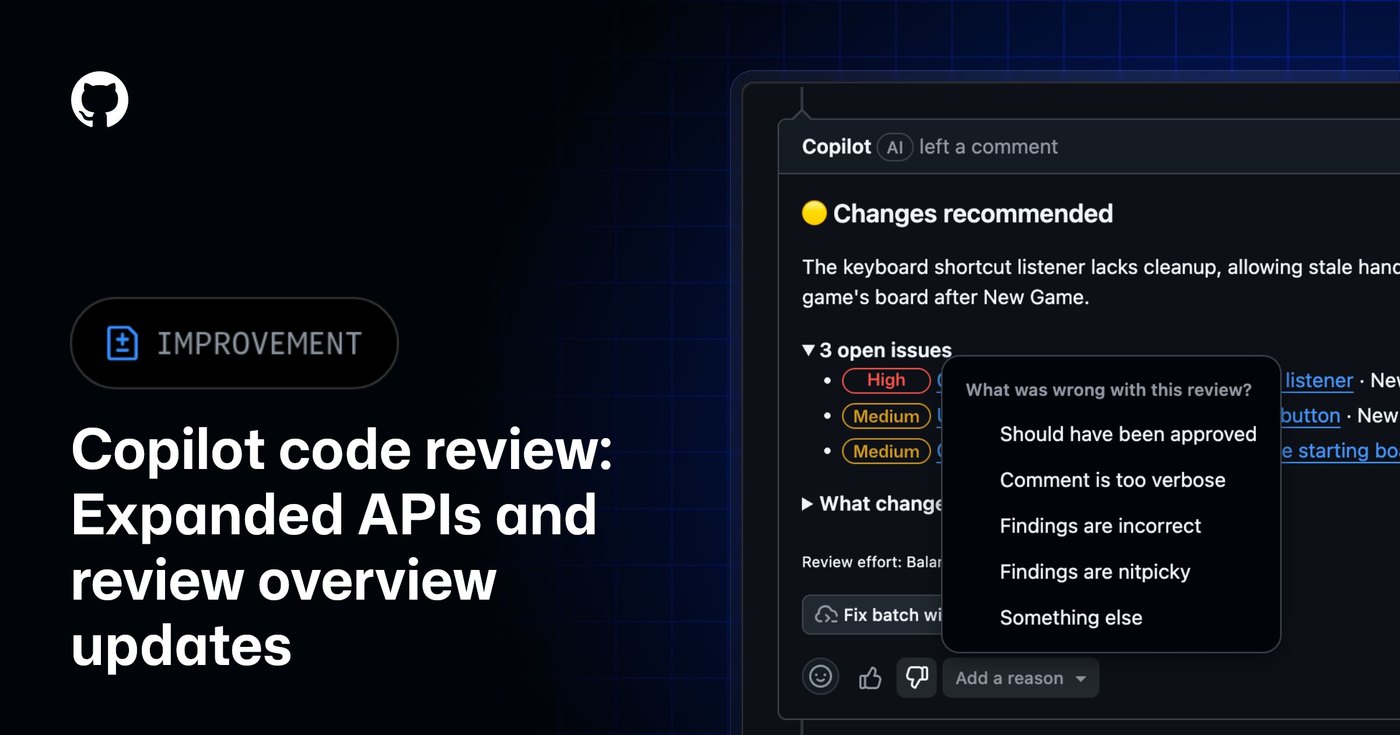
Model processing received backend updates on balanced effort evaluations, where Copilot now coordinates three reviewer models in parallel before a fourth synthesizer model aggregates their findings into one coherent critique. Repeated reviews on ongoing pull requests also introduce noise filtering, automatically collapsing and concealing previous findings that bear no relevance to a developer's latest commit. Agent sessions now render the exact count of artificial intelligence credits expended during each review pass, and repository rules configured for automatic reviews now respect designated bypass lists to prevent unneeded executions on exempted user accounts.
How to install or upgrade Copilot code review
Advertisement
Tech Pulse Daily
Get tomorrow's pulse first
Join engineers who read Tech Pulse before stand-up. Free, weekday mornings.
Access to these governance features is enabled automatically across active Copilot Pro, Pro+, Max, Business, and Enterprise subscriptions on GitHub. Repository administrators configuring automated workflows or querying settings can inspect repository review rules directly via GitHub REST endpoints using administrative tokens.
gh api /repos/{owner}/{repo}/copilot/code-reviewDevelopers managing repository settings programmatically can update review effort tiers and toggle custom instruction integration using standard command-line tools.
gh api --method PATCH /repos/{owner}/{repo}/copilot/code-review -f review_effort=balancedTeams requiring automated bot execution or third-party continuous integration triggers can invoke review requests directly through existing repository pull request management routes.
gh pr review --comment -b "Requesting Copilot code review"Gotchas and compatibility in Copilot code review
Enterprise and organization settings endpoints, including the organization runner endpoint, do not support GitHub Apps or fine-grained personal access tokens. Automations targeting enterprise or organization tiers must use classic personal access tokens with administrative privileges, while repository endpoints support both GitHub Apps and fine-grained personal access tokens requiring Administration: read and Administration: write permissions.
Billing state persistence received structural fixes so organizations turning code review off and on no longer lose customized billing structures or preview preferences. In addition, internal automations such as GitHub Actions, Dependabot, and organization-owned integration apps can once again request reviews on bot-created pull requests when the setting to block reviews requested with an external Copilot license is enabled, provided the parent organization covers the resulting review charges.
What to watch after Copilot code review
Execution reliability improvements now guard against automated review dropouts during transient network or model interruptions. The service automatically retries failed or timed-out reviews once, and Copilot can route requests to an alternative eligible model whenever its primary model encounters an outage. Reviews running during scheduled platform updates receive extended grace periods to conclude, and early failure misreporting that prematurely aborted newly initialized reviews has been eliminated.
Feedback mechanics have also been brought into alignment with privacy preferences. Review satisfaction surveys are now strictly suppressed across organizations that opted out of platform feedback gathering. Teams should watch how the multi-model balanced effort synthesizer and the four-tier model structure alter token consumption, as credit balances are now displayed per session across all ongoing reviews.
Developer Action Items
- ☐ Diff the official changelog for GitHub / Copilot before you bump — APIs, defaults, and removed flags only.
- ☐ Install through the vendor's documented channel in staging; keep a one-command rollback and time-box the canary.
- ☐ Grep your repo for old flag names, lockfile pins, and plugin versions that the notes mark as breaking.
- ☐ Prefer the first patch cut over the day-zero tag unless you have a reason to be on the leading edge.
- ☐ If GitHub Changelog did not name a region, plan, or SKU, screenshot the official availability line before you promise it to users.
Copilot code review FAQ
Which plans include the new Copilot code review API controls and review overview updates?
The updates are available to subscribers on GitHub Copilot Pro, Pro+, Max, Business, and Enterprise plans.
What authentication token types are supported for enterprise and organization settings endpoints?
Enterprise and organization settings endpoints do not support fine-grained personal access tokens or GitHub Apps, requiring classic personal access tokens with administrator permissions instead.
How does Copilot code review handle model timeouts and failures under the updated system?
Failed or timed-out reviews retry once automatically, and Copilot can switch to an alternate eligible model if the primary model becomes unavailable.
What model structure is used for balanced effort code reviews?
Balanced effort reviews run three distinct reviewer models in parallel, after which a separate fourth model synthesizes their findings into the final review summary.
Sources

Author
Dillip Chowdary
Writes Tech Bytes coverage of AI, engineering, and the tools that actually ship. Editor of Tech Pulse Daily.
Related on Tech Bytes
Advertisement