Google Donates Agent Substrate and GVisor to the CNCF
An Actor represents an individual agent session, preserving its dedicated filesystem, environment variables, tool configurations, and memory state.
By Dillip Chowdary • Nov 07, 2026 • Source: opensource.googleblog.com
Google Cloud announced on Thursday, November 5, 2026, that it is donating both Agent Substrate and gVisor to the Cloud Native Computing Foundation in Sandbox status alongside OpenRL, as detailed in opensource.googleblog.com's report. The contribution, presented around KubeCon North America in Salt Lake City, establishes an open-source, vendor-neutral infrastructure stack tailored specifically for running untrusted artificial intelligence agents. The platform pairs gVisor user-space kernel sandboxing with an actor-based orchestration layer that reached its 1.0 release after community efforts stabilized its core programming interfaces.
This analysis examines how the donation restructures agent orchestration, the mechanics of separating stateful sessions from warm compute workers, and the operational impact on platform teams running interactive assistants or evaluation loops. The technology targets site reliability engineering teams, enterprise platform architects, and reinforcement learning practitioners who manage thousands of concurrent agent tasks across Kubernetes clusters.
Google Donates Agent Substrate and GVisor: what actually changed
The governance of both the Agent Substrate runtime and the gVisor application kernel has transitioned from proprietary stewardship into the vendor-neutral custody of the Cloud Native Computing Foundation. By placing these projects in CNCF Sandbox status alongside OpenRL, Google shifted agent orchestration away from proprietary custom scheduling scripts toward an open specification that runs on any conformant Kubernetes cluster. The release coincides with the stabilization of Agent Substrate 1.0, establishing production-ready application programming interfaces for sandboxed execution environments across heterogeneous cloud native environments.
Twelve years after introducing Kubernetes pods as long-running, continuous compute abstractions, the underlying platform requirements have split into distinct runtime layers. Layer 1 uses gVisor, known as runsc, to isolate untrusted code execution inside user space. Layer 2 deploys Agent Substrate to multiplex stateful actor sessions across pre-warmed worker pools. Layer 3 integrates OpenRL to coordinate reinforcement learning loops and benchmark sandboxes. Together, these components eliminate reliance on custom internal virtual machine allocators for teams deploying AI agent workloads.
Google Donates Agent Substrate and GVisor: how it works
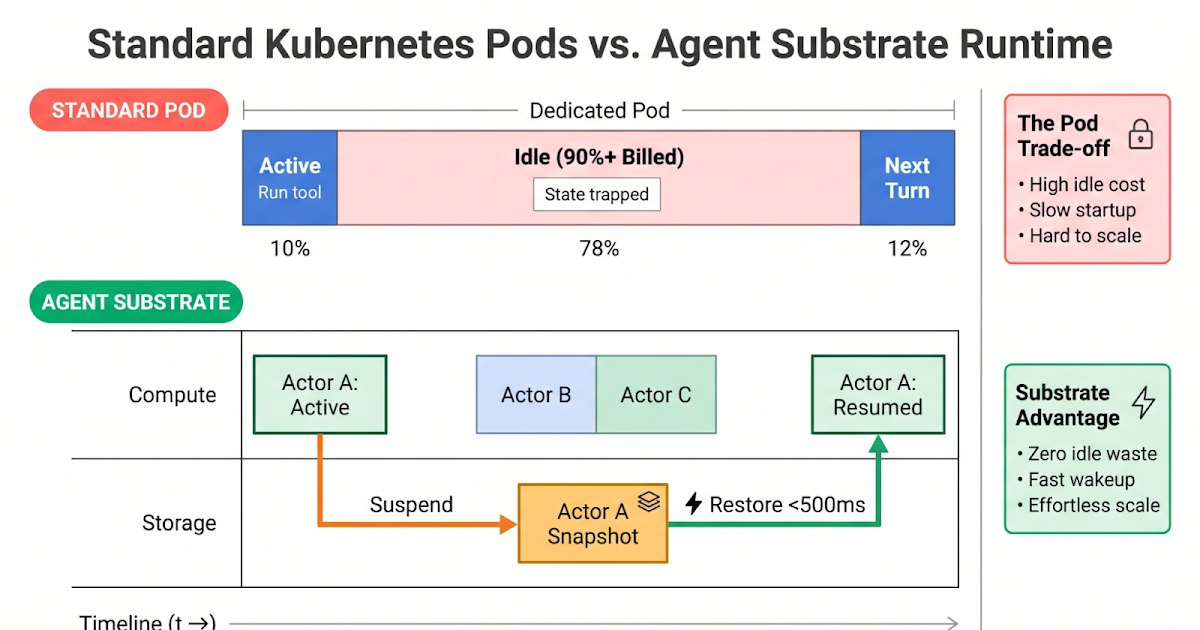
Agent Substrate decouples compute execution from session state by establishing two core abstractions: Actors and Workers. An Actor represents an individual agent session, preserving its dedicated filesystem, environment variables, tool configurations, and memory state. A Worker is a pre-warmed Kubernetes pod operating within a shared pool known as WorkerPool. When an incoming agent request arrives, the atenet-router Layer 7 proxy receives the traffic. If the target Actor is suspended, the proxy parks the request in memory while notifying the Substrate controller to assign the Actor to an available slot in the warm Worker pool.
The system restores the Actor memory pages and disk state from tiered storage in under 500 milliseconds, allowing the agent process to wake up right where it paused before the proxy flushes the pending request. Untrusted commands execute safely through gVisor, an application kernel written in Go that virtualizes process tables and intercepts system calls in user space rather than exposing the host Linux kernel. When the agent completes its active turn, Substrate snapshots modified memory pages back to tiered storage, freeing the worker slot for other sessions. For workloads needing custom hardware virtualization, Substrate also provisions Cloud Hypervisor microVMs through the exact same programming interface.
Advertisement
Tech Pulse Daily
Get tomorrow's pulse first
Join engineers who read Tech Pulse before stand-up. Free, weekday mornings.
Google Donates Agent Substrate and GVisor: why it matters
Standard Kubernetes architectures force infrastructure teams to navigate an unsustainable tradeoff between idle resource costs and extreme wakeup latency. During an interactive session, an agent spends between 90 percent and 95 percent of its lifecycle idle, waiting for model tokens to stream, external tool APIs to respond, or human reviewers to evaluate pull requests. Keeping a dedicated pod running around the clock avoids cold starts but accumulates massive compute waste across ten thousand active users. Conversely, scaling pods to zero forces containers to reinstall packages, clone repositories, and rebuild memory, driving cold-start wakeups beyond 20 seconds.
Agent Substrate resolves this operational bottleneck by eliminating control plane saturation during bursty agent workloads. In reinforcement learning and benchmark evaluation loops, executing thousands of concurrent sandbox tasks across traditional pods overwhelms the etcd database, floods kube-apiserver, and exhausts subnet IP address pools. Because Substrate manages actor state transfers directly on top of pre-warmed worker pools, thousands of agent environments can activate, snapshot, and suspend every second without generating new pod objects or straining core cluster control planes.
Google Donates Agent Substrate and GVisor: who is affected
Platform engineers maintaining interactive coding assistants, automated operations trouble-shooters, and multi-turn evaluation harnesses gain immediate structural relief from cluster over-provisioning. Engineering organizations operating multi-tenant Kubernetes nodes can execute model-generated code without risking host kernel compromises, relying on gVisor user-space isolation rather than standard shared-kernel Linux containers. Enterprise teams deploying across Google Kubernetes Engine can govern worker pools, manage snapshots through Filestore Agent Volumes, and isolate egress secrets without modifying their underlying application logic.
Attendees and contributors at KubeCon North America from November 9 to 12 at the Salt Palace in Salt Lake City encounter the stack across designated workshops and track sessions. The schedule features an ATEcon Agent Substrate Day on Monday, November 9, with sessions led by engineers including Tim Hockin, Eitan Yarmush, Ron Lev, Greg Castle, Taahir Ahmed, Benjamin Elder, Bowei Du, Lior Lieberman, and Jaana Dogan. Additional sessions include a fireside chat on Tuesday, November 10, between Tim Hockin and Kelsey Hightower, alongside hands-on lab deployments led by Mofi Rahman, Brandon Royal, Drew Brown, Casey West, Kaslin Fields, and Olivier Bourgeois.
Google Donates Agent Substrate and GVisor: what to watch
Adoption trajectories will depend on how quickly external cloud native platforms integrate the 1.0 runtime specifications hosted on GitHub under github.com/agent-substrate/substrate and documented at ate.dev. Industry observers should monitor ongoing ecosystem collaborations demonstrated at Google Cloud Booth 122, including GPU Actor infrastructure and OpenShell runtime integration developed with NVIDIA. Hardware virtualization testing using Cloud Hypervisor microVMs alongside gVisor will indicate how effectively the unified control plane accommodates heavy enterprise runtimes requiring dedicated kernel modules.
Operational benchmarks in production clusters will test whether the 500-millisecond restoration threshold holds when scaling up to multi-million agent fleets across varied network conditions. Cluster administrators should observe how efficiently atenet-router manages request parking during sudden traffic spikes, and evaluate how tiered storage systems absorb constant snapshot flushes. As the CNCF Sandbox community expands beyond Google Cloud, broader support across diverse Kubernetes distributions will determine if Agent Substrate becomes the universal runtime standard for agentic compute.
Developer Action Items
- ☐ Verify the claim on the official Google / Linux / Kubernetes page (or HN AI Agents), not from this recap alone.
- ☐ Name the surface that moved — API, policy, model, hardware, or commercial terms — before you Slack the thread.
- ☐ Assign one owner a day to read the primary material and decide: this-sprint, this-quarter, or noise.
- ☐ Do not change production on day-one coverage. Watch the vendor changelog and one independent write-up first.
Google Donates Agent Substrate and GVisor FAQ
What projects did Google Cloud donate to the CNCF?
Google Cloud donated Agent Substrate and gVisor to the Cloud Native Computing Foundation in Sandbox status alongside OpenRL.
How fast can Agent Substrate resume a suspended agent?
Agent Substrate restores an agent's memory and disk state from tiered storage and resumes execution in under 500 milliseconds.
Why can standard Kubernetes pods struggle with AI agent workloads?
Agents remain idle for 90 to 95 percent of their sessions while waiting for model inference or human review, causing dedicated pods to waste costly compute or serverless containers to suffer wakeup latencies exceeding 20 seconds.
How does gVisor isolate untrusted agent code?
Written in Go, gVisor intercepts system calls in user space through its runsc runtime, virtualizing its own process tables and memory to protect the host kernel.
Sources

Author
Dillip Chowdary
Writes Tech Bytes coverage of AI, engineering, and the tools that actually ship. Editor of Tech Pulse Daily.
Related on Tech Bytes
Advertisement