A developer launched BIA – boot into agent – an agent that has full social
An independent developer launched BIA, a free standalone operating system that turns unused personal computers into autonomous artificial intelligence agents.
By Dillip Chowdary • Oct 24, 2026 • Source: ownbia.com
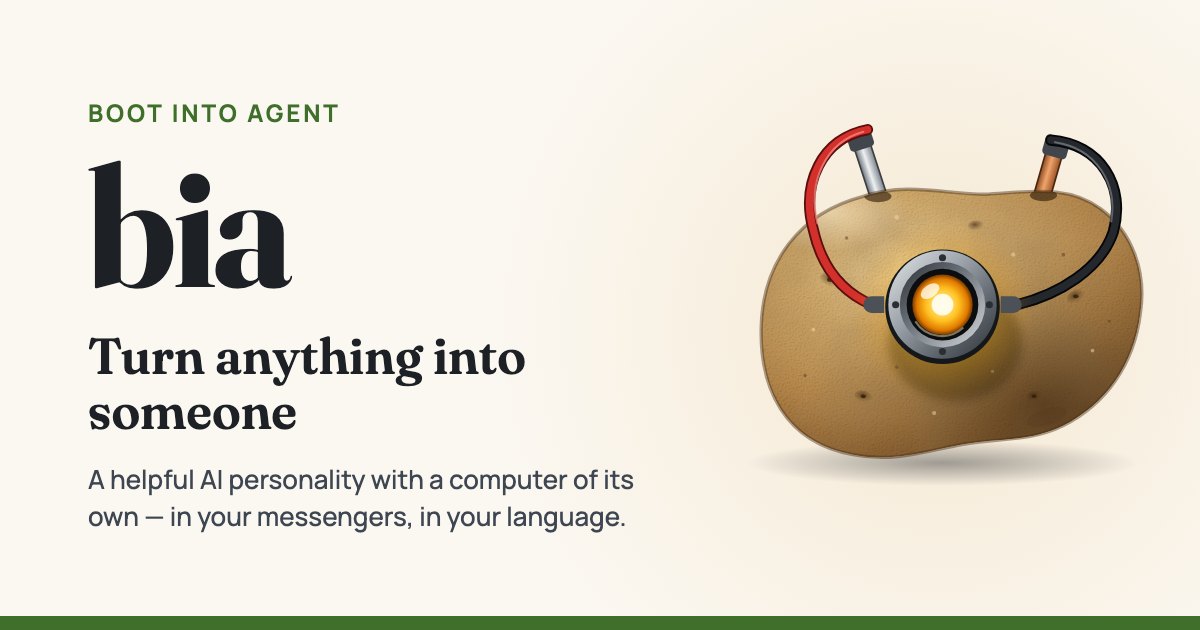
An independent developer launched BIA, short for boot into agent, a free standalone operating system that turns any unused personal computer, old laptop, or server into an autonomous artificial intelligence personality with its own dedicated hardware. Instead of running as an application on a primary computer where personal files and accounts could be exposed, BIA operates as an independent machine entity with separate files, its own accounts, a password vault, and a full desktop environment, according to ownbia.com's report. The project packages a full operating environment that users write to a USB stick, allowing the agent to manage independent communications, execute web workflows, and store its memories locally on dedicated disk storage.
This report covers the architecture, communication capabilities, hardware migration features, and operational requirements of the BIA platform. The system is designed for families seeking household assistance, small business operators running unattended customer desks, remote facilities operating with limited connectivity, and individuals looking to repurpose legacy computer hardware. Readers will learn how the software isolates AI credentials, handles multilingual communications across consumer messaging applications, and executes migration routines across different hardware architectures without relying on continuous cloud storage synchronizations.
A developer launched BIA – boot into agent –: what actually changed
Most artificial intelligence assistants deploy as desktop applications or background services that directly access a user's operating system, reading local files and utilizing existing user credentials. BIA fundamentally alters this deployment model by establishing an independent computing environment housed on its own machine, an old laptop, or a bootable USB drive. Because the agent maintains separate credentials, separate browser sessions, and dedicated local storage, users interact with it through external channels as they would with a remote colleague, keeping primary personal computers isolated from automated system tasks.
The system introduces twenty core abilities operating under a single persistent identity, maintaining its own address book with trust levels, communication channels, and conversation histories. Instead of storing chats and operational keys on centralized cloud provider servers, BIA keeps its data, encrypted credentials, passkeys, and daily activity logs locked directly on its local disk. It interacts across existing communication channels, operating as an authentic account on WhatsApp and Telegram rather than functioning as an embedded chatbot inside a secondary conversation window.
A developer launched BIA – boot into agent –: how it works
Setting up BIA requires downloading an installer application for Mac, Windows, or Linux and writing the operating image onto a USB flash drive with a minimum capacity of 8 GB. Users insert the drive into an unused computer or laptop and power the machine on, booting directly into the BIA operating system in approximately twenty minutes. The software includes its own dedicated private network chat application modeled after Telegram, which supports direct text chats, file sharing, audio calls, and screen monitoring over a local area network without external routing.
Once active, BIA can process tasks using an inexpensive pay-per-use cloud language model or execute completely offline if installed on a computer equipped with a high-end graphics processing unit or unified memory containing at least 64 GB of video memory. The agent manages its own instance of Google Chrome to log into websites, browse pages, complete forms, and solve complex user tasks. When programmatic web interaction is insufficient, BIA can observe its desktop display and operate the mouse and keyboard directly, consulting its human operator with simple selection buttons when encountering two-factor confirmations, captchas, or ambiguous business decisions.
Advertisement
Tech Pulse Daily
Get tomorrow's pulse first
Join engineers who read Tech Pulse before stand-up. Free, weekday mornings.
A developer launched BIA – boot into agent –: why it matters now
Current agent implementations create data exposure risks by requiring extensive system permissions across private personal workstations. BIA provides an architectural boundary by confining automated workflows, credentials, and conversation logs to a physically separated device. The software can hear approximately 100 languages, actively speak more than 40 languages, and adapt to unfamiliar spoken languages during live calls. When network disconnections occur, BIA queues inbound requests, re-establishes connectivity automatically, and processes missed messages sequentially so no contact is ignored.
The platform also provides persistent identity preservation across hardware lifecycles. Users can pack BIA's complete operational state, including its diary records, browser profiles, stored passwords, and acquired skills, and migrate the agent to another computer across a network or from a USB stick to an internal hard drive. The migration system functions interchangeably across Intel and ARM processor architectures. The agent conducts internal self-repair routines, updates software versions without erasing local memories, and maintains automated daily diaries at night to track ongoing commitments and unresolved tasks.
A developer launched BIA – boot into agent –: who is affected
Small business owners and guesthouse managers can use BIA to handle customer reservations, confirm arrival dates, and respond to inquiries across WhatsApp and Telegram at all hours. Because the agent communicates natively through voice calls and audio messages, clients receive updates in their primary languages without installing third-party applications. Families can deploy the agent on older household computers to set timed medication reminders, broadcast routine weather updates, and handle outbound phone check-ins with relatives while maintaining a private record of household schedules.
The platform also provides utility for remote operations, field stations, schools, and volunteer organizations working in environments where internet service is inconsistent or absent. When configured on machines that meet the 64 GB video memory threshold, BIA operates fully independent of external cloud servers. Freelancers and independent creators can offload scheduling, invoice workflows, and information gathering to a dedicated device, while the developer community can build modular skills that BIA loads on demand or configure multiple BIA instances to collaborate directly with other automated agents.
A developer launched BIA – boot into agent –: what to watch
Field deployments show that independent agency can be achieved on modest resources, as demonstrated by the creator's test agent named Fred. Over four weeks of continuous operation on a single laptop, the agent acquired voice capabilities, reconstructed its internal state after a flawed backup, and produced an unedited promotional video unaided using approximately $15 in OpenRouter inference credits. Observers should track whether the developer expands support for specialized local language models that reduce the 64 GB memory requirement for fully offline local inference.
Another key operational area involves the system's ability to maintain state across cross-platform transitions and unexpected power outages. Because BIA is engineered to retain reminders, schedules, and daily routines even after abrupt shutdowns, long-term testing will reveal how reliably its internal address book and self-repair systems function across extended deployments. Adoption will also depend on how easily non-technical users navigate the 8 GB USB boot process and manage their own local credential vaults without standard cloud account recovery options.
Developer Action Items
- ☐ Diff the official changelog for Google / Linux / Windows before you bump — APIs, defaults, and removed flags only.
- ☐ Install through the vendor's documented channel in staging; keep a one-command rollback and time-box the canary.
- ☐ Grep your repo for old flag names, lockfile pins, and plugin versions that the notes mark as breaking.
- ☐ Prefer the first patch cut over the day-zero tag unless you have a reason to be on the leading edge.
- ☐ If HN AI Agents did not name a region, plan, or SKU, screenshot the official availability line before you promise it to users.
A developer launched BIA – boot into agent – FAQ
What hardware is required to install BIA?
BIA requires an unused computer, laptop, or server and a USB stick with at least 8 GB of storage space. Fully offline execution without internet access requires a high-end graphics card or unified memory with at least 64 GB of video memory.
How does BIA protect personal data and passwords?
BIA runs on its own isolated machine rather than a user's primary workstation, storing its files, memories, and communication logs on its local drive instead of a shared cloud. Credentials, two-factor codes, and passkeys are kept in an encrypted vault on its own physical disk.
Can BIA move to a different computer without losing memory?
Yes, BIA can pack up its memories, conversations, browser profiles, and passwords to migrate across a local network or via USB stick to another computer, including transfers between Intel and ARM hardware architectures.
Sources

Author
Dillip Chowdary
Writes Tech Bytes coverage of AI, engineering, and the tools that actually ship. Editor of Tech Pulse Daily.
Related on Tech Bytes
Advertisement