A developer watched a humanoid robot clean my apartment. It felt like
Tau Robotics is deploying 4.5-foot teleoperated humanoid robots to clean San Francisco homes, charging $60 to $100 while harvesting manipulation training data.
By Dillip Chowdary • Nov 07, 2026 • Source: MIT Technology Review
San Francisco startup Tau Robotics has begun offering an in-home cleaning service using teleoperated humanoid robots designed to scrub surfaces, mop floors, and fold laundry while collecting real-world training datasets. According to MIT Technology Review's report, the young robotics company is using human-in-the-loop pilot operations to gather tactile manipulation data from live residential apartments. The service originally launched with promotional trial pricing of $30 for a single-hour appointment with one robot, and the startup has since updated its commercial pricing to $60 per weekly cleaning with two units, or $100 for a one-time cleaning session.
This report evaluates how Tau Robotics deploys remote human operators to steer physical hardware through domestic environments, examining the mechanical compromises made in claw design, navigation bottlenecks on indoor staircases, and current operational limitations. The analysis is structured for engineering teams tracking teleoperation-to-autonomy pipelines, domestic service robotics companies, and residential property owners evaluating the privacy and labor implications of putting cameras, wrist sensors, and remote contractors inside private homes.
A developer watched a humanoid robot clean my: what actually changed
Tau Robotics moved physical humanoid hardware out of closed laboratory testing and into customer apartments across San Francisco, testing real-world chores on live residential layouts. Early trial bookings cost $30 for an hour with a single machine, while current operational rates stand at $60 per week for two robots or $100 for a single on-demand appointment. The machines measure four and a half feet tall, featuring 3D-printed heads fitted with communications antennae and 3D-printed claw hands rather than articulated human-like fingers. To protect customer residences from damage during testing, the company dresses each machine in a branded Tau Robotics t-shirt and equips its feet with grippy socks to prevent scratches on hardwood floorboards.
The operational model has also shifted as fieldwork progressed past initial trials in September. During early residential appointments, Tau cofounder Cornelia Weinzierl or another company representative accompanied the machines inside the home for the entire duration of the booked hour. Tau has since eliminated the requirement for an on-site handler during cleanings, relying instead on remote telemetry links back to company headquarters. The business has completed a couple hundred cleanings so far, treating every customer session as an active data gathering exercise where real home chores generate the tactile feedback needed to build future autonomous models.
A developer watched a humanoid robot clean my: how it works
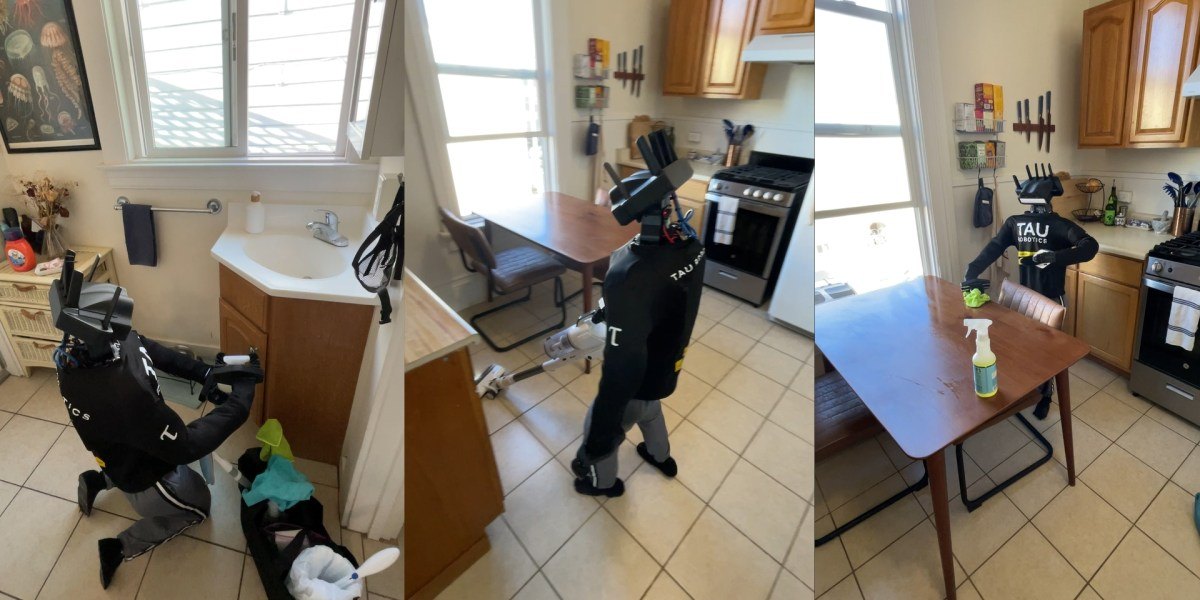
The system operates primarily as an advanced teleoperation platform where human drivers steer the hardware using real-time video feeds transmitted from cameras mounted on the robot's head and wrists. Complex manipulation tasks like smoothing bedsheets and folding laundry rely on kinematic guidance, an operational mode where human pilots perform required motor movements while sensors capture and mirror those inputs directly to the mechanical limbs. However, rudimentary tasks like floor vacuuming and wet mopping already execute autonomously on the machine without active operator intervention. Sensor readings and motion trajectories from every completed wipe and fold are saved to train Tau's downstream behavioral AI models.
Hardware communication travels across wireless networks back to Tau Robotics headquarters, where network latency directly influences balance and motor coordination. A short signal delay can cause the machine to stagger backward while attempting to navigate residential stairs. Environmental conditions introduce further friction; field testing revealed that elevated indoor temperatures caused controller monitoring equipment to overheat and crash, terminating remote operator sessions before cleanings finished. Mechanically, the 3D-printed claw design proved capable of blind repositioning: during a bathroom cleaning routine, the machine dislodged the head of a toilet brush wand three times, successfully reattaching the accessory each time by sweeping the handle until it connected at the proper mechanical angle.
Advertisement
Tech Pulse Daily
Get tomorrow's pulse first
Join engineers who read Tech Pulse before stand-up. Free, weekday mornings.
A developer watched a humanoid robot clean my: why it matters
Tau's commercial strategy shows that early domestic humanoid robotics is evolving through a heavily subsidized human teleoperation model rather than pure end-to-end artificial intelligence. Building autonomous foundation models for home manipulation requires diverse physical datasets across millions of edge cases, and residential clutter presents sensory challenges that simulated environments cannot replicate. By charging paying customers between $30 and $100 for residential cleanings, Tau effectively monetizes the manual collection of proprietary kinematic training demonstrations. The workflow turns messy residential apartments into live data factories, matching counter wiping, garment handling, and bathroom scrubbing directly to algorithmic training pipelines.
This data-first roadmap mirrors the validation trajectories seen across autonomous vehicle networks, though indoor manipulation poses more immediate mechanical failure modes. In live testing, the machine successfully wiped countertops and cleaned toilets, yet it left water taps dripping, toppled an air purifier it could not right, knocked over an olive oil bottle, and skipped cleaning the kitchen stove entirely. Proving that dual-claw robotic frames can work inside private residences without human handlers on site validates teleoperation as an interim commercial service, but bridging the gap between remote human control and fully autonomous cleaning remains an unsolved robotics challenge.
A developer watched a humanoid robot clean my: who is affected
The rollout directly touches domestic residential cleaning workers and the broader household maintenance industry. Co-founder Cornelia Weinzierl noted that cleaning roles face persistent labor shortages, high turnover, and elevated rates of physical strain or injury, arguing that automation addresses tasks that few human workers actively seek. If automated systems achieve reliable autonomy at low operational costs, commercial cleaning staff could face widespread job displacement, highlighting the lack of dedicated federal safety net programs designed for workers displaced by robotic automation.
Beyond standard housekeeping, Tau is exploring deployment across higher-risk environments where human exposure presents documented safety concerns. The startup is evaluating whether the same teleoperated hardware platform could handle hazardous work such as building mold remediation and physical home health care support. For residential consumers, participating in the program involves trading indoor privacy for low-cost manual labor: remote operators maintain continuous visual access to private living quarters through the machine's head and wrist cameras, turning ordinary personal rooms into remote workstations viewed by company drivers.
A developer watched a humanoid robot clean my: what to watch
Industry observers should monitor how rapidly Tau Robotics reduces its teleoperation ratios and transitions kinematically guided tasks into autonomous routines. While basic vacuuming runs independently today, complex multi-step manipulation tasks like laundry folding will require thousands of additional verified hours before onboard neural models can manage edge cases reliably. Tracking Tau's cleaning volume beyond its initial milestone of a couple hundred apartments will show whether the startup can scale its customer footprint across San Francisco while keeping network latency low enough for smooth remote steering.
Hardware durability and cooling engineering also remain critical milestones for future iterations. Tau must solve thermal management limits on operator telemetry links to avoid premature session shutdowns during warmer weather, while also refining stair-climbing locomotion to eliminate backward stumbling. Observers should watch whether Tau retains its custom 3D-printed claws or develops more dexterous, hardened manipulators capable of righting fallen household items and operating standard kitchen appliances. Regulatory scrutiny regarding consumer privacy safeguards and remote indoor surveillance will also dictate how fast teleoperated service robots expand into dense metropolitan markets.
Developer Action Items
- ☐ Verify the claim on the official developer watched humanoid robot page (or MIT Technology Review), not from this recap alone.
- ☐ Name the surface that moved — API, policy, model, hardware, or commercial terms — before you Slack the thread.
- ☐ Assign one owner a day to read the primary material and decide: this-sprint, this-quarter, or noise.
- ☐ Do not change production on day-one coverage. Watch the vendor changelog and one independent write-up first.
A developer watched a humanoid robot clean my FAQ
What does Tau Robotics charge for its humanoid robot cleaning service?
Tau Robotics initially offered promotional cleanings for $30 for a one-hour visit with a single robot, but now charges $60 per weekly cleaning with two robots or $100 for a one-time visit.
Are Tau Robotics cleaning robots fully autonomous?
No, the robots are piloted remotely by human operators using head and wrist cameras, relying on kinematic guidance for tasks like folding laundry, although basic chores like vacuuming and mopping run autonomously.
What physical hardware features do Tau robots have?
Each robot stands four and a half feet tall, features a 3D-printed head with communication antennae, uses two 3D-printed claw hands instead of articulated fingers, and wears grippy socks to avoid scratching hardwood floors.
What tasks did the robot complete and struggle with during testing?
The robot scrubbed countertops, cleaned a toilet, and mopped floors, but struggled with stairs, skipped the stove, left water taps dripping, and knocked over an olive oil bottle and an air purifier.
Sources

Author
Dillip Chowdary
Writes Tech Bytes coverage of AI, engineering, and the tools that actually ship. Editor of Tech Pulse Daily.
Related on Tech Bytes
Advertisement