I’ve reviewed almost every Android foldable this year — here’s how
Apple launched the $2,000 iPhone Duo with a matte folding screen and IP68 rating, challenging Android rivals despite higher weight and unoptimized apps.
By Dillip Chowdary • Nov 07, 2026 • Source: The Verge

Apple introduced its first foldable smartphone, the iPhone Duo, marking its entry into a category long dominated by Android hardware makers. At a starting price of $2,000, the device introduces Apple's curved frame design, Ceramic Shield glass, and a matte nano-texture inner screen into direct competition against established rivals like the Samsung Galaxy Z Fold 8 and Xiaomi 18 Fold. A detailed comparative review by Dominic Preston in The Verge's report evaluates how Apple's maiden hardware fares against an entire generation of folding devices after a week and a half of testing.
This breakdown examines how the iPhone Duo stacks up against Android flagships from Samsung, Google, Xiaomi, Oppo, Vivo, and Honor across physical construction, screen engineering, cameras, battery performance, and software layout. It offers prospective buyers and engineers an evaluation of whether Apple's first-generation folding device justifies its premium over mature alternatives that are now in their eighth iterations.
I’ve reviewed almost every Android foldable: what actually changed
Apple changed the standard physical expectations for folding displays by applying a matte nano-texture finish across the iPhone Duo's internal folding screen. This surface treatment softens reflections and helps mask the center crease, placing the visual prominence of the fold in the middle of current foldables. The crease remains more noticeable than the nearly invisible fold on the Oppo Find N6 or the crease on Samsung's Galaxy Z Fold 8, but it proves significantly less intrusive than the deep crease on Google's Pixel 11 Pro Fold.
Underneath that matte screen, Apple integrated stylus compatibility for the USB-C Apple Pencil, restoring an option that Samsung previously featured while matching active stylus inputs supported by recent Honor and Oppo models. The outer construction uses a squat, wide chassis with a Ceramic Shield back and an IP68 ingress protection rating, a durability tier matched among foldables only by Google and Honor. However, the hinge and internal assembly push overall device weight higher than all competing foldables, creating noticeable fatigue during one-handed operation.
I’ve reviewed almost every Android foldable: how it works
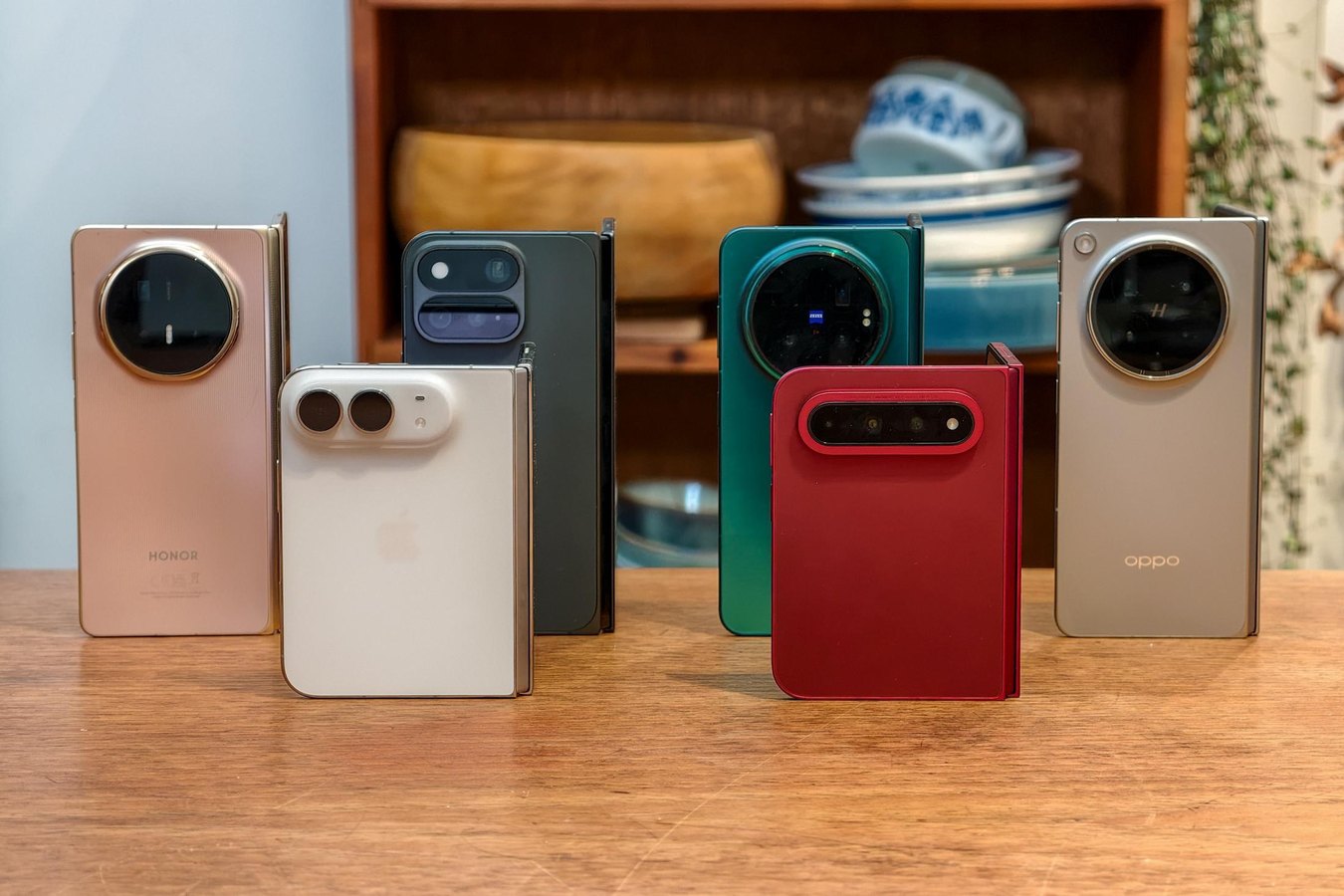
The device functions as a dual-posture computer with a squat cover display when folded and an expansive tablet view when unfolded. A dedicated magnetic hinge snaps the phone shut with tactile feedback, giving users quick access to standard mobile tasks on the front screen. Unfolded, the main display reveals an under-display camera set inside a pixelated screen circle that lacks the surrounding matte nano-texture coating, rendering the lens visible during general interface navigation while serving primarily for video calls.
Software handling relies on a newly designed persistent right-hand system rail intended to anchor core interface navigation along the phone's edge. In daily operation, this software border consumes valuable horizontal display space across the cover screen, leaving interactive viewports narrower than on dimensionally identical hardware like the Xiaomi 18 Fold. For rear photography, the system combines two 48-megapixel sensors covering main and ultrawide focal lengths, matching the dual-camera configuration of the standard Galaxy Z Fold 8 while relying on phone rotation to take high-resolution selfies with the primary lenses.
Advertisement
Tech Pulse Daily
Get tomorrow's pulse first
Join engineers who read Tech Pulse before stand-up. Free, weekday mornings.
I’ve reviewed almost every Android foldable: why it matters
The arrival of the iPhone Duo demonstrates that Apple can match established Android hardware standards on initial industrial design, but it exposes software scaling as Apple's primary vulnerability. While Samsung has iterated through eight generations of folding hardware to refine its interface, the Duo ships with third-party app friction. Software like Bluesky and Duolingo fails to scale to the broader display, rendering in narrow vertical strips bordered by large black bars rather than filling the canvas.
Furthermore, early reports of non-impact hinge and panel damage indicate that Apple is navigating structural durability hurdles that modern Android competitors largely overcame years ago. While not as widespread as the display failures seen during Samsung's 2019 debut, unexplained panel degradation highlights the inherent risk of adopting a first-generation hardware platform. The Duo offsets these liabilities with stronger daily battery endurance than Samsung's options, comfortably surviving a full day of mixed tasks, though it trails the multi-day endurance delivered by Honor's Magic V6.
I’ve reviewed almost every Android foldable: who is affected
Early adopters and iOS ecosystem users who require tablet multitasking inside a pocketable form factor face immediate tradeoffs between physical polish and everyday ergonomics. The phone's substantial heft makes one-handed thumb navigation difficult across both the cover screen and unfolded canvas. Buyers looking for flagship-tier zoom and portrait photography will also find the Duo restrictive compared to triple-camera setups found on Samsung's Z Fold 8 Ultra, Xiaomi's 18 Fold, and camera-centric foldables from Vivo.
Software developers building for iOS must also adapt layout architectures to accommodate Apple's right-hand rail without compromising usable content width. Applications like Slack have demonstrated successful implementations by adopting desktop-style two-column layouts that outperform stretched mobile interfaces on Android. In contrast, Google addressed the layout in Google Maps by expanding map graphics completely edge-to-edge, bypassing the rail to provide a larger navigation area.
I’ve reviewed almost every Android foldable: what to watch
Monitoring rapid app updates will determine how quickly the Duo resolves its interface deficiencies against Android rivals. Major platforms including Google Maps, Google Translate, and Instagram pushed layout revisions within days of release to improve canvas scaling, signaling an active developer push to eliminate dead black border space. Tracking whether developers adopt Apple's right-hand rail controls or bypass them entirely will indicate whether Apple's current navigation schema survives future iOS updates.
Long-term durability reports will also clarify whether reported hinge and display failures represent isolated manufacturing flaws or broader engineering defects in the folding assembly. Observers should watch whether forthcoming revisions reduce device weight toward the thin profile established by Honor's Magic V6. As Android competitors refine crease reduction and camera sensor scale, the speed with which Apple stabilizes its app ecosystem will determine whether the iPhone Duo retains its footing in the folding smartphone sector.
Developer Action Items
- ☐ Diff the official changelog for Google / Apple / Android before you bump — APIs, defaults, and removed flags only.
- ☐ Install through the vendor's documented channel in staging; keep a one-command rollback and time-box the canary.
- ☐ Grep your repo for old flag names, lockfile pins, and plugin versions that the notes mark as breaking.
- ☐ Prefer the first patch cut over the day-zero tag unless you have a reason to be on the leading edge.
- ☐ If The Verge did not name a region, plan, or SKU, screenshot the official availability line before you promise it to users.
I’ve reviewed almost every Android foldable FAQ
How much does the iPhone Duo cost?
The iPhone Duo retails for $2,000, positioning it directly against premium folding flagships from Samsung, Google, and Xiaomi.
Does the iPhone Duo support a stylus?
Yes, the iPhone Duo supports input from a USB-C Apple Pencil on its central folding screen, matching stylus capabilities offered by Honor and Oppo.
How does the iPhone Duo camera setup compare to Android foldables?
The Duo includes two 48-megapixel rear cameras covering wide and ultrawide shots, which matches Samsung's Galaxy Z Fold 8 but lacks the triple-camera arrays and larger sensors found on models from Vivo and Xiaomi.
Is the iPhone Duo waterproof?
The device features an IP68 ingress protection rating for dust and water resistance, matching Google and Honor foldables while exceeding standard water resistance on many rivals.
Sources

Author
Dillip Chowdary
Writes Tech Bytes coverage of AI, engineering, and the tools that actually ship. Editor of Tech Pulse Daily.
Related on Tech Bytes
Advertisement