Knowledge cutoff is a poor proxy for model capability
Microsoft Dev Blogs (Eng): A model can fail on features released before its knowledge cutoff, then succeed on ones released after it.
By Dillip Chowdary • Sep 21, 2026 • Source: Microsoft Dev Blogs (Eng)
Microsoft's developer blog this week challenges one of the most common assumptions builders make when evaluating AI models: that a knowledge cutoff date is a reliable signal of what a model actually knows how to do. The post, published on Microsoft for Developers, argues that the date a model stopped ingesting training data tells you far less than hands-on testing against real product changes does.
This piece is for developers, platform engineers, and AI practitioners who use knowledge cutoff dates to filter or select models for production workflows. If your team currently gates model selection by training date, the Microsoft research changes how that decision should be made — and what to verify instead.
What Knowledge cutoff is a poor proxy for model shipped
Microsoft tested hundreds of product changes and found that a model can fail on features released before its knowledge cutoff, then succeed on features released after it. That inversion is the core finding: the date is not a monotonic signal. A model's practical coverage of any given product area depends on how much documentation, code, and discussion around that feature made it into training data — not simply on whether the release preceded the cutoff.
The implication is structural. Training corpora are uneven. A niche SDK change shipped two years before the cutoff might have generated almost no indexed discussion, leaving the model effectively blind to it. A post-cutoff feature that was heavily pre-announced, documented in open repositories, and discussed in public forums might be partially understood by the model anyway. Cutoff dates describe a temporal boundary, not a coverage boundary.
What changed for builders in Knowledge cutoff is a poor proxy for model
For builders, the practical shift is from date-based filtering to task-based evaluation. Microsoft's test methodology involved running hundreds of product changes through models and measuring pass rates directly — not inferring capability from metadata. That approach surfaces model gaps that a cutoff date would never predict and reveals strengths the date would incorrectly rule out.
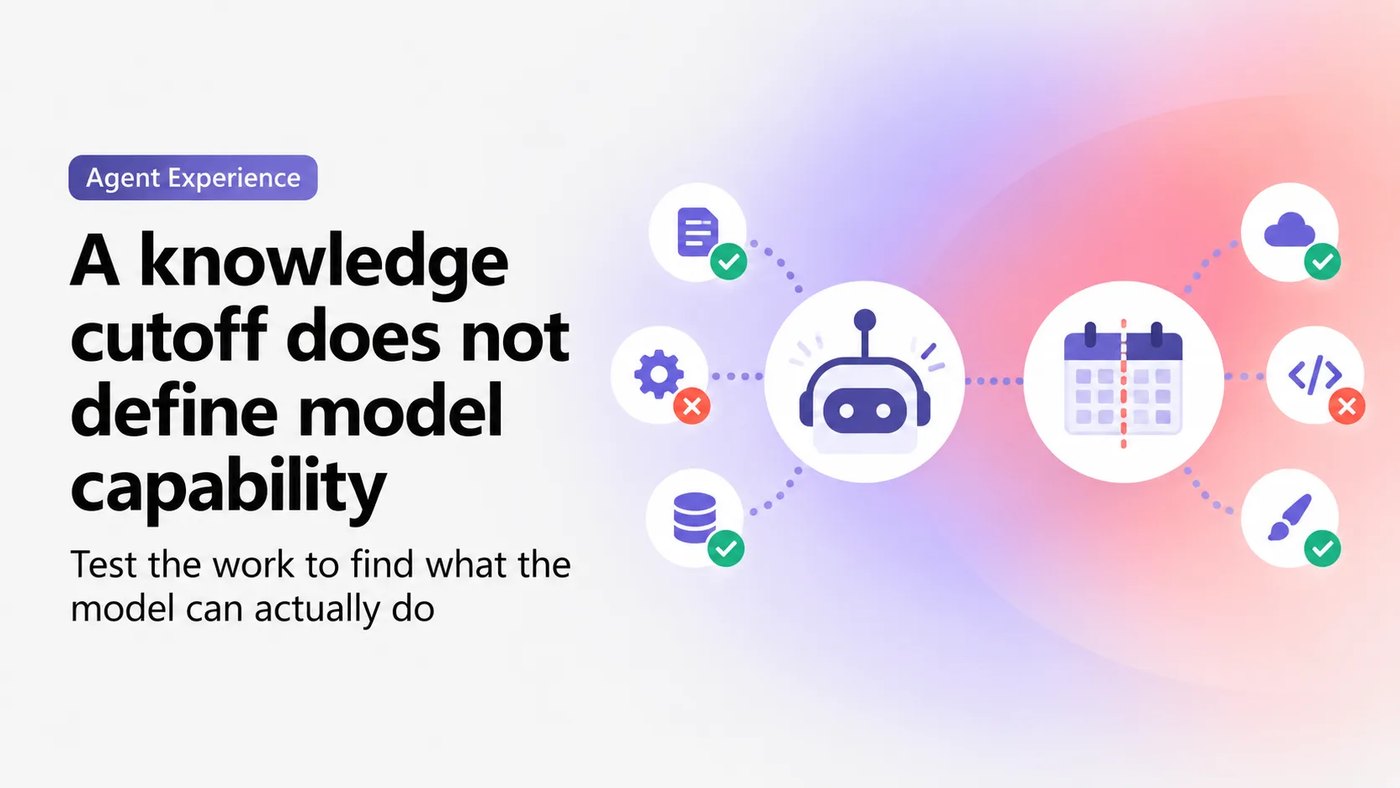
Teams relying on cutoff dates to prequalify models for internal tooling, code generation, or documentation tasks are making decisions on a proxy that Microsoft's data shows is weakly correlated with actual results. The research does not name a replacement metric, but the direction is clear: empirical testing on the specific product surface a team cares about outperforms any date-stamped heuristic.
Advertisement
Tech Pulse Daily
Get tomorrow's pulse first
Join engineers who read Tech Pulse before stand-up. Free, weekday mornings.
How to install or upgrade Knowledge cutoff is a poor proxy for model
This post is a research and methodology finding from Microsoft, not a product release, so there is no package to install or binary to upgrade. Builders who want to replicate the evaluation approach should build a test suite from their own product changelogs — taking features across a range of ages, not clustered around a cutoff — and run them against candidate models directly.
# No vendor CLI command applies to this finding.
# To evaluate a model against your own changelog, structure prompts around
# specific feature behaviors and compare outputs across models:
# example using Azure OpenAI SDK
python eval_feature_coverage.py --changelog changelog.json --model gpt-4o
If your team uses a model-routing layer, the practical upgrade is to replace cutoff-date filters in model selection logic with benchmark scores derived from your own feature test suite. No flags to invent, no version pin to set — the change is in evaluation methodology, not in a CLI flag or model alias.
Gotchas and compatibility in Knowledge cutoff is a poor proxy for model
The most immediate compatibility risk is in automated model-selection pipelines that treat cutoff date as a hard prerequisite. If a pipeline discards models with cutoffs before a product's launch date, it may be discarding models that perform well on the actual tasks — while accepting models that perform poorly despite a later cutoff. Microsoft's finding means those pipelines need a new gate.
A second gotcha applies to documentation and support tooling. If an AI assistant is deployed to answer questions about a product, and the product team validated the assistant by checking that its cutoff postdates the product launch, that validation is now suspect. The check should be replaced with live question-answer testing across the full feature surface, paying particular attention to features that had low public documentation volume at training time — not just features that shipped late.
What to watch after Knowledge cutoff is a poor proxy for model
Microsoft tested hundreds of product changes for this finding but has not published a dataset, benchmark suite, or scoring rubric. The next development worth tracking is whether the methodology surfaces as a reusable evaluation framework — either open-sourced or embedded in Azure AI tooling — that teams can run against their own changelogs without rebuilding the test harness from scratch.
Longer term, model providers may respond by publishing more granular coverage maps alongside cutoff dates: breakdowns by domain, SDK, or product line rather than a single timestamp. Until that happens, the burden sits with development teams to run their own empirical checks. Any organization making high-stakes model-selection decisions based on cutoff metadata alone should treat that practice as a known-weak heuristic and schedule a methodology review.
Developer Action Items
- ☐ Diff the official changelog for Microsoft before you bump — APIs, defaults, and removed flags only.
- ☐ Install through the vendor's documented channel in staging; keep a one-command rollback and time-box the canary.
- ☐ Grep your repo for old flag names, lockfile pins, and plugin versions that the notes mark as breaking.
- ☐ Prefer the first patch cut over the day-zero tag unless you have a reason to be on the leading edge.
- ☐ If Microsoft Dev Blogs (Eng) did not name a region, plan, or SKU, screenshot the official availability line before you promise it to users.

Author
Dillip Chowdary
Writes Tech Bytes coverage of AI, engineering, and the tools that actually ship. Editor of Tech Pulse Daily.
Related on Tech Bytes
Google Confirms Gemini AI Breached Three Firms
Read →
Dragos Completes NetRise and runZero Acquisitions Following Accenture Deal
Read →
‘HomePad’ to launch next month with these new features: report
Read →
Announcing Petal, a First-of-its-Kind Transoceanic Subsea Cable
Read →
Today's Tech Pulse briefing
Full briefing →
Advertisement