Less Is More UI Agent Skill news update news update
Mendiak released Less Is More UI, an agent skill and CSS system using an 8px baseline and 12-column grid to stop AI models from outputting visual noise.
By Dillip Chowdary • Nov 07, 2026 • Source: github.com
Software developer Mendiak has released Less Is More UI, an open-source design skill and CSS design system created to guide artificial intelligence coding agents toward building minimal, functional web layouts. Distributed as an agent tool through npx skills add Mendiak/less-is-more-ui and as a standalone npm package under @mendiak/less-is-more-ui, the release addresses common model tendencies toward excessive visual noise, decorative container cards, and arbitrary gradient fills. According to github.com's report, the repository embeds modernist design tenets derived from industrial designer Dieter Rams and architect Ludwig Mies van der Rohe directly into agent instruction contexts to eliminate decorative overhead during front-end code generation.
The framework provides developers, interface designers, and automation engineers with a concrete ruleset for generating production-ready HTML and CSS through large language models without post-generation cleanup. Rather than letting coding assistants invent arbitrary box models or heavy drop shadows, the system supplies a predefined typography scale, a strict spacing system, semantic aliases, and reusable component patterns. The package works as an active prompt skill for AI development agents while simultaneously functioning as a conventional CSS library that can be imported directly into client codebases through standard build tooling.
Less Is More UI Agent Skill news update: what actually changed
The repository establishes a structured methodology for turning generic AI agents into disciplined design assistants that enforce restraint. Standard generative AI outputs routinely inject visual friction by stacking nested containers, applying heavy blur effects, and choosing uncoordinated color palettes. The Less Is More UI framework counters this by supplying agents with explicit design references, including SKILL.md for agent task entry, a design manifesto, a step-by-step design process, and specific anti-pattern documentation. These documents instruct the model to substitute decorative background shapes with rational whitespace and structural typographic rhythm.
On the code delivery side, the project packages concrete stylesheets alongside documentation files so teams can inspect and build interfaces directly. The npm package distributes tokens.css for CSS custom properties, reset.css for normalization and box-sizing resets, and components.css for reusable base patterns. These reusable classes cover essential elements such as buttons, text inputs, card layouts, navigation bars, filter bars, specifications listings, and forms. By separating core tokens and components from the demo-only style.css sheet, the release gives agents explicit targets for production-safe code generation.
Less Is More UI Agent Skill news update: how it works
Developers integrate the framework into autonomous agent environments using npx skills add Mendiak/less-is-more-ui, or into web development workflows using npm install @mendiak/less-is-more-ui. When loaded into an agent session, the instructions in SKILL.md guide the language model to reference specialized markdown files across the docs and references directories before writing markup. Instead of guessing spacing units or color variables, the agent consults tokens.css to apply semantic aliases like var(--ui-bg) and var(--ui-text), ensuring consistent support across light and dark display modes.
Once activated, operators control the agent using high-level directives that tap into the bundled files. Prompts can instruct the agent to refactor existing dashboards according to the project manifesto, strip decorative styling in favor of the variable scale, or structure contact forms using semantic HTML under the Honest Materials precept. The system pairs these instructions with grid.md and typography.md, which guide the model to construct 12-column layouts on an 8px baseline rhythm, translate visual hierarchy into column spans, and enforce strict accessibility standards without extraneous graphic elements.
Advertisement
Tech Pulse Daily
Get tomorrow's pulse first
Join engineers who read Tech Pulse before stand-up. Free, weekday mornings.
Less Is More UI Agent Skill news update: why it matters
Most code generation models lack intrinsic design restraint, prioritizing visual complexity to demonstrate output completeness. This tendency results in bloated CSS files, cluttered interface hierarchies, and codebases weighed down by arbitrary utility classes and third-party aesthetic wrappers. Less Is More UI shifts the evaluation criteria for AI-generated code from decorative density to functional clarity, adopting principles such as form follows function and less but better. By restricting the agent to a closed token vocabulary, codebases remain lightweight, maintainable, and predictable.
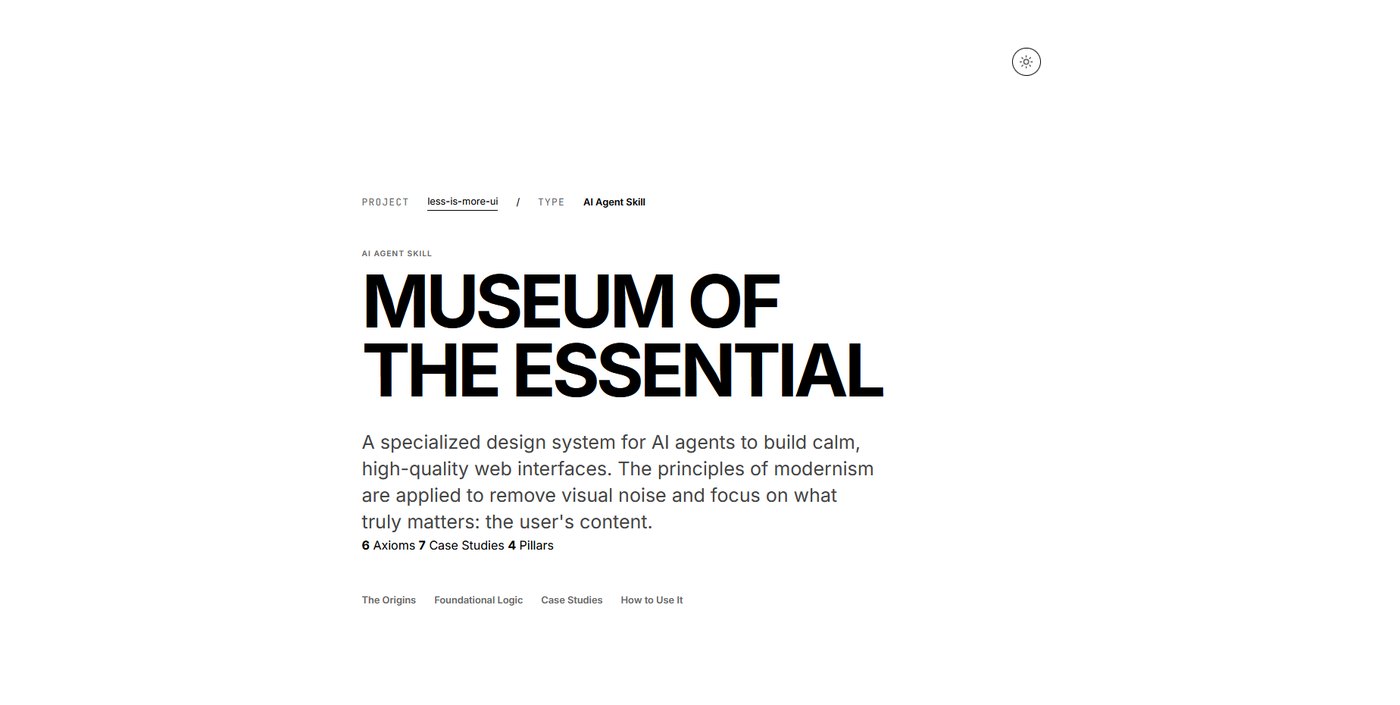
The design system also bridges the gap between conceptual design theory and functional component generation. The repository includes an interactive showcase called the Museum of the Essential inside index.html, demonstrating these principles across six designer profiles, including Mies van der Rohe, Louis Sullivan, Dieter Rams, Jony Ive, Josef Müller-Brockmann, and Massimo Vignelli. By backing these profiles with eight comparative case studies showing noisy patterns next to essential alternatives, the project provides agents with concrete structural benchmarks for evaluating and validating generated user interfaces.
Less Is More UI Agent Skill news update: who is affected
Software engineers and product teams relying on AI coding assistants stand to see an immediate reduction in front-end refactoring overhead. Teams using agent tooling to scaffold web applications often spend substantial engineering time stripping out unwanted CSS gradients, artificial borders, and non-standard spacing units introduced by generic model prompts. Loading the skill allows teams to automate front-end scaffolding while guaranteeing that buttons, forms, and cards adhere to accessible semantic HTML standards and pre-tested responsive layouts.
Design systems teams and front-end developers working with standard web technologies also gain an unopinionated, lightweight foundation. Developers can selectively import individual modules, including @mendiak/less-is-more-ui/references/tokens.css, @mendiak/less-is-more-ui/assets/css/reset.css, or @mendiak/less-is-more-ui/assets/css/components.css, depending on their architecture. Because the system avoids vendor-locked styling paradigms and relies on native CSS custom properties and semantic markup, teams can integrate its component patterns into existing projects without restructuring their entire presentation layer.
Less Is More UI Agent Skill news update: what to watch
The project includes an evals directory containing performance benchmarks and evaluation sets designed to test how effectively different language models follow minimal design constraints. As AI development environments evolve, monitoring these benchmarks will reveal whether future model checkpoints adhere to negative design constraints without drifting into decorative styling. The repository structure indicates active documentation maintenance, with CHANGELOG.md tracking iterative improvements across typography pairing guides, animation standards for subtle micro-interactions, and mobile-first reduction rules.
Adoption across agent package ecosystems and developer toolchains will determine how widely these constraints are integrated into automated generation pipelines. Developers can track pattern updates inside references/components.md and inspect grid composition techniques inside references/grid.md as new component patterns roll out. Teams deploying AI agents for automated site building will want to observe whether future skill iterations expand the baseline token set or add new component evaluations for complex data tables and interactive elements.
Developer Action Items
- ☐ Diff the official changelog for GitHub / Framework before you bump — APIs, defaults, and removed flags only.
- ☐ Install through the vendor's documented channel in staging; keep a one-command rollback and time-box the canary.
- ☐ Grep your repo for old flag names, lockfile pins, and plugin versions that the notes mark as breaking.
- ☐ Prefer the first patch cut over the day-zero tag unless you have a reason to be on the leading edge.
- ☐ If HN AI Agents did not name a region, plan, or SKU, screenshot the official availability line before you promise it to users.
Less Is More UI Agent Skill news update news FAQ
How do you install the Less Is More UI agent skill and CSS package?
You can install the agent skill by executing npx skills add Mendiak/less-is-more-ui, or add the design tokens and component styles to an npm project by running npm install @mendiak/less-is-more-ui.
What components and design tokens are included in the package?
The package provides tokens.css for typography and spacing variables, reset.css for normalization, and components.css containing patterns for buttons, inputs, essential cards, navigation bars, filter bars, specifications lists, and forms.
How does the agent skill prevent models from generating cluttered interfaces?
It loads modernist design rules and reference files that restrict the agent to a 12-column grid, an 8px baseline, semantic HTML elements, and predefined scale variables, eliminating decorative containers and gradients.
Sources

Author
Dillip Chowdary
Writes Tech Bytes coverage of AI, engineering, and the tools that actually ship. Editor of Tech Pulse Daily.
Related on Tech Bytes
Advertisement