METR: Independent Assessment of AI R&D Acceleration at Anthropic
METR evaluated Anthropic's research workflows and found model capability growth reached 1.9 times historical rates without scaling training compute.
By Dillip Chowdary • Nov 07, 2026 • Source: lesswrong.com
Nonprofit research organization METR completed a high-access evaluation at Anthropic examining whether artificial intelligence is accelerating its own development pace, according to lesswrong.com's report by Zach Stein-Perlman on the October 2026 assessment. Conducted between August 12 and October 29, 2026, the investigation evaluated whether internal model development workflows are compounding frontier capability progress. Evaluators gained direct access to internal metrics spanning pretraining, reinforcement learning, domain-specific training compute allocations, internal benchmark logs, automated speedup measurements, future capability projections, and staff interviews across the engineering organization.
This technical breakdown reviews empirical findings on capability compounding, evaluation methodologies, and operational bottlenecks identified within frontier lab environments. The analysis serves machine learning engineers, alignment researchers, and systems architects tracking recursive self-improvement dynamics and algorithmic scaling trajectories. By isolating external hardware expansions from software-driven acceleration, the assessment provides an empirical baseline for understanding how automated engineering tools influence commercial frontier model releases.
Independent Assessment of AI R&D Acceleration: what actually changed
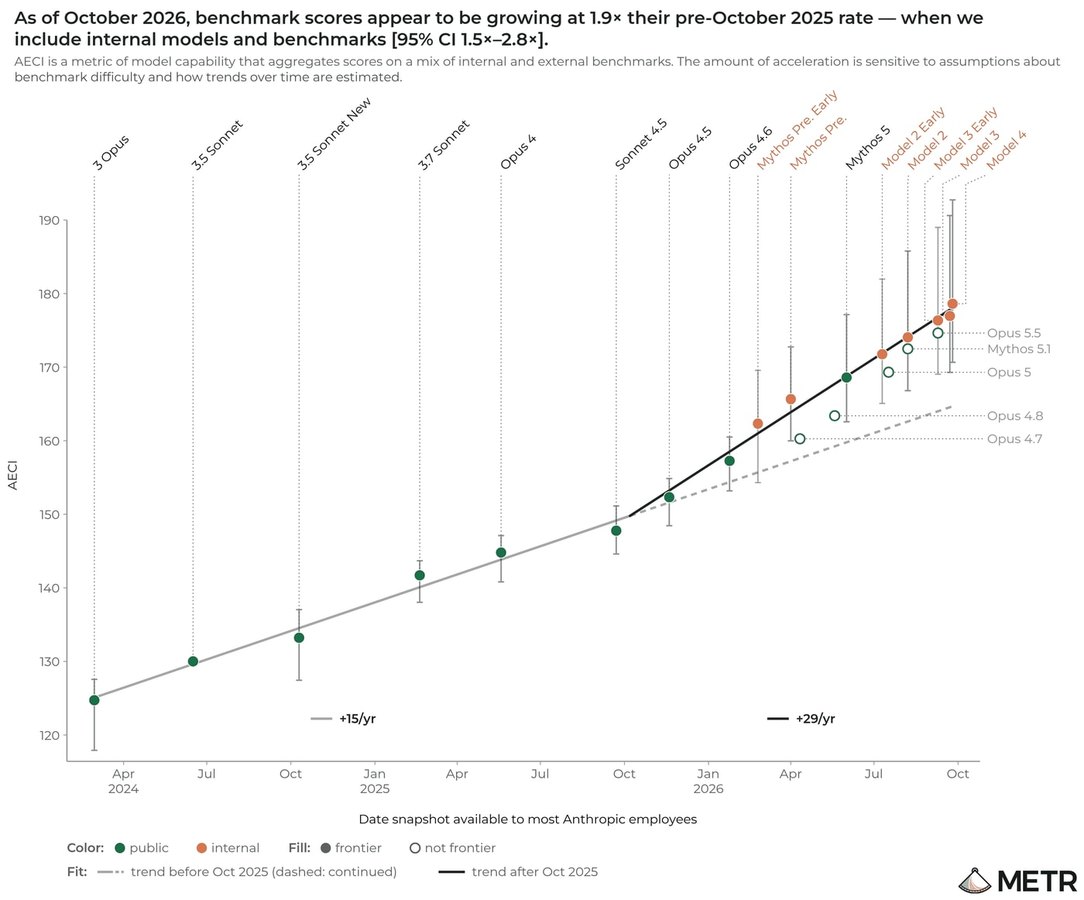
Anthropic’s capability growth rate on well-specified benchmark evaluations expanded to approximately 1.9 times its historical baseline between October 2025 and October 2026. Evaluators established a 95 percent confidence interval spanning 1.5x to 2.8x for this multiplier, indicating that the laboratory compressed roughly two standard calendar years of capability progress into a single twelve-month window. The pace comparison benchmarks current gains against historical development rates recorded from March 2024 through October 2025. Evaluators noted that while baseline uncertainty could place the true acceleration between 1.3x and 3.0x, empirical trajectory points confirm a sustained elevation in output over the past year.
Capability measurements relied on Anthropic’s version of the Epoch Capabilities Index, designated as AECI, to evaluate model output across structured tasks. Crucially, evaluation teams verified that this capability surge did not stem from an accelerated expansion of physical training compute clusters. The measured velocity represents algorithmic efficiency gains and research workflow enhancements rather than raw hardware cluster additions. Although external analysts like Ryan Greenblatt originally anticipated modest acceleration rates between 1.15x and 1.3x for 2026, the observed metrics demonstrate that automated engineering pipelines generated higher returns than prior predictive modeling expected.
Independent Assessment of AI R&D Acceleration: how it works
The observed velocity relies primarily on AI-assisted workflows embedded throughout the research lifecycle rather than fully autonomous systems operating without human guidance. Staff interviews and internal company surveys revealed substantial productivity uplifts across coding, architectural iteration, and test harness execution. Engineering personnel reported that assisted tooling has largely alleviated implementation bottlenecks, shifting operational limits toward concept generation and experiment hardware allocation. While fully autonomous contributions remain limited across production pretraining pipelines, initial deployment signals indicate automated agents are preparing to handle broader segments of end-to-end experimental verification.
Data sharing during the evaluation included detailed logs covering reinforcement learning regimes, pretraining compute splits, internal validation checkpoints, and forward projections for unreleased model architectures. However, Anthropic applied redactions to several primary data artifacts that directly shaped the evaluators' ultimate risk conclusions. Evaluators noted that these redactions prevent outside observers from directly inspecting core causal mechanisms. The validity of conclusions attributing the majority of the 1.9x uplift to model-driven tooling relies partly on the technical evaluations conducted by METR personnel during on-site inspections.
Advertisement
Tech Pulse Daily
Get tomorrow's pulse first
Join engineers who read Tech Pulse before stand-up. Free, weekday mornings.
Independent Assessment of AI R&D Acceleration: why it matters
Recursive acceleration dynamics suggest that utilizing frontier models to design subsequent architectures can collapse historical delivery timelines. Research staff including Ajeya Cotra and Daniel Kokotajlo observed that sustained 2x acceleration shifts standard timeline forecasts for transformative systems significantly forward, surpassing assumptions modeled in projections like AI 2027. If internal engineering velocity reaches thresholds outlined in responsible scaling policies, capability emergence could outpace governance and evaluation windows. Demonstrating that benchmark growth doubled without a matched surge in training hardware scaling confirms that software-level workflow optimizations are actively driving frontier progress.
The assessment noted an absence of acute operational bottlenecks across algorithmic design, experiment compute allocations, or training data reserves over the coming twelve-month window. Without evident diminishing returns, ongoing tool integration risks triggering steeper compounding loops. However, independent observers like Thane Ruthenis pointed out that benchmark curves show an initial slope change around early 2026 rather than a continually steepening exponential curve. This pattern suggests productivity gains may function as discrete operational step-changes requiring ongoing structural unlocks rather than automatic continuous compounding.
Independent Assessment of AI R&D Acceleration: who is affected
Frontier research laboratories and AI safety organizations face immediate operational implications from compressed development schedules. When engineering cycles compress from twenty-four months to twelve, safety auditing teams operate under reduced lead times to validate model safeguards, red-teaming harnesses, and interpretability tooling before deployment. External evaluation bodies depend on transparent access regimes to verify safety claims, making company-controlled redactions a point of friction. Analysts emphasizing evidence transparency noted that public visibility into causal mechanisms remains constrained when underlying evaluation data cannot be externally audited.
Technical personnel and platform engineers adapting to automated research infrastructure experience shifting daily workflows. Internal interviews demonstrate that routine code execution and test iteration have largely migrated to assisted systems, altering traditional developer responsibilities. Research institutions tracking alignment policies must recalibrate pacing metrics, as baseline timelines developed under 2024 conditions fail to capture current laboratory execution speeds. The compression forces safety researchers to formalize evaluation standards capable of tracking systems designed partly by earlier automated models.
Independent Assessment of AI R&D Acceleration: what to watch
Tracking the potential transition from human-directed AI assistance to fully autonomous experimental execution represents the primary technical indicator over the next twelve months. Evaluators highlighted several methodological limitations that could lead to underestimating acceleration, including recent velocity increases, expanding task automation in internal labs, and AECI metrics failing to capture real-world operational impact. Conversely, the analysis could overestimate acceleration if non-AI research breakthroughs drove late-2025 performance, if AECI's focus on verifiable tasks skewed output measurements, or if early baselines from 2023 to 2025 reflected abnormally slow intervals.
Industry observers will monitor whether upcoming model iterations produce further structural step-changes in the AECI curve or encounter compute boundaries during large-scale runs. The degree of information sharing across future evaluation windows will dictate how effectively external bodies track automated R&D. If subsequent laboratory reports reveal automated agents executing complete research loops without human intervention, projections surrounding recursive capabilities will require immediate upward revisions across the technical ecosystem.
Developer Action Items
- ☐ Verify the claim on the official Anthropic page (or HN Claude/Codex/Fable), not from this recap alone.
- ☐ Name the surface that moved — API, policy, model, hardware, or commercial terms — before you Slack the thread.
- ☐ Assign one owner a day to read the primary material and decide: this-sprint, this-quarter, or noise.
- ☐ Do not change production on day-one coverage. Watch the vendor changelog and one independent write-up first.
Independent Assessment of AI R&D Acceleration FAQ
What was the evaluated speedup in Anthropic's AI research progress?
METR estimated that Anthropic improved capabilities on well-specified tasks at roughly 1.9 times its pre-October 2025 rate, with a 95 percent confidence interval between 1.5x and 2.8x.
Did expanded hardware clusters cause the acceleration?
Evaluators confirmed that the measured acceleration was not caused by an accelerated scaling of physical training compute.
How much of the research process is fully autonomous?
R&D acceleration currently stems primarily from human-assisted AI tooling rather than fully autonomous contributions, though evaluators noted early signs of autonomous execution expanding.
Sources

Author
Dillip Chowdary
Writes Tech Bytes coverage of AI, engineering, and the tools that actually ship. Editor of Tech Pulse Daily.
Related on Tech Bytes
Advertisement