Nvidia’s Jensen Huang resigns, chipmaker names CFO Colette Kress
Nvidia's board accepted Jensen Huang's resignation and named CFO Colette Kress interim CEO as the stock fell up to 19%, erasing more than $855 billion in value.
By Dillip Chowdary • Nov 14, 2026 • Source: TechCrunch
Jensen Huang has resigned as president and chief executive of Nvidia, and the chipmaker has named chief financial officer Colette Kress as interim CEO, according to TechCrunch's report. The resignation came just days after Huang admitted to a romantic affair with an alleged Chinese spy, a disclosure that set off a U.S. national security crisis.
This piece covers the leadership change, the hit to Nvidia's market value, the company's growth under Huang, and the web of AI investments that now face new uncertainty. It is written for engineers, operators and buyers who depend on Nvidia GPUs and the data center ecosystem the company has helped finance.
01Kress as interim CEO, Jones as first chair
In a regulatory filing, Nvidia said its board accepted Huang's resignation on Wednesday, and the company announced it on Thursday. Colette Kress, currently chief financial officer and executive vice president, will serve as interim CEO until Nvidia finds a permanent successor. She will keep her role as CFO at the same time.
The board also appointed Harvey C. Jones as the company's first-ever chair of the board of directors.
Jones is a managing partner of Square Wave Ventures and a former CEO of Synopsys, and he has sat on Nvidia's board since 1993. As chair, he is likely to play a central role in the search for a permanent CEO.
The company thanked its founder in a statement: "Jensen's contributions to NVIDIA are profound. NVIDIA is one of the most consequential technology companies in the world." The statement added that the board and the company thank Huang "for his immeasurable contributions to the company and the industry."
02An $855 billion market cap slide
Nvidia's shares were down nearly 12% in early morning trading on Thursday. Since Friday, the stock has fallen by as much as 19%, wiping out more than $855 billion in market capitalization.
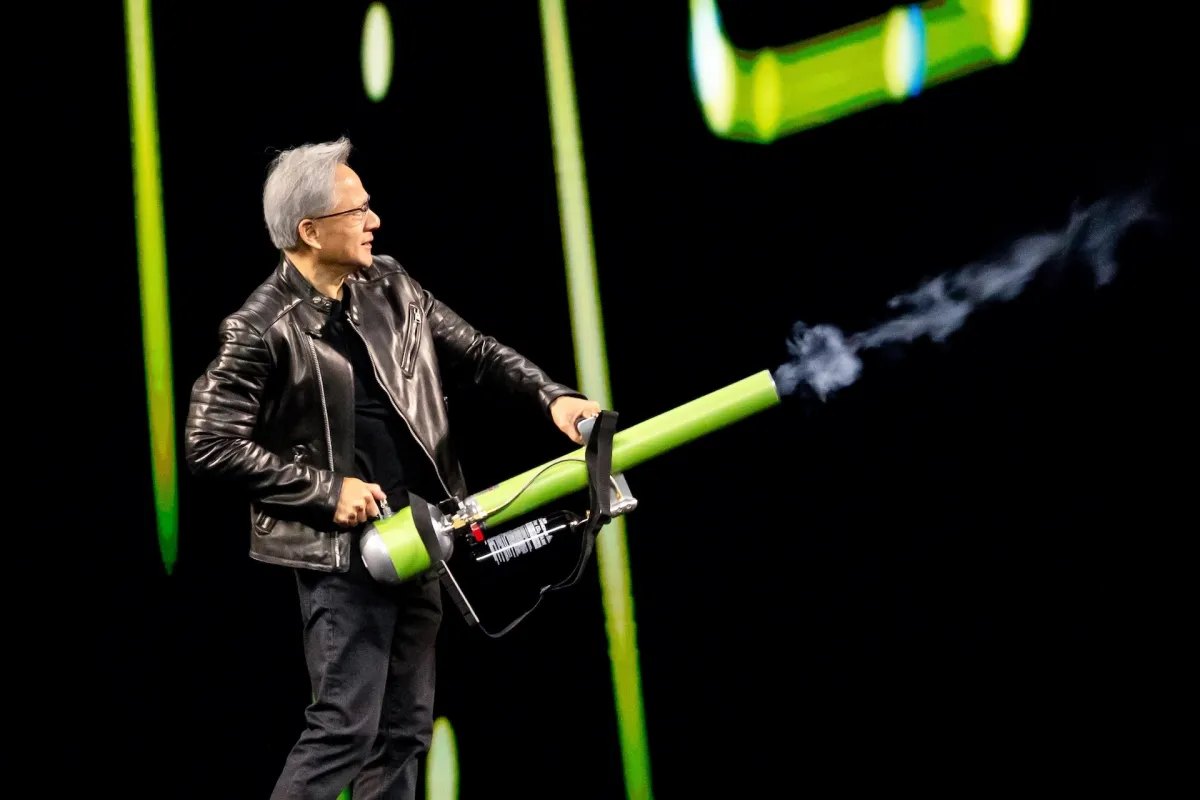
The drop follows a historic run. Before ChatGPT launched and sparked the AI boom, Nvidia shares traded at about $15; as of last month they had risen more than 1,450% to an all-time high of $243. The company's market cap rose by $5.5 trillion over that period, reaching as high as $5.88 trillion early in October.
Revenue rose more than 1,500% to $96.22 billion as of the company's second quarter, up from $5.93 billion in Q3 2023, just before the ChatGPT moment. Profits grew nearly 88 times over the same stretch, to $59.69 billion as of July 2026 from $680 million in October 2023.
Advertisement
Tech Pulse Daily
Get tomorrow's pulse first
Join engineers who read Tech Pulse before stand-up. Free, weekday mornings.
03From gaming GPUs and CUDA to AI dominance
Huang founded Nvidia in 1993 and led it as CEO from then until his resignation. The company's early years were marked by struggle and layoffs before it landed on a GPU design that performed well enough to become the standard for graphics processing in PCs.
Those chips also proved extremely good at running large numbers of calculations at once, which made them popular for crypto mining and, later, for training and running neural networks. Nvidia had already moved beyond gaming into general-purpose computing in 2006 with the CUDA architecture, which lets developers use the chips for calculations and research.
After AI researchers began training neural networks on Nvidia GPUs more than a decade ago, Huang pushed the company toward AI and data center chips. He traveled to conferences worldwide to promote AI, lobbied for looser rules after the Biden administration placed export controls on high-power AI chip sales to China, and cultivated a close relationship with Trump, often to Nvidia's benefit.
04Nvidia's $99 billion AI investment book
Huang's exit raises questions about Nvidia's sprawling AI investments, which have helped fund startups and the large data centers needed to run their models. As of the end of its second quarter, Nvidia reported $99 billion in investments and another $25 billion in commitments, plus $36 billion in cloud service commitments that help AI cloud operators finance the GPUs and equipment they buy from Nvidia.
The company put $2 billion into CoreWeave in January and another $2 billion into Nebius in March, and was said to be considering acting as a guarantor for Nscale's planned West Virginia data center. It has also signed up to provide up to $105 billion in credit guarantees for an OpenAI data center campus in Ohio.
Nvidia invested $30 billion in OpenAI and $10 billion in Anthropic, backed Mira Murati's Thinking Machines Lab in a deal involving at least 1 GW of Vera Rubin GPU systems, and put $3.5 billion into MediaTek for custom AI chips that work with Nvidia systems. On Thursday, CoreWeave shares fell about 9%, reversing part of a 25% rally the day before, while Nebius dropped about 16% and IREN fell 6.6%.
05China exposure and a missing succession plan
The resignation lands at a sensitive moment for Nvidia's China business. China's weight in the company's finances has shrunk because of strict U.S. export controls and Beijing's push for domestic alternatives, but Chinese customers still accounted for about $7.9 billion in second-quarter revenue, roughly 8% of the total.
Huang is Nvidia's single largest personal shareholder, yet he owns only about 3.5% of the shares and holds no supervoting rights, so the board could vote him out at any time. He ran a very flat organization with around 60 direct reports and kept tight control over the company.
There was no heir apparent or formal succession plan, although two of Huang's children work in executive roles at Nvidia. The first public look at how the company operates without him comes next week, when Nvidia reports earnings on Tuesday and holds its quarterly conference call.
Nvidia’s Jensen Huang resigns FAQ
Who is Nvidia's interim CEO after Jensen Huang's resignation?
Colette Kress, Nvidia's chief financial officer and executive vice president, is interim CEO until the company finds a permanent successor. She will continue to serve as CFO.
Why did Jensen Huang resign from Nvidia?
Huang resigned a few days after he admitted to a romantic affair with an alleged Chinese spy, which sparked a U.S. national security crisis. Nvidia's board accepted his resignation on Wednesday.
How much did Nvidia stock fall after Huang's resignation?
Shares were down nearly 12% in early trading on Thursday. Since Friday, the stock has fallen by as much as 19%, a market cap loss of more than $855 billion.
Who is Nvidia's new board chair?
Harvey C. Jones, a managing partner of Square Wave Ventures and former CEO of Synopsys, became Nvidia's first-ever board chair. He has been on the board since 1993.
When does Nvidia report earnings next?
Nvidia reports earnings on Tuesday next week, with its quarterly conference call giving the first look at the company after Huang.
Sources

Author
Dillip Chowdary
Writes Tech Bytes coverage of AI, engineering, and the tools that actually ship. Editor of Tech Pulse Daily.
Related on Tech Bytes
Anthropic's Model Taught Itself to Run on AMD in "Three Days."
Read →
Claude the Business Analyst
Read →
Constellation Space launches its platform for managing fleets of satellites with AI tools
Read →
What a week of Claude Code holds: the usage meter, per token type
Read →
Today's Tech Pulse briefing
Full briefing →
Advertisement