OpenAI releases a new image classifier and ChatGPT warnings to combat CSAM
OpenAI launched a free CSAM image classifier for select firms and added 24-hour account bans in ChatGPT to prevent users from accessing abusive child imagery.
By Dillip Chowdary • Nov 16, 2026 • Source: TechCrunch
At a glance
- Product
- CSAM image classifier and ChatGPT warnings
- Developer
- OpenAI
- Price
- Free API access for select companies
- Availability
- Select companies and law enforcement
- Key partners
- NCMEC, Tech Coalition, ROOST
- Account penalty
- 24-hour suspension for violations
OpenAI launched a comprehensive suite of safety tools designed to detect and combat child sexual abuse material across artificial intelligence applications, according to TechCrunch's report. The company introduced a novel image classifier engineered to identify synthetic and real abusive imagery, accompanied by explicit warning dialogs and temporary account bans inside ChatGPT. The deployment also provides formal technical documentation for external software developers alongside dedicated investigative analysis tools for child exploitation law enforcement agencies.
This article examines the classifier's architectural benchmarks, API distribution terms, partner testing findings, and automated account enforcement procedures across consumer applications. It serves software developers integrating OpenAI endpoints, trust and safety professionals configuring platform moderation pipelines, policy researchers studying automated deterrent messaging, and compliance officers evaluating legal frameworks for child protection across generative computing infrastructure.
01Image classifier metrics and partner testing
The newly introduced image classifier detects visual indicators of abuse within previously uncataloged images, examining both synthetic artificial intelligence outputs and real-world photographic material. Rather than providing a binary classification, the system calculates an indicative score designed to guide human content reviewers during moderation assessments. OpenAI developed the classification model in direct collaboration with the National Center for Missing and Exploited Children.
OpenAI is partnering with the Tech Coalition and ROOST to distribute the technology to external organizations. Early empirical testing alongside partner groups demonstrated that the classifier flags 48 percent fewer total images while identifying the same absolute volume of abusive material. Because the system filters out baseline noise, images flagged by the classifier are twice as likely to contain confirmed abuse compared to prior tooling.
Note: OpenAI provides API access to this classifier at no cost to select companies through coordinated distribution with the Tech Coalition and ROOST. The integration allows partner platforms to scan novel media without relying solely on existing hash registries.
02ChatGPT account warnings and temporary suspensions
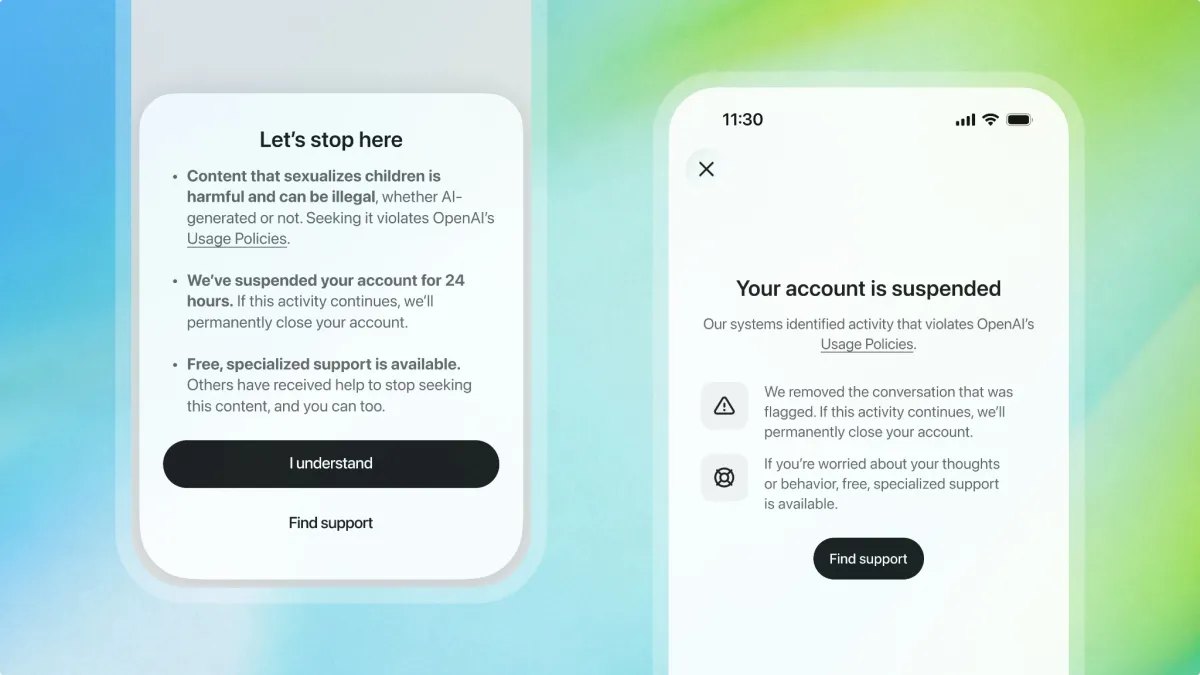
OpenAI introduced real-time warning screens inside ChatGPT to intercept prompts seeking to generate or retrieve content that sexualizes children. When an account submits a prohibited request, the platform presents an explicit warning modal directing the individual toward specialized support services designed to halt harmful behavior. Simultaneously, the system places the offending user account under an automatic 24-hour suspension as an immediate operational deterrent.
ChatGPT currently enforces automated filters that block child sexual abuse material and reject associated queries outright. OpenAI confirmed that accounts engaging in repeated attempts to bypass these barriers will face permanent removal from the platform. The phased disciplinary protocol aims to establish immediate friction against abusive behavior while preserving an escalation pathway toward complete account termination for persistent offenders.
The language and operational guidance governing these intervention warnings were crafted alongside independent child protection organizations and specialized academic researchers. OpenAI collaborated with Finnish child welfare organization Protect Children, the United Kingdom charity Lucy Faithfull Foundation, and Joel Scanlan from the University of Tasmania. Scanlan independently evaluated experimental trials measuring how effectively structured deterrent warnings stopped individuals from pursuing harmful content online.
Advertisement
Tech Pulse Daily
Get tomorrow's pulse first
Join engineers who read Tech Pulse before stand-up. Free, weekday mornings.
03Developer guidelines and reporting registry adoption
OpenAI published official developer guidelines detailing technical methodologies to prevent, detect, and report child sexual abuse material within third-party applications. The documentation outlines implementation protocols for embedding safety classifiers into external software and configuring automated notification pipelines directly into law enforcement databases. This resource ensures engineering teams building commercial tools on OpenAI infrastructure follow uniform safety baselines from initial development through public deployment.
Early partner trials indicated that the guidance helped multiple software developers integrate child safety tooling into their application architectures and register directly with the National Center for Missing and Exploited Children. Registering with the center provides developers with a compliant reporting pathway to submit discovered violations directly to authorized federal authorities. The framework removes technical ambiguity for smaller developer teams attempting to implement robust reporting infrastructure.
The initiative reflects a push to close moderation gaps across downstream consumer products powered by large language models and vision APIs. By offering standardized developer workflows alongside free classifier access, the company seeks to prevent exploitative material from propagating across external software ecosystems. Software creators are instructed to treat automated screening and regulatory reporting as required baseline components of application design.
04Law enforcement plugins and investigative training
OpenAI assembled a specialized toolset tailored specifically for law enforcement units investigating child sexual exploitation and digital abuse cases. The technical package supplies investigators with dedicated software plugins, investigative search utilities, and complex data analysis capabilities built to process high-volume digital evidence. Administrative access to these tools is centrally controlled and vetted through designated program administrators to prevent unauthorized usage.
The release supplements technical software with operational instruction, providing officers with specialized training and a comprehensive field guide covering generative artificial intelligence. The instructional curriculum demonstrates how investigative teams can utilize machine learning to accelerate complex digital forensics without compromising chain of custody or evidentiary integrity. These tools assist forensic examiners in analyzing forensic records and digital media during time-sensitive child rescue operations.
05Industry scrutiny and prior safety blueprint changes
The safety announcement follows heightened legal pressure against OpenAI, including several lawsuits alleging that the company's generative systems have caused measurable harm to users and minors. In parallel, nonprofit advocacy group Common Sense Media evaluated OpenAI's consumer tools and designated the technology as presenting an unacceptable risk for teenage users. Broader industry scrutiny intensified after competing chatbot systems, notably Grok, were exploited to generate nonconsensual sexualized imagery of children.
Over the preceding twelve months, OpenAI implemented several platform alterations aimed at curbing exploitative content and mitigating systemic child safety risks. The startup published an institutional safety blueprint, updated its content guidelines to explicitly prohibit inappropriate material, and retuned core models to refuse harmful prompt injections. The company also introduced a dedicated version of ChatGPT for teenagers that applies stricter moderation thresholds to everyday interactions.
These cumulative measures reflect OpenAI's effort to harden its model boundaries as legislative bodies and consumer advocates demand greater corporate accountability from generative artificial intelligence developers. By combining algorithmic detection, user warnings, downstream developer protocols, and direct investigative assistance, the company attempts to counter multifaceted risks across its software portfolio. The new tools establish a coordinated defensive perimeter across both internal consumer interfaces and third-party commercial deployments.
Frequently asked questions
What does the new OpenAI image classifier do?
The classifier detects visual signs of child sexual abuse material in unseen images, including artificial intelligence outputs. It assigns an indicative score to assist reviewers, flagging 48 percent fewer images while finding the same volume of abuse.
How much does access to the image classifier cost?
OpenAI provides API access to the image classifier at no cost to select companies. Distribution is managed in coordination with partner organizations including the Tech Coalition and ROOST.
What happens when a user attempts to access CSAM in ChatGPT?
ChatGPT displays a warning screen, directs the user toward specialized support resources, and suspends the account for 24 hours. Repeated offenses can result in permanent account removal.
What tools is OpenAI offering to law enforcement?
OpenAI provides law enforcement with dedicated plugins, investigative tools, complex data analysis capabilities, an instructional field guide, and training on using artificial intelligence in investigations.
Sources

Author
Dillip Chowdary
Writes Tech Bytes coverage of AI, engineering, and the tools that actually ship. Editor of Tech Pulse Daily.
Related on Tech Bytes
Advertisement