Opera One now lets Mac users run Apple’s foundation model directly
Starting October 27, 2026, Opera One's preview lets Mac users run Apple's on-device foundation model directly in the browser through the WebAI standard.
By Dillip Chowdary • Oct 27, 2026 • Source: 9to5Mac
Opera announced on October 27, 2026 that Opera One is the first of its browsers with built-in access to local AI models. That day, Opera One users can access a preview that taps local models through WebAI, a proposed web standard. 9to5Mac's report gives Opera's account: the implementation is model-agnostic and built around open models, with Google's Gemma and, on Macs, Apple's on-device foundation model directly in Opera. Opera GX and Opera Neon will follow.
This piece covers the Opera One preview, the launch models, the opt-in rules, and HTML-in-Canvas, launched the same day. It is for Mac users who want Apple's on-device foundation model in Opera One, for people using Google's Gemma, and for developers adding a free, open-weight model without a subscription or a per-request fee.
Opera One now lets Mac users run Apple’s: the announcement
Opera said Opera One is the first of its browsers to offer built-in access to local AI models, and it made that access available on October 27, 2026 as a preview. The feature uses WebAI, a proposed web standard backed by companies such as Google and Microsoft. WebAI lets websites and browser extensions use AI hosted through the browser and reach models running locally on the user's device. Opera's implementation is model-agnostic and built around open models, offering users a choice among AI providers.
At launch, the models come from Google and Apple. Opera named Google's Gemma and, on Macs, Apple's on-device foundation model, both directly in Opera. Opera GX and Opera Neon do not have the feature yet. Opera said those browsers will follow Opera One. The same day, Opera launched HTML-in-Canvas, which it says lets developers put real, interactive web pages inside 2D and 3D scenes. Menus, buttons, and forms stay usable as the pages move, and the scenes use HTML and CSS.
What actually changed with Opera One now lets Mac users run Apple’s
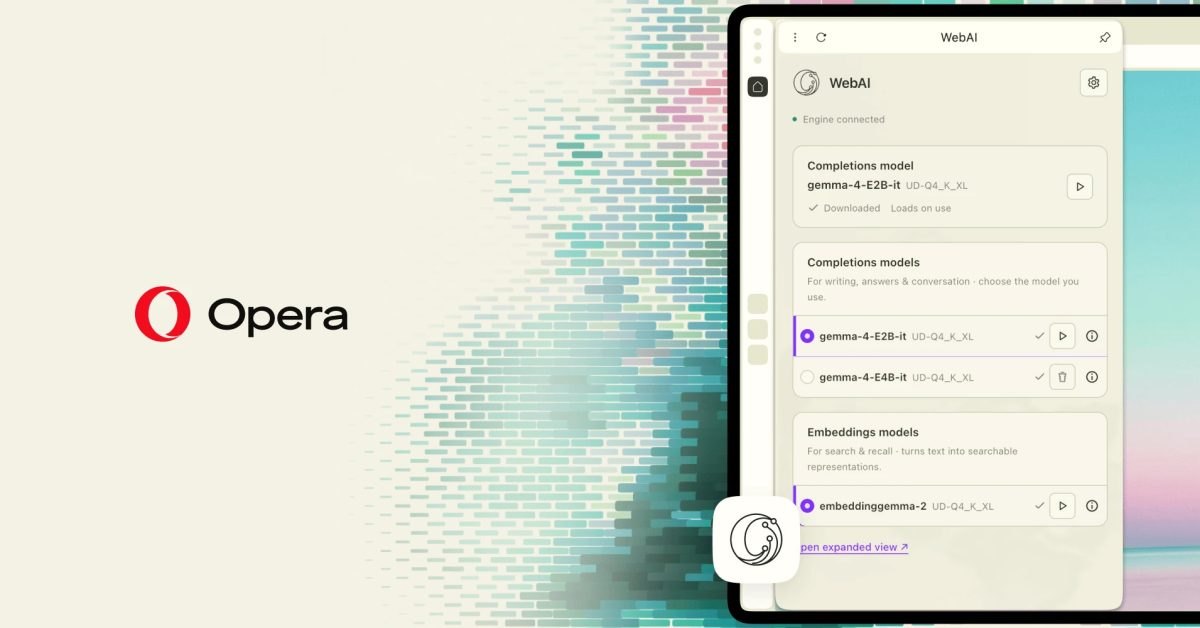
Websites and extensions in Opera One can call a model that runs on the computer. WebAI is the proposed standard for that call. Opera says sites and extensions use AI hosted through the browser, and its implementation is model-agnostic and built around open models, with a choice among providers. At launch those providers are Google and Apple: Google's Gemma, and Apple's on-device foundation model on a Mac. WebAI can generate text, classify content, and identify relationships between pieces of information.
The preview is opt-in, no subscription is required, and the user controls which websites can access the local models. Developers can add AI features without running AI infrastructure and without paying for every request. Information the local AI handles stays on the device, and the user stays in control of the AI on the computer. An extension could sort tabs, flag clickbait, or spot relevant job posts with no account, no fee, and no data sent to an AI service.
Advertisement
Tech Pulse Daily
Get tomorrow's pulse first
Join engineers who read Tech Pulse before stand-up. Free, weekday mornings.
Who should care about Opera One now lets Mac users run Apple’s
Opera One on a Mac is where both launch models are available. Apple's on-device foundation model is the Mac option, Google's Gemma is the Google model, and Opera says both run directly in Opera. The Apple model in this preview is for Macs. Opera GX and Opera Neon are not in the first release. Opera said Opera One is the first of its browsers with built-in access to local AI models, and that Opera GX and Opera Neon will follow.
Developers are the other group Opera addressed. Anyone can build on free, open-weight models, and developers can add AI features without running AI infrastructure or paying for every request. WebAI can generate text, classify content, and identify relationships between pieces of information. Opera's examples are extensions that sort tabs, flag clickbait, or spot relevant job posts, with no account, no fee, and no data sent to an AI service. The preview is opt-in, needs no subscription, and keeps that information on the device.
How to try Opera One now lets Mac users run Apple’s
The preview is in Opera One as of October 27, 2026. Opera called Opera One the first of its browsers with this access and said Opera GX and Opera Neon will follow, so the preview is not in those two browsers yet. The feature is opt-in, and Opera says no subscription is required. The user controls which websites can access the local AI models. Google's Gemma is available at launch. On a Mac, Apple's on-device foundation model is available directly in Opera as well.
Opera released a collection of example extensions for developers and users exploring WebAI. Its example sorts tabs, flags clickbait, or spots relevant job posts with a model on the laptop, with no account, no fee, and no data sent to an AI service. HTML-in-Canvas launched the same day. Webpage Bulldozer turns elements of a web page into physical objects. Gamer Room is a virtual 3D room whose screens display live web pages. Both demos work in Opera browsers without any additional setup.
What to watch after Opera One now lets Mac users run Apple’s
Opera GX and Opera Neon are the later browsers Opera named. Until they follow, the preview remains in Opera One, with Google's Gemma and, on Macs, Apple's on-device foundation model. WebAI is still a proposed standard. Opera said companies such as Google and Microsoft back it, and websites and extensions use it for local AI hosted through the browser on the device. The implementation stays model-agnostic and built around open models. The providers at launch are still Google and Apple.
HTML-in-Canvas launched on October 27, 2026. Maciej Kocemba, Product Director at Opera GX, said, "You can take a real web page and throw it into a 3D world, and everything still works: buttons, text, menus, all of it." He added, "We wanted users to get their hands on it early and see what they come up with." Developers use HTML and CSS to put interactive pages inside 2D and 3D scenes, and menus, buttons, and forms stay usable as they move.
Developer Action Items
- ☐ Verify the claim on the official Google / Apple / Microsoft page (or 9to5Mac), not from this recap alone.
- ☐ Name the surface that moved — API, policy, model, hardware, or commercial terms — before you Slack the thread.
- ☐ Assign one owner a day to read the primary material and decide: this-sprint, this-quarter, or noise.
- ☐ Do not change production on day-one coverage. Watch the vendor changelog and one independent write-up first.
Opera One now lets Mac users run Apple’s FAQ
Does Opera One run Apple's foundation model on a Mac?
Yes. On October 27, 2026, Opera One's preview gained Apple's on-device foundation model directly in Opera on Macs, through WebAI. Google's Gemma is available at launch as well.
Is Opera One's local AI preview a paid subscription?
No. Opera says the feature is opt-in and needs no subscription. An extension can sort tabs, flag clickbait, or spot relevant job posts with no account, no fee, and no data sent to an AI service, and the information the local AI handles stays on the device.
Which Opera browsers have the local-model preview?
Opera One is the first. Opera said Opera GX and Opera Neon will follow. At launch, the models are from Google and Apple, including Google's Gemma and, on Macs, Apple's on-device foundation model.
What can WebAI do in Opera One?
Opera says WebAI can generate text, classify content, and identify relationships between pieces of information. Websites and browser extensions reach a model running on the device, and the user controls which websites get that access.
What is HTML-in-Canvas?
Opera launched it on October 27, 2026 so developers can put real, interactive web pages inside 2D and 3D scenes with HTML and CSS. Menus, buttons, and forms stay usable as they move. Webpage Bulldozer and Gamer Room are the demos, and both work in Opera browsers without additional setup.
Sources

Author
Dillip Chowdary
Writes Tech Bytes coverage of AI, engineering, and the tools that actually ship. Editor of Tech Pulse Daily.
Related on Tech Bytes
Advertisement