The Download: a humanoid cleans house and Samsung builds for the AI boom
Tau Robotics deployed teleoperated cleaning robots in San Francisco as Samsung built its fifth Pyeongtaek fab amid an almost $2.5 trillion technology sell-off.
By Dillip Chowdary • Nov 07, 2026 • Source: MIT Technology Review
San Francisco startup Tau Robotics has begun deploying teleoperated humanoid cleaning robots directly into residential apartments, while semiconductor giant Samsung expands its chipmaking infrastructure in Pyeongtaek, South Korea, to supply specialized memory stacks for generative artificial intelligence models, according to MIT Technology Review's report. The physical testing of domestic robotics in private homes arrives alongside a massive industrial mobilization across global supply chains. At the same time, severe financial friction has struck the broader market, where almost $2.5 trillion was recently wiped off technology equities during the worst trading day for the Nasdaq since April 2025.
This report examines the operational realities of remote-piloted domestic robotics, the physical scale of semiconductor fabrication powering machine learning workloads, and the economic headwinds confronting technology leaders. It is intended for software engineers, hardware designers, operations managers, and enterprise strategists monitoring the transition from experimental artificial intelligence deployments to physical automation. Across domestic spaces, Korean manufacturing lines, and international financial markets, the infrastructure underpinning automated systems is confronting strict physical, operational, and capital boundaries.
A humanoid cleans house and Samsung builds: what actually changed
Tau Robotics shifted domestic humanoid testing into active customer residences across San Francisco by opening a customer waitlist on X for apartment cleaning sessions. The operational unit that arrived at testing locations utilized remote human operators rather than full onboard autonomy, relying on continuous camera feeds to direct the robot through cleaning routines. The deployment represents an intermediate engineering bridge designed to capture physical domestic training data while providing an immediate cleaning service, even as autonomous software models remain insufficient to manage messy domestic spaces independently.
Across the Pacific, Samsung accelerated construction on its sprawling manufacturing campus in Pyeongtaek, located south of Seoul, to address unrelenting demand for high-performance memory chips required by generative models. Three fabrication plants at the Pyeongtaek hub are already operating around the clock, while a fourth facility is coming online and thousands of workers are actively constructing a fifth fab. This manufacturing expansion represents one of the largest capital commitments to memory production in industrial history, scaling physical capacity to prevent bottlenecks in frontier artificial intelligence training pipelines.
A humanoid cleans house and Samsung builds: how it works
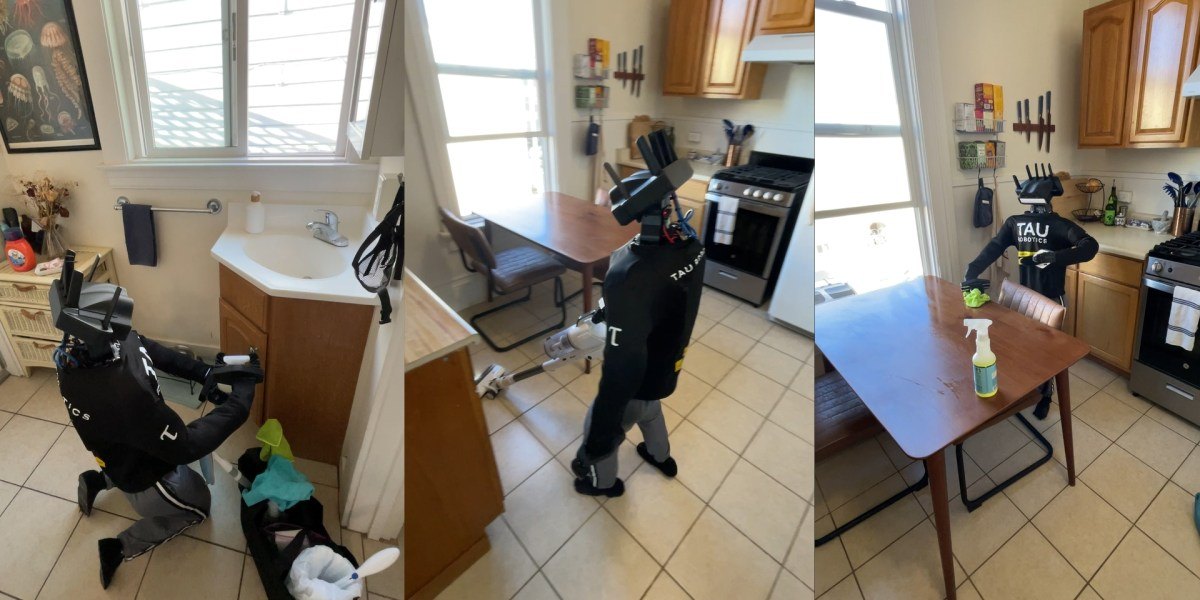
The Tau Robotics system functions through teleoperation hardware integrated into a humanoid form factor. Human pilots monitor the machine's surroundings remotely through onboard visual sensors and optical cameras, manually translating perceptual inputs into spatial movement and manipulator control. This architecture bypasses the current limitations of domestic object recognition and real-time planning, allowing operators to navigate unfamiliar apartment layouts, address physical obstacles, and handle household items while engineering teams gather real-world telemetry for future autonomous iterations.
Samsung's semiconductor operations in Pyeongtaek produce the dense stacks of specialized memory silicon that generative model accelerators require to move parameters and activations without latency stalls. The campus operates continuous, 24-hour cleanroom manufacturing across three existing fabrication plants, utilizing thousands of on-site construction workers to assemble the structural and utility foundations of the fifth fabrication line. By scaling cleanroom capacity across multiple concurrent mega-fabs, Samsung manufactures specialized memory dies at high density to supply global server clusters.
Advertisement
Tech Pulse Daily
Get tomorrow's pulse first
Join engineers who read Tech Pulse before stand-up. Free, weekday mornings.
A humanoid cleans house and Samsung builds: why it matters
These twin developments highlight the immense physical and capital requirements necessary to bring artificial intelligence into the real economy. Tau Robotics demonstrates that practical domestic robotics cannot yet rely purely on artificial intelligence agents, making human-in-the-loop teleoperation the only viable near-term path for handling delicate domestic chores. Meanwhile, Samsung's aggressive expansion demonstrates that software advancements remain entirely tethered to massive civil engineering and silicon fabrication efforts, demanding billions in physical investments south of Seoul simply to sustain current computing roadmaps.
However, this capital-intensive physical expansion is taking place against severe market instability. Investors wiped almost $2.5 trillion from technology equities during the Nasdaq's sharpest retreat since April 2025, with the Magnificent Seven shedding more than $1 trillion in market capitalization while Tesla and SpaceX lost over $420 billion combined. Ballast Rock Private Wealth senior wealth adviser Jim Carroll characterized the violent market reset by noting that the steamroller showed up as investors reassessed artificial intelligence revenue expectations, prompting sell-offs that quickly rippled across Asian and European exchanges.
A humanoid cleans house and Samsung builds: who is affected
Domestic service companies, consumer households, and hardware engineers are directly affected by the progress and shortcomings of humanoid deployments. Early adopters seeking automated housekeeping still encounter human teleoperators viewing their living spaces through cameras, underscoring ongoing privacy considerations and operational limitations in residential automation. In enterprise computing, hyperscale cloud operators and hardware teams depend directly on Samsung's Pyeongtaek fabrication output to avoid memory shortages, meaning any construction delays on the fourth and fifth fabs directly impact international data center capacity.
Broader technology enterprises face simultaneous regulatory and legislative scrutiny alongside stock market contractions. In Washington, emboldened Democratic lawmakers are organizing congressional hearings with technology executives, with Senator Bernie Sanders advocating for a national moratorium on data center construction and Representative Yassamin Ansari proposing a legislative pause on advanced artificial intelligence development. These political initiatives, combined with data center neighborhood resistance, create substantial headwinds that could delay high-profile corporate transitions such as Anthropic's planned initial public offering.
A humanoid cleans house and Samsung builds: what to watch
Industry observers must track how quickly Tau Robotics can transition its cleaning units from teleoperated human control to autonomous execution, as continuous remote piloting presents clear unit-economic and privacy barriers. Concurrently, operational tracking will focus on the activation timeline of Samsung's fourth Pyeongtaek fab and construction milestones on the fifth facility. Analysts will measure whether memory manufacturing output can outpace cooling enterprise sentiment, particularly as researchers at Anthropic report that Claude models are accelerating the development of successor systems at nearly twice their previous speed.
Attention will also center on commercial infrastructure resilience and corporate realignments. US government agencies recently warned of an ongoing cyber threat targeting commercial freezers, while Russian officials issued public denials regarding involvement in the attacks. Meanwhile, Tesla has signaled the end of Cybertruck production, preparing to wind down manufacturing at its Texas facility next year following its status as a major market disappointment. Monitoring these operational adjustments alongside Capitol Hill data center hearings will determine whether physical artificial intelligence infrastructure can endure volatile market corrections.
Developer Action Items
- ☐ Verify the claim on the official Samsung page (or MIT Technology Review), not from this recap alone.
- ☐ Name the surface that moved — API, policy, model, hardware, or commercial terms — before you Slack the thread.
- ☐ Assign one owner a day to read the primary material and decide: this-sprint, this-quarter, or noise.
- ☐ Do not change production on day-one coverage. Watch the vendor changelog and one independent write-up first.
- ☐ Quote $2.5 trillion only if it appears in the primary source; otherwise leave the hole visible.
A humanoid cleans house and Samsung builds FAQ
What approach does Tau Robotics use to clean apartments?
Tau Robotics uses teleoperated humanoid robots piloted remotely by human operators who navigate apartments and manipulate objects through onboard camera streams, as fully autonomous domestic software is not yet capable of handling the tasks alone.
Where is Samsung expanding its artificial intelligence memory chip manufacturing?
Samsung is expanding its semiconductor manufacturing footprint at its Pyeongtaek campus south of Seoul, South Korea, where three fabrication facilities operate around the clock, a fourth is coming online, and a fifth is under construction.
How severe was the recent market sell-off across technology stocks?
The Nasdaq recorded its worst single-day performance since April 2025 as nearly $2.5 trillion was wiped off technology stocks, including over $1 trillion in losses across the Magnificent Seven and more than $420 billion lost between Tesla and SpaceX.
What legislative challenges are technology companies facing in the United States?
Congressional Democrats are preparing hearings for technology chief executives, while Senator Bernie Sanders has called for a national data center moratorium and Representative Yassamin Ansari has proposed pausing advanced artificial intelligence development.
Sources

Author
Dillip Chowdary
Writes Tech Bytes coverage of AI, engineering, and the tools that actually ship. Editor of Tech Pulse Daily.
Related on Tech Bytes
Advertisement