What Democrats Can Learn From New York’s Data Center Moratorium
New York's one-year data center moratorium set the stage for midterm battles as 20 gubernatorial candidates pledged development pauses across the country.
By Dillip Chowdary • Nov 01, 2026 • Source: Wired
In July, New York Governor Kathy Hochul enacted the nation’s first statewide moratorium on data center development through an executive order, establishing a one-year pause across the state while confronting mounting public pushback over grid capacity and environmental impacts, as detailed in Wired's report. The temporary freeze arrived two months after Hochul had publicly dismissed the concept, shifting state policy as newly mobilized community coalitions demand enforceable guardrails against large electrical loads.
This analysis details how New York’s executive moratorium operates, the friction between legislative mandates and executive discretion, and the broader electoral calculations facing policymakers nationwide. It provides utility planners, municipal leaders, technology developers, and policy analysts with factual reporting on administrative deadlines, regulatory limits, public polling results, and economic findings surrounding high-density digital infrastructure.
Democrats Can Learn From New York’s Data: what actually changed
New York’s pause officially took shape when Governor Kathy Hochul signed an executive order halting data center approvals for twelve months. The directive emerged as a compromise following action by the New York State Legislature, which had earlier passed an omnibus bill establishing a statutory one-year moratorium. While Hochul’s order established an immediate administrative pause, it bypassed several binding requirements contained in the legislative draft, prompting debate over the permanent regulatory framework for commercial compute facilities across the state.
The legislative omnibus bill, sponsored in the State Senate by Democrat Kristen Gonzalez, proposed more aggressive restrictions than the executive order. It established statutory caps on facility footprint and power consumption while directing the state Department of Environmental Conservation to conduct mandatory environmental impact reviews of data center operations. Hochul holds until the end of the year to sign or veto that legislative bill, and her executive staff maintains that the measure remains under formal administrative review.
Democrats Can Learn From New York’s Data: how it works
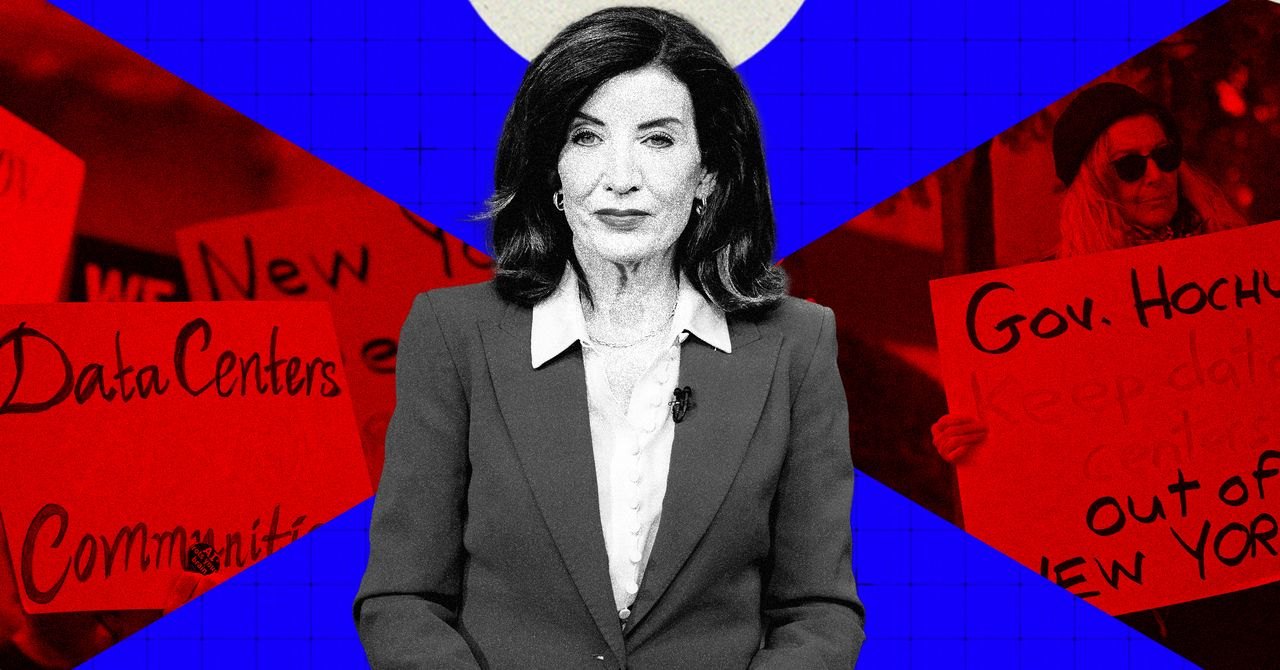
Under the executive order, state authorities paused active permitting while agency personnel assess baseline infrastructure constraints. In western Genesee County, grassroots organizer Adrienne Yocina spent two years challenging a proposed 600-megawatt data center planned near the Tonawanda Seneca Nation’s reservation and an adjacent federal wildlife refuge. Yocina expressed concern that without mandatory Department of Environmental Conservation involvement, the executive pause merely delays development rather than establishing permanent ecological protections for vulnerable local ecosystems.
State Senator Kristen Gonzalez conducted a statewide data center tour late in the summer, gathering feedback from residents living adjacent to active server facilities. Community members reported persistent noise and air pollution from backup diesel generation alongside steep spikes in local water and electric utility bills. At a Hudson Valley farm roundtable alongside Gonzalez and Representative Alexandria Ocasio-Cortez, Hochul outlined proposals to eliminate state tax breaks for data centers, asserting that local municipalities must retain the authority to reject incoming projects.
Advertisement
Tech Pulse Daily
Get tomorrow's pulse first
Join engineers who read Tech Pulse before stand-up. Free, weekday mornings.
Democrats Can Learn From New York’s Data: why it matters now
The political fallout from New York’s moratorium quickly influenced state and national campaign messaging. Ahead of Tuesday’s election, Hochul leveraged the pause against Republican challenger Bruce Blakeman, who had criticized the executive freeze as crazy when it was signed in July. A Quinnipiac poll indicated that 53 percent of New York voters trusted Hochul to manage artificial intelligence and data center expansion, compared to 31 percent who trusted Blakeman.
Public sentiment against large-scale digital infrastructure extends beyond New York’s gubernatorial contest. A September Siena poll found that 63 percent of New Yorkers oppose local data center construction even after the current moratorium expires, an objection that rises to 75 percent among registered Democrats. Research compiled by government relations firm MultiState shows at least 20 gubernatorial candidates across the country pledged data center moratoria or pauses, while incumbents including Pennsylvania Governor Josh Shapiro and Texas Governor Greg Abbott announced plans for tighter industrial oversight.
Democrats Can Learn From New York’s Data: who is affected
Local residents surrounding proposed infrastructure hubs represent the primary organizers driving policy intervention. In rural upstate communities, organizers such as Yocina—a mother of three who had never participated in municipal voting before the Genesee County proposal—mobilized neighborhood groups to redirect economic development away from hyperscale facilities. After her youngest son enlisted in the Army following an unsuccessful regional job search, Yocina’s group shifted its mandate toward recruiting diverse industrial employers that offer broader local employment.
Economic research underscores the limited employment yields that data centers provide host municipalities. A study published by two real estate and urban economics professors in The Conversation revealed that server farms generate modest hiring gains in transportation and warehousing, but fail to produce downstream job growth for retail, dining, or neighborhood service establishments. Despite those modest labor returns, political advertisers invested $12 million into campaign commercials focused on data center development during a 90-day window leading into the midterm elections.
Democrats Can Learn From New York’s Data: what to watch
Resource constraints are forcing tech operators to disclose significant financial and logistical liabilities tied to power sourcing. In recent initial public offering disclosures, artificial intelligence developer Anthropic warned investors that its strategy to construct proprietary data centers creates material financial risks due to its heavy reliance on natural gas, which threatens to inflate fuel prices and tighten national gas supplies. Concurrently, regional reporting by Gaby Del Valle in The Verge highlighted severe water resource strains caused by high-density compute facilities in Arizona.
Heading into January, newly elected governors who campaigned on regulatory promises must determine whether to execute formal pauses or permit utility expansion. In New York, the primary benchmark remains whether Hochul signs the legislative omnibus bill before the year ends, binding the Department of Environmental Conservation to statutory oversight. Siting decisions will hinge on whether state officials can balance national compute demand against communities seeking statutory veto power over heavy grid infrastructure.
Developer Action Items
- ☐ Verify the claim on the official Framework page (or Wired), not from this recap alone.
- ☐ Name the surface that moved — API, policy, model, hardware, or commercial terms — before you Slack the thread.
- ☐ Assign one owner a day to read the primary material and decide: this-sprint, this-quarter, or noise.
- ☐ Do not change production on day-one coverage. Watch the vendor changelog and one independent write-up first.
Democrats Can Learn From New York’s Data FAQ
What is New York's data center moratorium?
In July, Governor Kathy Hochul issued an executive order establishing a one-year pause on data center development across New York state.
How does the executive order differ from the state legislature's omnibus bill?
The omnibus bill sponsored by State Senator Kristen Gonzalez establishes strict facility size limits and mandates environmental reviews by the Department of Environmental Conservation, whereas the executive order lacks those statutory requirements.
What do polls show regarding voter support for data centers?
A September Siena poll found that 63 percent of New Yorkers, and 75 percent of New York Democrats, oppose data centers in their communities even after the moratorium expires.
What economic impact do data centers have on local communities?
Academic research indicates data centers create modest jobs in warehousing and transportation, but do not spur employment in local services like restaurants or retail.
Sources

Author
Dillip Chowdary
Writes Tech Bytes coverage of AI, engineering, and the tools that actually ship. Editor of Tech Pulse Daily.
Related on Tech Bytes
Advertisement