World-Model MCP for Finance news update news update
Ergen launched a financial relationship graph and Model Context Protocol server that tracks multi-hop risk vectors and alignment shifts across market entities.
By Dillip Chowdary • Nov 07, 2026 • Source: ergen.ai
Financial intelligence startup Ergen launched a risk and interactions data platform paired with a Model Context Protocol server designed to feed structured relational graphs directly into AI agents, according to ergen.ai's report. The system quantifies, indexes, and scores interactions between public companies, executives, suppliers, investors, and state regulators rather than treating market exposure as isolated balance sheet holdings. By packaging graph pathfinding, alignment tracking, and anomaly detection into an HTTP-based MCP endpoint at https://app.ergen.ai/mcp alongside a REST API and web dashboard, the company provides automated trading desks, risk analysts, and autonomous agents with real-time traversal across supply chains, litigation records, and institutional ties.
This release covers how Ergen structures financial relationships and exposes them programmatically for hedge funds, prop desks, geopolitical analysts, and compliance teams. Operating in private alpha, the infrastructure allows autonomous models such as Claude, GPT, Gemini, and Kimi to inspect how counterparty distress or political realignments propagate across multiple degrees of separation. For quantitative analysts, multi-strat investment teams, and due diligence investigators, the platform translates abstract corporate networks into structured API responses, enabling algorithmic research pipelines to identify latent systemic exposure before material events appear in periodic regulatory filings.
World-Model MCP for Finance news update: what actually changed
Ergen built an index that monitors pairwise entity relationships by logging and scoring every recorded corporate action, public statement, capital transaction, and regulatory event over time. Instead of relying solely on keyword search or flat financial feeds, the platform indexes historical interactions into an alignment time series where relational shifts receive numerical scores between positive one and negative one. An integrated Model Context Protocol server exposes these tools under the server identifier ergen via standard JSON configuration, allowing developers to configure the HTTP connection directly in an agent project root.
The platform also introduced programmatic query systems named StreetQuery, DeepQuery, and What-If Impact Propagation alongside an authenticated REST API. In REST benchmarks, Ergen demonstrated pathfinding queries returning multi-hop entity chains, relationship classifications including family and professional links, and confidence scores ranging between 0.88 and 0.94 in 0.6 seconds. The entire stack is accessible either through Ergen's web dashboard or by having client AI agents call tools for entity lookup, trajectory traversal, and morning watchlist routines without custom integration code.
World-Model MCP for Finance news update: how it works
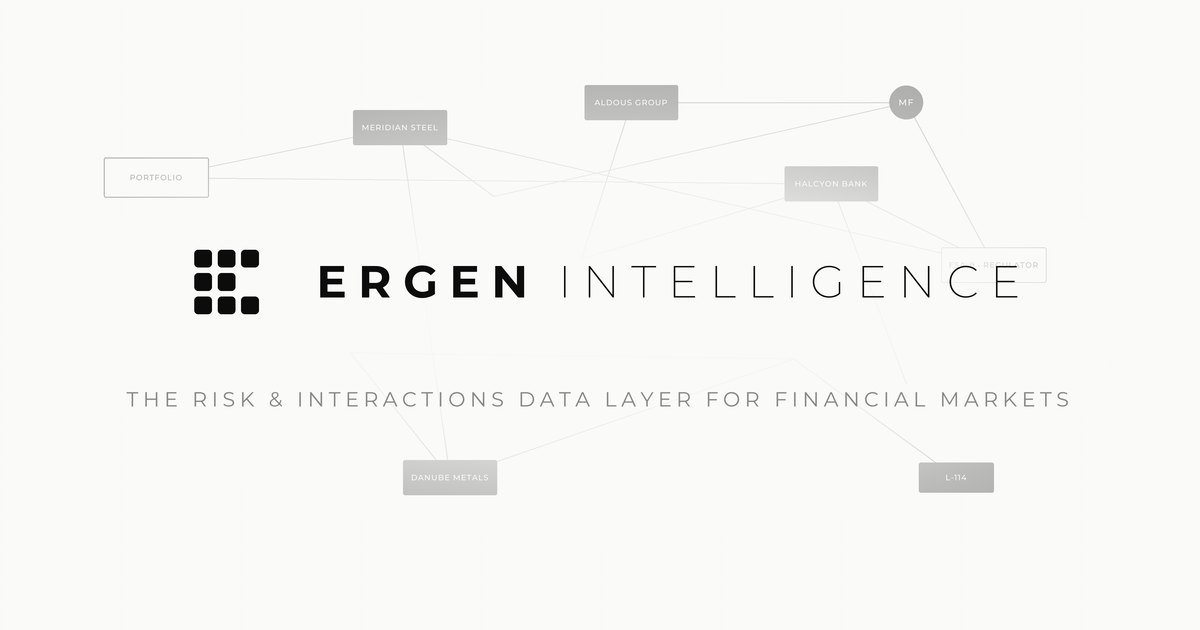
At the data layer, Ergen establishes an interaction graph connecting corporations, executives, suppliers, board members, and government regulators across chains up to six hops away. When an analyst runs StreetQuery, the system translates abstract relationship criteria into matching real-world entity sets, such as identifying public company executives with financial ties to their industry overseers or flagging chief executives experiencing alignment drops with board members. DeepQuery acts as an automated research harness with native database access, traversing leads across counterparties and returning verified research briefs directly to callers.
For predictive modeling, the platform uses What-If Impact Propagation to simulate hypothetical stress scenarios. Users submit a simulated event between two entities, prompting a model swarm to evaluate and propagate downstream shocks across customer networks, supplier dependencies, and shared ownership stakes. Furthermore, anomaly detection tools scan trailing baselines to flag entities exhibiting two-sigma spikes in negative-interaction volume, while automated monitoring routines can monitor watchlists overnight and dispatch email or Slack alerts whenever counterparties or clients face lawsuits.
Advertisement
Tech Pulse Daily
Get tomorrow's pulse first
Join engineers who read Tech Pulse before stand-up. Free, weekday mornings.
World-Model MCP for Finance news update: why it matters
Traditional financial terminals and equity research workflows focus primarily on reported metrics, direct counterparty disclosures, and direct supply contracts, often missing secondary and tertiary vectors of exposure. By indexing relationship paths up to six hops removed, Ergen quantifies how executive scandals, regulatory investigations, and state interventions ripple through holding companies and unlisted intermediaries. In an internal cross-model consensus evaluation against Deep Research runs conducted by Claude Fable, GPT 5.6 Sol, Gemini 3.1 Pro, and Perplexity, Ergen reported that its specialized agent outperformed general frontier models on relational research tasks.
Exposing this dataset through the Model Context Protocol changes how quantitative researchers and autonomous trading systems conduct due diligence. Rather than spending a full week manually reviewing regulatory filings, corporate registries, and court dockets to unearth hidden ties, an agent connected to Ergen can resolve multi-hop structural queries in sub-second API requests. This speed eliminates cost penalties for asking open-ended investigative questions, enabling continuous portfolio risk assessment across fast-moving geopolitical events, sudden supply chain choke points, and executive turnover.
World-Model MCP for Finance news update: who is affected
The service directly targets buy-side hedge funds, proprietary trading desks, and multi-strategy asset managers looking to detect sentiment shifts and competitive maneuvers before they appear in quarterly regulatory disclosures. Portfolio managers can track sudden reversals in counterparty alignment over twelve-month horizons, using the graph to uncover indirect ownership links or supplier disruptions that could impair portfolio holdings. By identifying structural vulnerabilities early, trading desks can hedge exposure or adjust position sizing before market consensus prices in the counterparty risk.
Geopolitical analysts, government think tanks, and legal compliance departments are also direct users of the infrastructure. Due diligence officers at banks and brokerages can trace corporate affiliations through intermediaries and shell entities, surfacing exposure to sanctioned figures that standard name-matching databases miss. Geopolitical specialists can map how state influence travels across international borders through overlapping business, family, and institutional connections, giving policy researchers and sovereign risk desks a tool to observe regional influence patterns before political disputes escalate into diplomatic headlines.
World-Model MCP for Finance news update: what to watch
Ergen is operating in an alpha phase while reviewing access requests from investment institutions, risk and compliance groups, and specialized research firms. Observers should track developer adoption of its beta HTTP MCP endpoint across autonomous agent frameworks, specifically whether production trading firms deploy the MCP server directly within automated model swarms or rely primarily on authenticated REST endpoints. Future pricing tiers and commercial terms will indicate how Ergen plans to scale access beyond closed institutional trials.
Industry watchers should also monitor the operational accuracy and false-positive rates of Ergen's anomaly detection and relationship scoring algorithms during live market stress. Key benchmarks will include how effectively the platform's two-sigma interaction spikes and What-If propagation models anticipate real-world defaults, regulatory enforcement actions, and corporate breakups. As agentic finance workflows expand, performance comparisons between standalone frontier foundation models and domain-specific relational graphs will determine whether dedicated interaction layers become standard infrastructure for financial market intelligence.
Developer Action Items
- ☐ Verify the claim on the official Claude / Gemini page (or HN AI Agents), not from this recap alone.
- ☐ Name the surface that moved — API, policy, model, hardware, or commercial terms — before you Slack the thread.
- ☐ Assign one owner a day to read the primary material and decide: this-sprint, this-quarter, or noise.
- ☐ Do not change production on day-one coverage. Watch the vendor changelog and one independent write-up first.
World-Model MCP for Finance news update news FAQ
What is Ergen?
Ergen is a financial intelligence and risk data platform that indexes and scores interactions, relationships, and alignment between companies, executives, suppliers, and regulators.
How does Ergen connect to AI agents?
Ergen provides an HTTP-based Model Context Protocol server at https://app.ergen.ai/mcp alongside a REST API, allowing models like Claude, GPT, Gemini, and Kimi to call its graph tools natively.
What features are included in Ergen's toolset?
The platform includes StreetQuery for schema-based entity searches, DeepQuery for end-to-end research briefs, What-If Impact Propagation for stress testing, anomaly detection for two-sigma interaction spikes, and multi-hop pathfinding up to six hops.
Sources

Author
Dillip Chowdary
Writes Tech Bytes coverage of AI, engineering, and the tools that actually ship. Editor of Tech Pulse Daily.
Related on Tech Bytes
Advertisement