After printing 40,000 whistles, this is the 3D printer I’d buy
Bambu Lab's P2S Combo cuts maintenance with quick-swap hotends and sealed multi-spool storage, proving its durability after 1,692 test hours and 40,000 prints.
By Dillip Chowdary • Nov 07, 2026 • Source: The Verge
Bambu Lab has positioned the P2S Combo as a fully enclosed, automated-material 3D printer designed to eliminate the manual calibration and maintenance friction common to consumer desktop fabrication. The machine features an integrated touchscreen, automated multi-spool feeding, and an enclosed chamber that regulates printing temperatures across technical materials. Priced at a normal retail rate of $749 and discounted to $649 through December 1st—available at Best Buy for $650 and direct from the manufacturer—the system pairs the core printer chassis with the Automated Material System. Long-term durability and hardware performance metrics were documented across 6,770 hours of testing across four separate machines in The Verge's report, providing real-world operational benchmarks after producing 40,000 alert whistles for community organizers.
This evaluation examines mechanical reliability, filament management, long-term maintenance overhead, and total operating cost for prospective buyers seeking a hands-off manufacturing tool. The machine addresses makers, home fabricators, and small-batch production operators who want reliable multi-color or multi-material printing without bed leveling, manual tensioning, or complex nozzle rebuilds. By assessing hardware endurance across 1,692 hours of dedicated P2S run time alongside competing hardware from Elegoo and earlier Bambu generations, this breakdown provides prospective buyers with component wear data, jam clearance requirements, and clear comparisons against lower-priced alternatives.
After printing 40: what actually changed
Physical iterations from earlier desktop designs center on user intervention points, chamber maintenance, and routine hotend serviceability. Compared to the older P1P and P1S platforms, the P2S incorporates a full-color built-in touchscreen interface that handles print jobs and filament spool configurations directly at the machine. The internal build volume features an integrated alignment guide that seats the removable magnetic build plate correctly every time, backed by automatic sensor detection that aborts the job if an operator forgets to reinstall the sheet. Beneath the bed, the enclosure floor slopes downward into a smooth ramp, allowing plastic purge pellets and loose debris to be swept out without dismantling internal panels.
Thermal control and mechanical servicing have also undergone significant structural changes. Bambu Lab installed active chamber ventilation on the P2S, permitting high-temperature PLA printing with the front glass door and top lid sealed shut rather than propped open to prevent heat creep. At the motion gantry, smooth stainless steel linear rods replace earlier rail setups for quicker residue wiping and lubrication. The hotend assembly dispenses with legacy mounting bolts and loose heater wiring entirely, switching to a quick-swap cartridge secured by an elastomeric gasket and a single metal spring clip that can be detached with mini pliers in under sixty seconds.
After printing 40: how it works
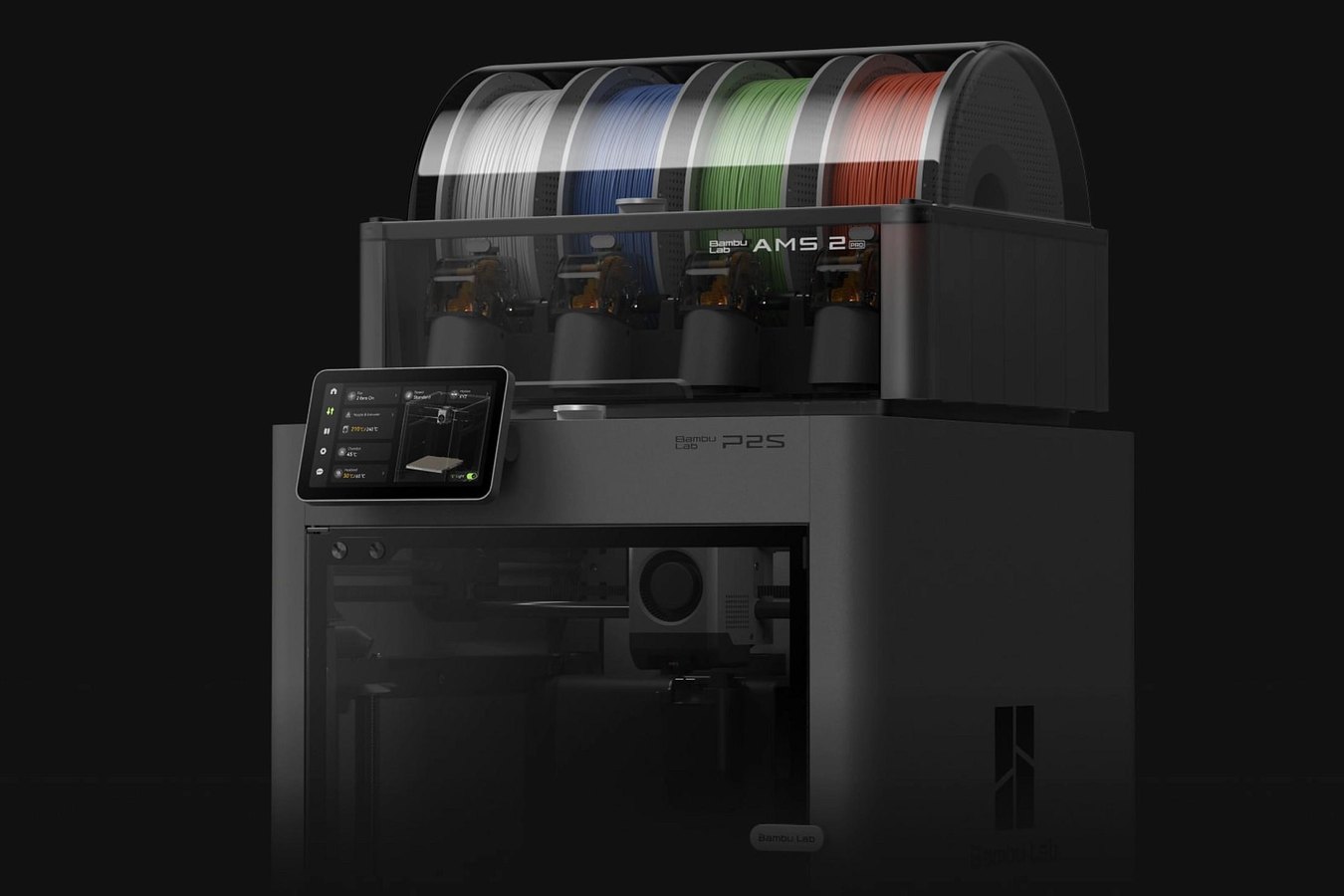
Automated operation relies on the enclosed Automated Material System, designated as AMS 2, working alongside an automatic calibration routine. Users select pre-sliced models through Bambu's cloud mobile app or desktop suite, transmitting print commands remotely over local networks. The machine executes automated vibration compensation and dynamic bed leveling before feeding filament through reverse Bowden tubes into the toolhead. Once a job wraps, the toolhead automatically shears the filament strand, retracts the leftover line into the sealed AMS casing, and winds the spool tidy for storage. The chamber's integrated video camera streams print progress and automatically records timelapses under bright interior lighting.
Multi-spool management solves material degradation by housing four filament spools in a sealed, desiccated container while routing lines through independent drive gears. The sealed compartment stops hygroscopic materials like PLA from absorbing ambient humidity, keeping strands pliable over months of idle storage instead of turning brittle and fracturing within feed tubes. The revised AMS 2 unit incorporates accessible internal channels, letting users extract broken filament fragments without completely disassembling the internal drive gears. Operators needing higher volume or additional color complexity can link an auxiliary second AMS module for eight-material printing or mount a fifth single spool on a rear external spindle.
Advertisement
Tech Pulse Daily
Get tomorrow's pulse first
Join engineers who read Tech Pulse before stand-up. Free, weekday mornings.
After printing 40: why it matters
Comparative bench testing across 6,770 total print hours reveals that sealed material storage and component service speed matter far more over multi-month print schedules than raw sticker price. Competing options like the $369 Elegoo Centauri Carbon 2 Combo deliver four-color automatic feeding for $280 less, yet store filament rolls out in the open on unsealed external spindles. Across 1,271 hours on an original Centauri Carbon and 939 hours on a Carbon 2, open rolls steadily pulled moisture from ambient air, producing line jams. Elegoo's spools also suffered spindle slippage, active cooling fans ran continuously even during idle standby, and low-fidelity chamber cameras made remote monitoring difficult.
Long-term durability and breakdown diagnostics further differentiate these platforms when hardware inevitably experiences wear and tear. Over 1,000 hours of concurrent side-by-side testing, the original Centauri Carbon's extruder suffered internal plastic gear erosion that accumulated dark dust, while a Carbon 2 suffered unrecoverable bed-leveling lockups after an unexpected nozzle crash. Rectifying that fault required dismantling the heated platform to reseat four fragile internal wiring harnesses. By contrast, 1,692 hours of P2S operation required only two nozzle replacements, routine rod lubrication, periodic washings of the textured build surface with dish soap, and routine clearance of minor AMS jams.
After printing 40: who is affected
Prospective buyers navigating the desktop 3D printing catalog face clear operational tradeoffs between initial cash outlay and ongoing maintenance labor. Hobbyists considering entry-level multi-color units like the Bambu A1 Combo, the Snapmaker U1, or the $369 Elegoo Centauri Carbon 2 save substantial upfront capital, but take on frequent manual labor. They must dry spools externally, mount reels before each session, and clear frequent feed jams. Users who run intermittent jobs benefit substantially from the P2S enclosure, which keeps loaded filament rolls dry and ready to print instantly without recurring setup overhead, preheating waits, or manual plastic feeding through chassis tubes.
Existing owners of Bambu's prior-generation P1P and P1S systems also face upgrade decisions as their hardware logs heavy run time. The $509 Bambu P1S Combo remains capable of identical print quality across thousands of production hours, but lacks the P2S platform's refinement. Servicing a worn nozzle on older designs or competing printers requires wrenching hot metal threads or spending $30 for complete wired hotends, whereas P2S toolless hotend assemblies cost $18 and install without electrical uncoupling. For high-volume makers churning out components around the clock, reduced service downtime quickly offsets the $140 price difference between the two systems.
After printing 40: what to watch
Hardware buyers must track ecosystem limitations and consumables before standardizing on the P2S platform. Lightweight cardboard spools can slip or buckle inside the AMS drive rollers, requiring owners to transfer filament onto reusable plastic Bambu spools or purchase spool refills from vendors like Sunlu, Elegoo, or Bambu. While the toolhead's revised wipe paddle and redesigned purge chute reduce plastic residue buildup, the machine remains a mechanical device requiring periodic rail grease, bed washing, and tension inspections. Prospective purchasers should monitor Bambu's product pipeline as community rumors discuss a leaked P3C model that could potentially introduce multi-toolhead switching.
Market dynamics and competitive pricing shifts heading into the holiday sales window will influence long-term platform value. Bambu Lab's promotional price of $649 runs through December 1st before returning to the standard $749 list price, placing it in direct competition with Elegoo's aggressive discounting and Bambu's own $509 P1S Combo. The open-source community continues to debate Bambu Lab's closed-source software architecture and commercial monetization practices. Nevertheless, the manufacturer's combination of airtight multi-roll storage, fast-swap maintenance hardware, and robust remote cloud orchestration maintains a distinct operational lead over budget-tier open-frame alternatives across extended high-volume production runs.
Developer Action Items
- ☐ Verify the claim on the official printing whistles printer buy page (or The Verge), not from this recap alone.
- ☐ Name the surface that moved — API, policy, model, hardware, or commercial terms — before you Slack the thread.
- ☐ Assign one owner a day to read the primary material and decide: this-sprint, this-quarter, or noise.
- ☐ Do not change production on day-one coverage. Watch the vendor changelog and one independent write-up first.
After printing 40 FAQ
How much does the Bambu Lab P2S Combo cost, and when does the sale end?
The Bambu Lab P2S Combo is on sale for $649 through December 1st ($650 at Best Buy), marked down 13 percent from its normal $749 retail price.
How does the P2S hotend replacement compare to competitors like Elegoo?
The P2S uses an $18 toolless hotend that swaps out in under a minute by pulling a gasket and opening a single spring clip, whereas Elegoo requires wrenching off hot nozzles or removing a $30 wired assembly with bolts.
Why is sealed filament storage important on multi-material printers?
Sealed storage keeps rolls of filament from absorbing airborne moisture over weeks or months, preventing brittle strands that break inside feed tubes and cause extruder jams.
What are the main upgrades on the P2S compared to the older P1S and P1P?
The P2S adds a built-in touchscreen, quick-swap hotends, magnetic build plate alignment guides with missing-plate detection, active chamber ventilation for PLA, a smooth ramp floor, and easier rod maintenance.
Sources

Author
Dillip Chowdary
Writes Tech Bytes coverage of AI, engineering, and the tools that actually ship. Editor of Tech Pulse Daily.
Related on Tech Bytes
Advertisement