Can a Radar-Equipped AC Actually Cut Your Power Bill?
Smart air conditioners from Samsung, LG, and Midea use millimeter-wave radar to track occupants and claim 30 percent power cuts as cooling demand surges.
By Dillip Chowdary • Nov 07, 2026 • Source: Wired
Major appliance manufacturers including Samsung, LG, Midea, Hisense, and Dyson have deployed millimeter-wave radar, optical sensors, and predictive algorithms across their latest air conditioning lineups to track occupants and direct airflow, according to Wired's report. The transition from basic room-wide climate control to targeted micro-cooling comes as buildings consume roughly 20 percent of global electricity for cooling and fans, generating 3 to 4 percent of total greenhouse gas emissions. The International Energy Agency projects cooling demand will rise by 1,600 terawatt-hours by 2035—an increase equivalent to the combined electrical consumption of Japan and South Korea—while the worldwide fleet of cooling units could expand to 5.5 billion appliances by 2050.
This analysis examines the mechanics, verified energy claims, and mechanical limitations of radar-guided residential air conditioners. It evaluates targeted cooling systems for homeowners and apartment renters seeking lower utility bills, while comparing sensor-driven power reductions against broader structural upgrades such as compact 120-volt heat pumps and low-global-warming-potential natural refrigerants like propane.
A Radar-Equipped AC Actually Cut Your Power: what actually changed
Residential air conditioning sensing has evolved from the crude passive infrared hardware first introduced by Mitsubishi Electric in 1994 and mid-2010s 3D infrared sensing into millimeter-wave radar networks that track individuals with millimeter-level precision. Throughout 2026, manufacturers rolled out targeted systems: Samsung released its Bespoke AI system in March, Dyson debuted its Find+Follow feature for the Purifier Cool fan in June, and Hisense, Dreo, and Midea introduced sensor-equipped models at IFA in September. LG integrated a 5-meter radar sensor into its DualCool AI unit to map everyday movement routines, while Hisense launched the Companion Living AC, which ingests smart home sensor data to pre-cool specific paths through a home before an occupant arrives.
Hardware makers pair these tracking arrays with automation routines that scale power draw based on physical occupancy. Dyson's Find+Follow platform uses a 17-point skeletal detection camera that maps head, arm, and shoulder coordinates on-device without facial recognition, oscillating up to 350 degrees between six occupants before dropping to a low-power Auto mode one hour after a room empties. Samsung's Bespoke AI WindFree Pro incorporates a motion radar sensor capable of tracking two people simultaneously, alternating between an AI Direct Wind blast and an indirect diffusion mode. Samsung also integrated wearable telemetry at IFA, allowing a Galaxy Watch or Galaxy Ring to detect sleep and switch the unit into Windfree Cooling overnight.
A Radar-Equipped AC Actually Cut Your Power: how it works
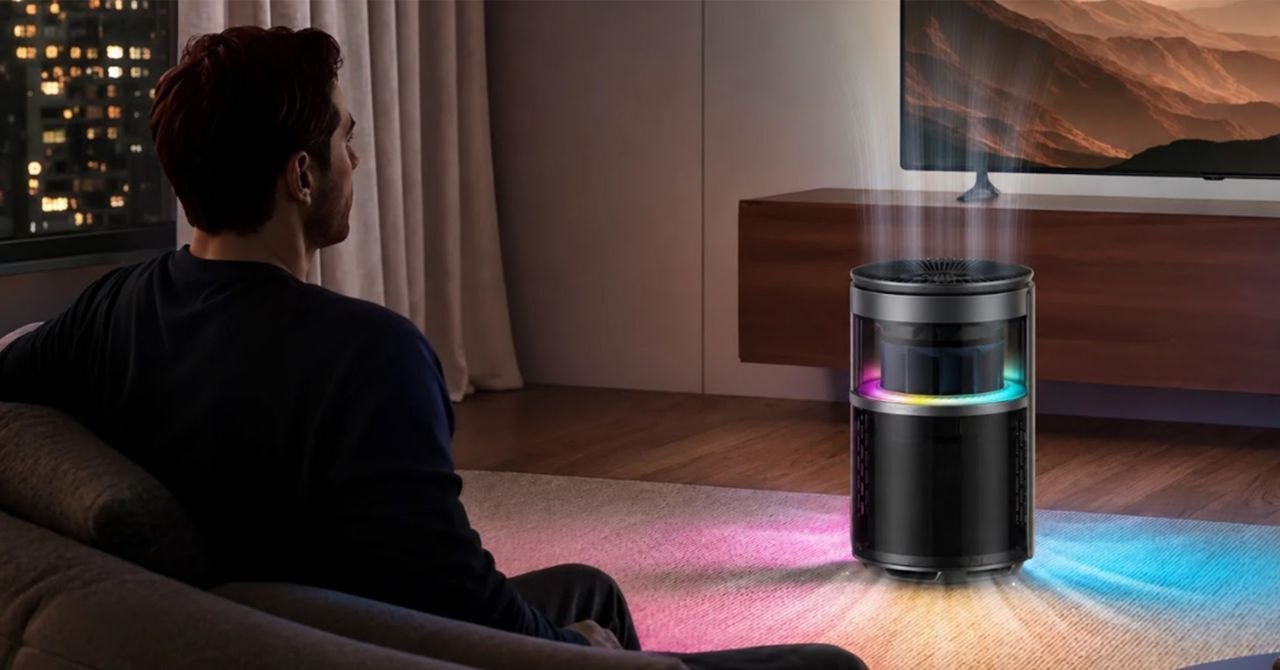
Targeted cooling relies on radio frequency hardware operating at short wavelengths between 1 and 10 millimeters, matching the high-frequency spectrum utilized in 5G cellular communication. In Midea's upcoming VitaBreeze AC, scheduled for release in early 2027, the system combines user-uploaded room setup photographs with millimeter-wave radar echoes to generate a 3D virtual grid of room boundaries and furniture locations. The radar transceiver continuously calculates the distance, angle, and micro-movements of occupants in the room. When an occupant shifts position, the Follow Me algorithm registers the spatial change and commands motorized louvers to redirect airflow directly at or away from the detected coordinates.
The underlying thermodynamic objective is reducing waste by chilling inhabited zones rather than entire cubic volumes of air. Björn Palm, senior professor in energy technology at the KTH Royal Institute of Technology in Stockholm, notes that localized cooling offers clear theoretical potential to lower total power draw, though real-world reductions depend on household habits. Samsung reports residential test figures showing up to 30 percent energy savings when running its overall AI energy mode. Similarly, Manuel Seethaler, head of residential air conditioning product strategy in Europe for Midea, claims its radar-driven algorithms cut cooling energy consumption by more than 30 percent compared to identical compressors operating without targeted direction.
Advertisement
Tech Pulse Daily
Get tomorrow's pulse first
Join engineers who read Tech Pulse before stand-up. Free, weekday mornings.
A Radar-Equipped AC Actually Cut Your Power: why it matters
Global cooling infrastructure faces severe environmental and grid pressures as baseline temperatures increase. Air conditioning units sold in 2024 operated roughly 20 percent more efficiently than models manufactured in 2014, yet efficiency gains struggle to offset rising global unit volume. Vincent Romanin, founder and chief technology officer of San Francisco-based window heat pump maker Gradient, argues that adding complex occupancy sensors to traditional air conditioning architectures produces diminishing returns. Romanin points out that while effective directional cooling provides an incremental boost, fundamental electrification retrofits can slash building energy demand by 85 percent, making a 2 percent marginal gain from tracking sensors far less significant in decarbonization efforts.
Achieving sustainable cooling by 2050 requires transforming underlying compressor mechanics rather than relying strictly on intelligent air direction. Refrigerant leaks from conventional cooling equipment currently emit approximately 720 million metric tons of CO2-equivalent greenhouse gases annually. Palm emphasizes that long-term climate targets require three structural industry shifts: manufacturing affordable, compact heat pumps designed for dense housing; engineering low-charge sealed systems to prevent leaks; and adopting climate-safe natural refrigerants like propane (R290), which Bosch brought to market in September with its Climate 6000iP. Because natural refrigerants are flammable, cooling equipment requires spark-free electrical engineering and strict mechanical safeguards before securing widespread regulatory approval in markets like the United States.
A Radar-Equipped AC Actually Cut Your Power: who is affected
The emergence of sensor-driven units directly impacts urban apartment tenants and residential homeowners confronting elevated summer electricity tariffs. For renters living in older buildings where central HVAC renovations are prohibited, window installations remain the primary cooling method. Gradient manufactures 120-volt all-weather window heat pump units that draw roughly one-third less energy than standard window air conditioners. These compact systems mount over window sills to preserve window glass access, reduce operating noise compared to traditional through-the-wall units, and handle both space cooling and heating without requiring electrical panel upgrades.
Consumers evaluating radar-equipped units must balance premium retail costs against actual field efficiency. While Dyson environmental care engineer Alex Hudson emphasizes that privacy concerns are mitigated by processing skeletal coordinates entirely on-device and deleting positional frames immediately, smart air conditioners demand increased technical setup. For example, Midea's VitaBreeze requires occupants to manually capture and submit multi-angle room photographs through an app to establish the baseline spatial grid. Buyers prioritizing absolute power reductions face a divided market: consumers can purchase sensor-heavy smart cooling appliances from LG, Samsung, and Midea, or invest in mechanically redesigned heat pump packages focused on structural compressor efficiency.
A Radar-Equipped AC Actually Cut Your Power: what to watch
The residential cooling market will see critical real-world validation tests throughout 2027 as next-generation appliances reach consumers. Midea's VitaBreeze will hit retail channels in early 2027, providing independent testing laboratories an opportunity to verify whether its mmWave grid and companion app achieve the manufacturer's claimed 30 percent power savings outside controlled environments. Observers will also track whether Samsung expands its wearable ecosystem to integrate non-Galaxy fitness trackers, assessing whether physiological sleep data reliably optimizes overnight compressor modulation across diverse residential layouts.
Long-term market trajectory depends on whether international regulatory bodies accelerate the transition to natural refrigerants while standardizing heat pump safety certifications. Engineering teams must refine spark-free compressor architectures so R290 propane units like Bosch's Climate 6000iP can overcome US supply chain hesitation and safety restrictions. As Palm outlines, resolving the global cooling crisis by 2050 will not depend on an air conditioner tracking someone across a room for a midnight snack. Instead, sustainable cooling hinges on scaling compact, quiet, low-cost heat pumps running non-synthetic working fluids through leak-resistant mechanical compressors.
Developer Action Items
- ☐ Diff the official changelog for Samsung 5.5 before you bump — APIs, defaults, and removed flags only.
- ☐ Install through the vendor's documented channel in staging; keep a one-command rollback and time-box the canary.
- ☐ Grep your repo for old flag names, lockfile pins, and plugin versions that the notes mark as breaking.
- ☐ Prefer the first patch cut over the day-zero tag unless you have a reason to be on the leading edge.
- ☐ If Wired did not name a region, plan, or SKU, screenshot the official availability line before you promise it to users.
A Radar-Equipped AC Actually Cut Your Power FAQ
Can a radar-equipped air conditioner reduce electricity bills?
Manufacturers like Samsung and Midea claim their radar-guided and AI-driven cooling modes can cut cooling electricity consumption by up to 30 percent by directing airflow specifically at occupants and lowering output when rooms are empty.
How do radar air conditioners detect people in a room?
Appliances like Midea's VitaBreeze and LG's DualCool AI use millimeter-wave radar sensors operating between 1 and 10 millimeters to calculate the distance, angle, and physical movement of occupants, adjusting motorized louvers to direct chilled air.
What alternative technologies provide larger household energy savings?
Compact 120-volt window heat pumps, such as units built by Gradient, consume roughly one-third less energy than conventional window air conditioners while providing both heating and cooling without requiring building electrical panel upgrades.
Why are natural refrigerants like R290 propane important for sustainable cooling?
Leaking synthetic refrigerants account for an estimated 720 million metric tons of CO2-equivalent emissions every year, and switching to natural alternatives like propane eliminates high global warming potential, though flammability requires low-charge, spark-free mechanical redesigns.
Sources

Author
Dillip Chowdary
Writes Tech Bytes coverage of AI, engineering, and the tools that actually ship. Editor of Tech Pulse Daily.
Related on Tech Bytes
Advertisement