GPT-6 Astra, Sol, and Luna: For production agents in Microsoft Foundry
Explore GPT-6 Astra, Sol, and GPT-6 Luna in Microsoft Foundry, with scalable model options for production AI agents, complex workflows, and high-volume tasks.
By Dillip Chowdary • Sep 24, 2026 • Source: Microsoft Azure Blog
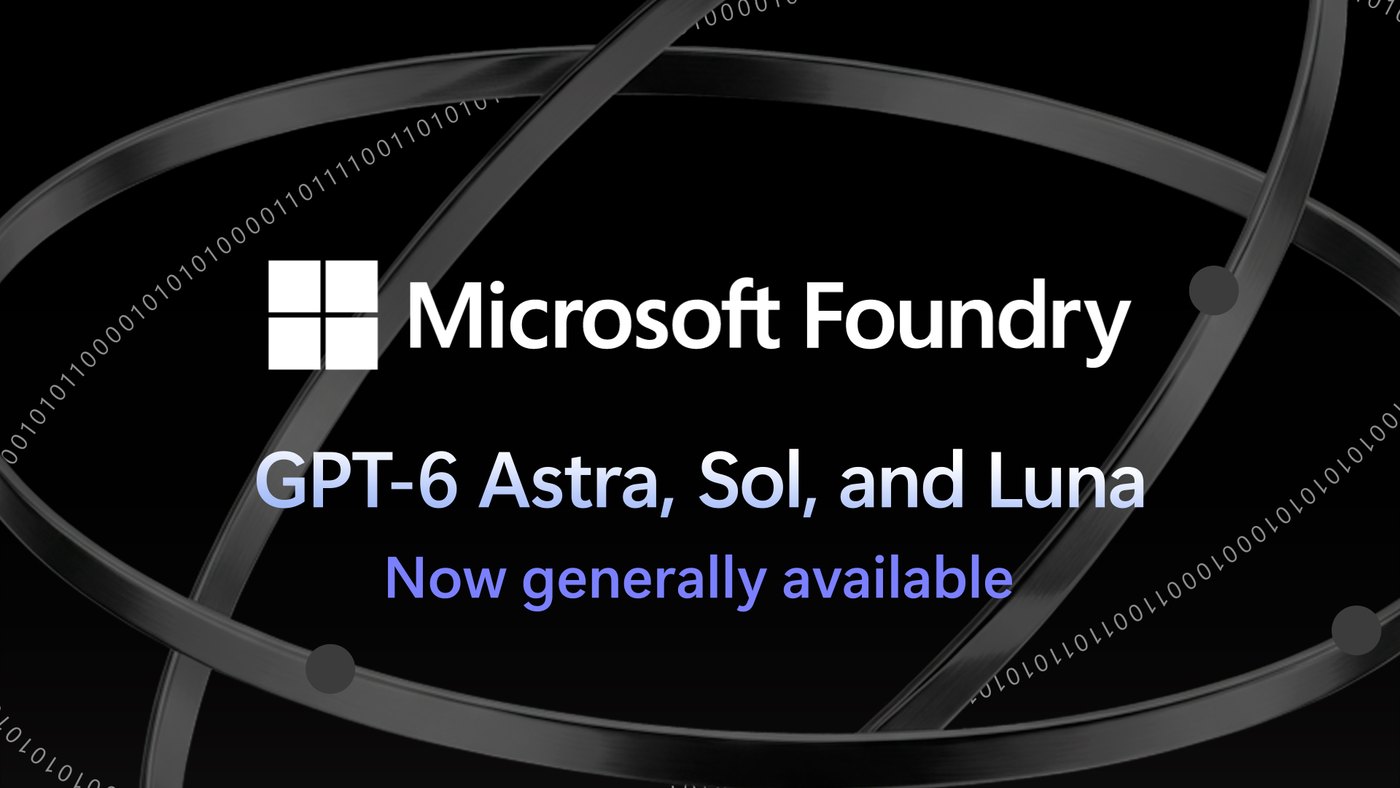
Microsoft shipped three new models under the GPT-6 family — GPT-6 Astra, GPT-6 Sol, and GPT-6 Luna — available now through Microsoft Foundry, the company's platform for building and deploying production AI agents and complex automated workflows. The release positions each model at a different point on the capability-and-cost spectrum, giving teams a tiered set of options rather than a single flagship to route every workload through.
This piece covers what differentiates Astra, Sol, and Luna at the model level, where each fits in a production agent stack, and what developers need to do to start using them in Azure AI Foundry today. It is written for engineers and architects who are already building on Azure and need a practical read on whether these models belong in their pipelines.
What shipped in GPT-6 Astra, Sol, and Luna
Microsoft launched all three GPT-6 variants through Azure AI Foundry, the same surface developers use to deploy, evaluate, and orchestrate AI agents at scale. Astra is positioned as the most capable of the three, suited to complex reasoning tasks and multi-step agentic workflows that require holding large context windows and chaining tool calls reliably. Sol sits in the middle of the family as a balanced option, targeting workflows that need strong reasoning without the full compute weight of Astra.
Luna rounds out the trio as the high-throughput, lower-latency model in the family, designed for high-volume tasks where response speed and cost per token matter more than ceiling capability. Together the three models allow a Foundry-based agent system to route tasks by complexity — sending long-horizon planning to Astra, mid-tier reasoning to Sol, and classification, summarization, or rapid-fire tool calls to Luna — without switching between unrelated model families.
What improved in GPT-6 Astra, Sol, and Luna
The GPT-6 family represents a step up from earlier GPT-4o-class models available in Azure in several dimensions, including benchmark performance, context handling, and agent-loop reliability. Microsoft has not published a full comparison table for all three variants at time of writing, so the table below reflects the structural tiers disclosed in the announcement rather than specific benchmark scores.
| Dimension | Previous generation | GPT-6 family |
|---|---|---|
| Model tiers available | Single flagship (GPT-4o) | Three tiers: Astra / Sol / Luna |
| Target workload | General purpose | Production agents, complex workflows, high-volume tasks |
| Routing granularity | Swap models manually | Tiered selection within one family |
Builders evaluating these models should run their own evals on the tasks they care about — latency under concurrent agent load, tool-call accuracy over long chains, and cost per successful workflow completion — before locking in which tier handles which traffic class.
What you gain from GPT-6 Astra, Sol, and Luna
Advertisement
Tech Pulse Daily
Get tomorrow's pulse first
Join engineers who read Tech Pulse before stand-up. Free, weekday mornings.
For teams running multi-agent systems in Foundry, the most immediate practical gain is intra-family routing. Because Astra, Sol, and Luna share a common training lineage and are served on the same Foundry platform, teams can move a request from one tier to another without renegotiating prompt formatting, tool schemas, or authentication. This reduces the engineering overhead of operating a heterogeneous model mix.
For high-volume pipelines specifically, Luna's throughput orientation means developers can handle bursts of parallel agent calls — document triage, extraction runs, or classification queues — without overprovisioning to a larger model. Astra's strength in complex workflows means that orchestration layers handling long-horizon planning or iterative reasoning now have a dedicated tier rather than defaulting to a general-purpose model and hoping it holds up over dozens of tool turns.
How to get GPT-6 Astra, Sol, and Luna
All three models are accessible through the Azure AI Foundry portal and via the Azure OpenAI Service API. Developers already using the openai Python SDK against an Azure endpoint can switch to any of the three variants by updating their deployment name. The following commands cover the most common access paths:
# Install or update the Azure CLI and AI extension
az extension add --name ml --upgrade# Swap to a GPT-6 tier by updating your deployment name in the client call
client = AzureOpenAI(
azure_deployment="gpt-6-astra", # or "gpt-6-sol" / "gpt-6-luna"
azure_endpoint=os.environ["AZURE_OPENAI_ENDPOINT"],
api_key=os.environ["AZURE_OPENAI_API_KEY"],
api_version="2024-12-01-preview",
)# Create a new deployment targeting a specific GPT-6 tier via CLI
az cognitiveservices account deployment create \
--name <your-resource> \
--resource-group <your-rg> \
--deployment-name gpt-6-luna \
--model-name gpt-6-luna \
--model-version latest \
--model-format OpenAI \
--sku-capacity 10 \
--sku-name StandardDevelopers should verify which specific model version strings Microsoft has registered in their region before deploying, as availability can roll out incrementally across Azure regions.
What to watch after GPT-6 Astra, Sol, and Luna
The open question for teams adopting the tiered family is routing logic correctness. Deciding at runtime whether a task belongs to Astra, Sol, or Luna adds a new failure mode: misclassification sends expensive tasks to Luna and wastes Astra capacity on trivial ones. Teams should instrument their orchestration layer to log which tier handled each request and track outcome quality by tier to catch routing drift early.
Microsoft's longer trajectory is also worth monitoring. Launching a named, tiered model family — rather than incrementing a single model version — signals that Foundry is moving toward a model-routing platform rather than a model host. Developers building on Azure today should expect future GPT-6 releases to extend the family with additional tiers or specialized variants, making the routing and evaluation infrastructure they build now a durable investment rather than a one-off integration.
Developer Action Items
- ☐ Diff the official changelog for Microsoft / Windows / Azure before you bump — APIs, defaults, and removed flags only.
- ☐ Install through the vendor's documented channel in staging; keep a one-command rollback and time-box the canary.
- ☐ Grep your repo for old flag names, lockfile pins, and plugin versions that the notes mark as breaking.
- ☐ Prefer the first patch cut over the day-zero tag unless you have a reason to be on the leading edge.
- ☐ If Microsoft Azure Blog did not name a region, plan, or SKU, screenshot the official availability line before you promise it to users.

Author
Dillip Chowdary
Writes Tech Bytes coverage of AI, engineering, and the tools that actually ship. Editor of Tech Pulse Daily.
Related on Tech Bytes
Gemini 3.8 text-to-speech models now available on AI Gateway
Read →
Claude Opus 5.5 now available on AI Gateway
Read →
OpenAI says Apple Intelligence users showed little interest in ChatGPT integration
Read →
Meta announces camera-free glasses, dedicated Muse AI gadget, more
Read →
Today's Tech Pulse briefing
Full briefing →
Advertisement