Indie App Spotlight: ‘CueFlip’ automatically turns the page for your sheet
CueFlip launched on iOS 16.4 with automatic sheet music page turning that listens to live playing, alongside a 20,000-term musical translation dictionary.
By Dillip Chowdary • Nov 07, 2026 • Source: 9to5Mac
Independent developer Yuze Pan, a 15-year-old classical guitarist based in Beijing, launched CueFlip, an application for iPhone and iPad that automatically turns sheet music pages by listening to live performance audio. According to 9to5Mac's report, the utility runs on iOS 16.4 and iPadOS 16.4 or later, featuring audio alignment, Face ID gesture recognition, and an integrated score translation lexicon.
This analysis details the operational mechanics, hardware configurations, and tiered pricing structure of CueFlip for solo performers, chamber musicians, and music students seeking hands-free score navigation. The overview examines how the listening engine tracks dynamic tempo changes, how facial gestures provide fallback control, and how feature restrictions separate the free application from the commercial Pro subscription.
Indie App Spotlight: what actually changed
The debut of CueFlip transforms standard digital score management by replacing physical touch inputs with autonomous audio observation. Classical musicians who perform with digital sheet music have traditionally faced disruption during complex pieces, where turning a page requires lifting a hand from an instrument or pressing an auxiliary foot switch. Pan developed the application after experiencing these continuous interruptions firsthand during performances with the Primal Guitar Quartet. Instead of requiring tactile triggers, the mobile application tracks performance audio through the device microphone, advancing digital pages autonomously when the music reaches specified markers.
Beyond its acoustic tracking core, the application integrates camera-based facial gesture detection alongside an extensive multilingual terminology engine. Performers who prefer non-audio inputs can trigger page turns using Face ID hardware, configuring eye winks to cycle forward or backward through musical documents. The platform also preserves compatibility with standard Bluetooth page turners for artists who rely on physical accessories. To demystify archaic and non-English performance directions, the system incorporates a reference dictionary containing more than 20,000 terms translated across up to 13 languages, pulling notations directly from imported or scanned scores.
Indie App Spotlight: how it works
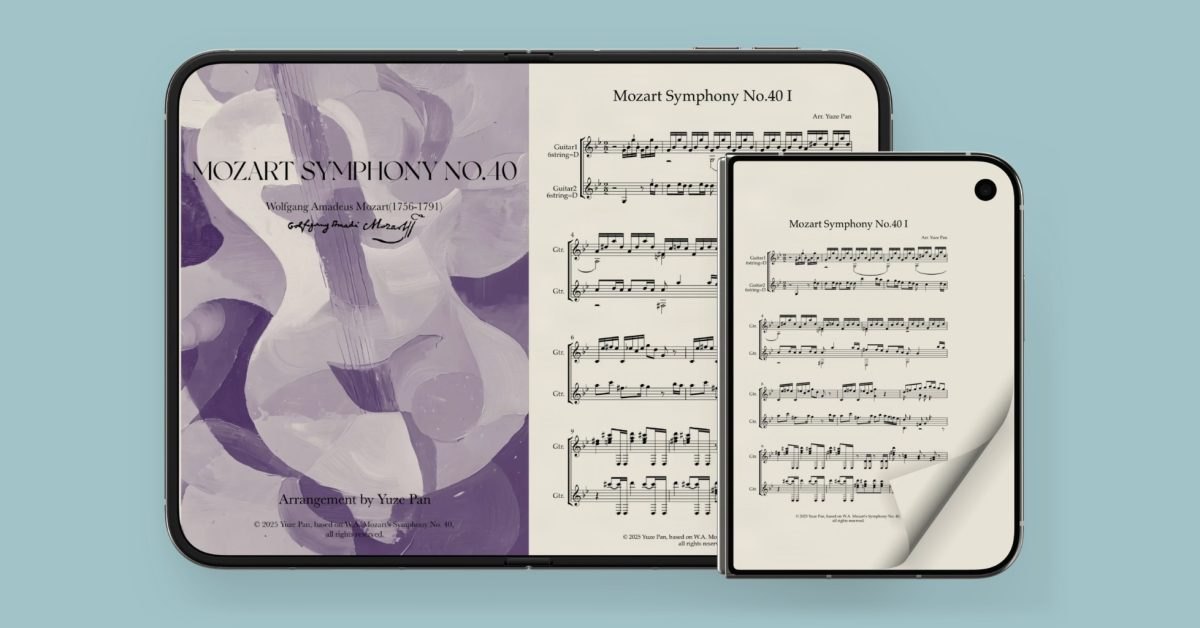
Operation begins with a calibration process where the musician explicitly instructs CueFlip how a piece will be interpreted. The user establishes this baseline either by executing a live rehearsal in front of the device microphone or by sharing a pre-recorded audio file with the app. During this review phase, the musician marks the exact points where page turns must occur. The software correlates these transition flags with acoustic data derived from published audio alignment research, mapping the temporal coordinates of the piece to prepare for dynamic execution during live performances.
During an active performance, the system continuously monitors the instrument audio to follow the player across tempo fluctuations. If an instrumentalist alters speed, the audio alignment engine dynamically tracks the shift, ensuring page turns execute at the designated acoustic cue rather than on an unyielding timer. If players choose optical controls, CueFlip utilizes the device camera and Face ID to register directional eye gestures: winking with the right eye advances the document forward, whereas winking with the left eye turns backward. External Bluetooth pedals remain fully supported as hardware fallbacks for traditional foot triggering.
Advertisement
Tech Pulse Daily
Get tomorrow's pulse first
Join engineers who read Tech Pulse before stand-up. Free, weekday mornings.
Indie App Spotlight: why it matters
The core value of CueFlip lies in solving the physical constraints of conventional sheet music reading during expressive instrumental performance. Manual page turning requires instrumentalists to sacrifice string contact or keyboard positioning, breaking artistic phrasing and risking dropped notes. Pan emphasized these practical burdens when designing the tool, noting that physical pedals or facial winks demand conscious effort during complex passages: "a pedal or a wink is one more thing to remember in the middle of a phrase, and timed turns can’t follow a performer who speeds up and slows down."
The development arc demonstrates how academic audio alignment literature can be translated into functional consumer software through iterative chamber testing. Pan initially attempted to build the application in 2025, but that preliminary release failed to deliver reliable tracking during actual playing. In May 2026, the developer resumed engineering from the ground up, studying academic papers on audio alignment and deploying successive builds directly into daily rehearsals with the Primal Guitar Quartet. This routine exposure to live polyphonic playing allowed Pan to refine the recognition algorithms against natural acoustic variations.
Indie App Spotlight: who is affected
The software directly impacts instrumental performers, chamber groups, and classical soloists who routinely navigate multi-page repertoire under performance pressure. Guitarists, pianists, and orchestral musicians encounter passages where pausing to swipe a screen or flip paper degrades rhythmic accuracy and disrupts collaborative balance. For chamber groups like the Primal Guitar Quartet, automated tracking eliminates stops during rehearsal runs, maintaining continuous ensemble momentum. Soloists who perform complex literature benefit from playing without diverting attention toward physical pedals or risking pedal misfires during live concerts.
The app also assists music students, educators, and scholars who regularly study multilingual scores featuring historical expressive terminology. Many classical compositions incorporate performance directions written in Italian, German, or French that students struggle to interpret without external references. CueFlip addresses this barrier through its 20,000-term dictionary and 13-language translation support, which identifies terms in scanned scores and imported PDFs. Students can access historical composer intent directly within their scores, avoiding external browser searches and keeping rehearsal sessions focused entirely on musical execution.
Indie App Spotlight: what to watch
Market adoption of CueFlip will depend largely on how performers respond to the platform's distribution model and platform constraints on the Apple App Store. The software is available for iPhone and iPad devices running iOS 16.4 or iPadOS 16.4 and subsequent releases. Apple users can access the base tier without charge, which provides PDF score viewing, markup annotations, and automated page turning restricted to one score. This single-score allowance gives musicians a risk-free trial to test whether acoustic tracking functions reliably within their specific practice spaces before making a financial commitment.
Expanding beyond the single-score limit requires a subscription to CueFlip Pro, priced at $4.99 per month or $29.99 annually. Subscribing unlocks unlimited automated page turning across full music libraries, access to the 20,000-term translation dictionary, and the Face ID eye-winking gesture controls. Analysts and musicians will watch whether Pan's acoustic listening model proves durable in crowded performance environments with ambient background noise, and whether the indie project can establish a lasting presence against established tablet sheet music readers in the broader mobile music software market.
Developer Action Items
- ☐ Verify the claim on the official iOS page (or 9to5Mac), not from this recap alone.
- ☐ Name the surface that moved — API, policy, model, hardware, or commercial terms — before you Slack the thread.
- ☐ Assign one owner a day to read the primary material and decide: this-sprint, this-quarter, or noise.
- ☐ Do not change production on day-one coverage. Watch the vendor changelog and one independent write-up first.
Indie App Spotlight FAQ
What devices and operating systems support CueFlip?
CueFlip is available for iPhone and iPad devices running iOS 16.4 or iPadOS 16.4 and later.
How does CueFlip turn sheet music pages automatically?
The application listens to acoustic instruments via the device microphone during live play, matching performance audio against marked cues established during rehearsal calibration.
What features are included in the free version versus CueFlip Pro?
The free tier includes PDF score viewing, markup annotations, and automatic page turning for a single score. CueFlip Pro costs $4.99 per month or $29.99 per year to unlock unlimited automated score turning, Face ID eye-winking controls, and a 20,000-term musical translation dictionary.
Can musicians use hardware controllers or gestures instead of audio tracking?
Yes, performers can advance pages forward or backward by winking their right or left eye via Face ID, or by connecting standard Bluetooth page-turning foot pedals.
Sources

Author
Dillip Chowdary
Writes Tech Bytes coverage of AI, engineering, and the tools that actually ship. Editor of Tech Pulse Daily.
Related on Tech Bytes
Advertisement