The Open-Sourcing of DeepSeek Harness Opens the Door to Modular, Unbundled
DeepSeek open-sourced DeepSeek Harness under the MIT license, delivering a modular Cordis-based execution runtime designed for customizable AI agent workflows.
By Dillip Chowdary • Oct 10, 2026 • Source: InfoQ
DeepSeek announced the developer preview release of DeepSeek Harness (dsh), an open-source execution runtime distributed under the MIT license for constructing autonomous artificial intelligence agents. Built on top of the Cordis meta-framework, the software was introduced alongside its GitHub repository and developer documentation to provide a decoupled alternative to tightly integrated agent execution environments. According to InfoQ's report, the system implements a micro-kernel architecture where functional units operate as isolated extensions rather than monolithic system modules.
This release targets engineers building agentic workflows who require modular control over model endpoints, sandboxing environments, and tool execution pipelines. By separating core execution logic from external integrations, the framework allows development teams to swap out individual components through declarative configuration files without rewriting underlying agent loops. The software recorded its initial public milestone with four distinct runtime profiles designed for varying operational needs from bare-bones shell sessions to full autonomous agent setups.
What Open-Sourcing of DeepSeek Harness Opens shipped
DeepSeek Harness version 0.1 preview ships with a micro-kernel engine that handles agent lifecycle events while loading external capabilities as dynamic plugins. Under this architecture, model adapters, tool registries, sandboxing environments, session state handlers, event dispatchers, and user interfaces function as interchangeable extensions. Developers can switch execution targets between remote API providers and local runtime servers by modifying YAML or JSON configuration files that define environment constraints and plugin dependencies.
The software includes an append-only event logging subsystem that writes every operational event into a unified execution trajectory. The trajectory captures user messages, tool invocations, intermediate reasoning states, token metrics, and sub-agent dispatch signals. This structured dataset gives engineers the ability to perform historical replays, isolate execution errors, benchmark model behaviors across runs, and evaluate decision pathways during development.
What changed for builders in Open-Sourcing of DeepSeek Harness Opens
The project unbundles traditional agent architecture into separate operational layers, giving developers direct control over how tools and models interact within an agent loop. Rather than binding an agent to a specific execution pipeline, engineers can adjust system behavior by updating declarative schemas. Early technical discussions across developer communities on Reddit's LocalLLaMA forum and GitHub Discussions have highlighted the framework's dynamic plugin registration and reactive lifecycle management features.
| Metric or Feature | Before Open-Sourcing | After Open-Sourcing | | System Architecture | Monolithic modules | Micro-kernel with isolated plugins | | Configuration Schema | Hardcoded logic | Declarative YAML or JSON definitions | | Event Logging | Fragmented outputs | Unified append-only trajectory system | | Runtime Profiles | Fixed setup | 4 baseline modes (Standard, Code, Minimal, Creator) |
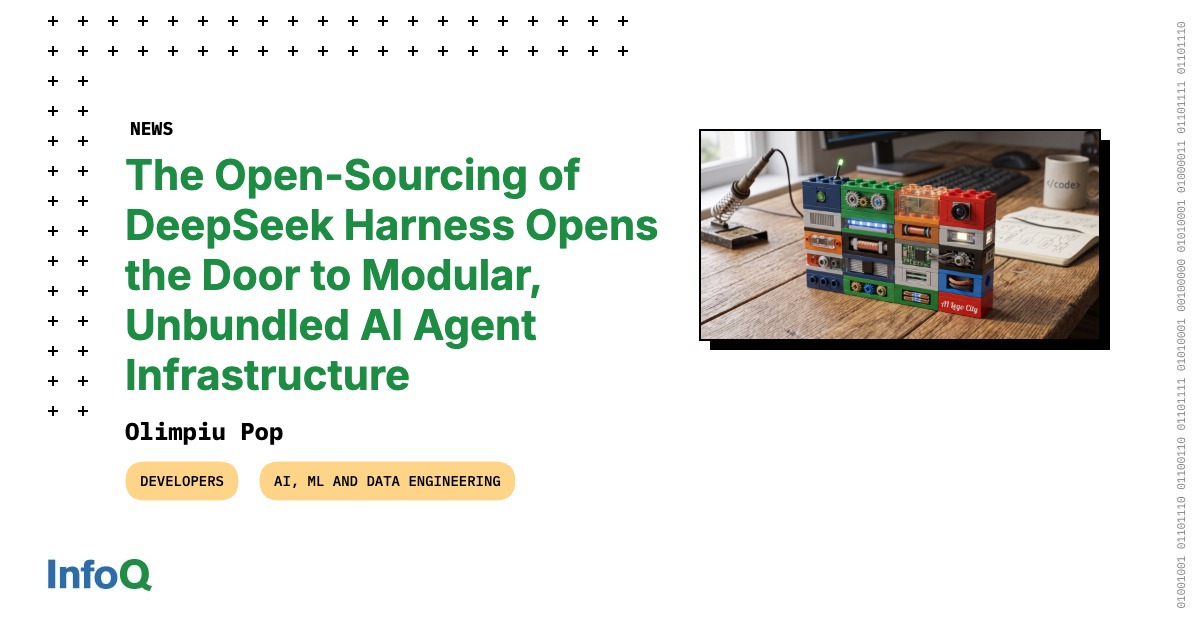
Version 0.1 preview defines four baseline operational profiles tailored to specific developer workflows. Standard mode exposes a full agent setup with shell execution and web retrieval capabilities. Code mode provides an SDK interface enabling models to execute multi-step tool calls in programmatic batches. Minimal mode restricts agent access to a persistent shell session and text-editing utilities, while Creator mode serves as a diagnostic environment specifically for testing new plugin configurations.
How to install or upgrade Open-Sourcing of DeepSeek Harness Opens
Advertisement
Tech Pulse Daily
Get tomorrow's pulse first
Join engineers who read Tech Pulse before stand-up. Free, weekday mornings.
Installing and updating DeepSeek Harness relies on package management tools and environment configurations detailed in the project's developer documentation. Developers can fetch the latest release from the repository and set up their environment using standardized commands.
npm install -g @deepseek/harness/model dsh-v0.1-previewdsh --model dsh-v0.1-previewexport DSH_DEFAULT_MODEL=dsh-v0.1-previewGotchas and compatibility in Open-Sourcing of DeepSeek Harness Opens
Because DeepSeek Harness is currently in an active developer preview phase, its extension contracts and API schemas remain subject to breaking changes across early releases. Developers building custom plugins must maintain their code against evolving specifications in the developer documentation. Long-term adoption of the framework will depend heavily on the stability of its plugin ecosystem, continuous API maintenance, and how seamlessly it integrates into existing software development pipelines.
System stability also relies on maintaining clean boundary lines between the Cordis meta-framework and third-party extensions. The append-only event logging system requires adequate storage management when running high-volume benchmark loops or complex sub-agent dispatches, as every intermediate reasoning step and token metric gets written to disk. Teams integrating local runtime servers alongside cloud API endpoints must ensure their custom model adapters adhere strictly to the micro-kernel interface definitions.
What to watch after Open-Sourcing of DeepSeek Harness Opens
Industry observers are monitoring how DeepSeek Harness progresses beyond its initial preview phase as community contributions shape its plugin registry. The transition toward modular, unbundled infrastructure marks a key trend in agent execution design, contrasting with closed, single-vendor frameworks. Future updates are expected to address plugin interface stability and expand compatibility with third-party developer tools.
Further evolution will depend on how effectively the project handles dynamic plugin loading under production workloads. As developers test Creator mode and build specialized model adapters, community feedback on GitHub Discussions will influence the stabilization of baseline APIs. Tracking version iterations beyond 0.1 preview will reveal whether the micro-kernel design gains traction across enterprise engineering teams.
Developer Action Items
- ☐ Diff the official changelog for Meta / GitHub / Framework 0.1 before you bump — APIs, defaults, and removed flags only.
- ☐ Install through the vendor's documented channel in staging; keep a one-command rollback and time-box the canary.
- ☐ Grep your repo for old flag names, lockfile pins, and plugin versions that the notes mark as breaking.
- ☐ Prefer the first patch cut over the day-zero tag unless you have a reason to be on the leading edge.
- ☐ If InfoQ did not name a region, plan, or SKU, screenshot the official availability line before you promise it to users.
Open-Sourcing of DeepSeek Harness Opens FAQ
What is DeepSeek Harness?
DeepSeek Harness (dsh) is an open-source execution runtime built on the Cordis meta-framework for constructing autonomous AI agents using a micro-kernel architecture.
What license is DeepSeek Harness released under?
The software is released under the MIT open-source license and includes its full source code alongside official developer documentation.
What are the four operational modes in version 0.1 preview?
Version 0.1 preview includes Standard mode for full agent capabilities, Code mode for programmatic SDK batching, Minimal mode for persistent shell editing, and Creator mode for plugin diagnostics.
How does DeepSeek Harness handle event logging?
It features an append-only event logging subsystem that records user messages, tool calls, token metrics, reasoning states, and sub-agent dispatches into a unified execution trajectory.
Sources

Author
Dillip Chowdary
Writes Tech Bytes coverage of AI, engineering, and the tools that actually ship. Editor of Tech Pulse Daily.
Related on Tech Bytes
Unlocking hidden revenue streams with market models
Read →
Astropad Workbench 1.3 adds faster streaming, privacy curtain, and more
Read →
Camera-equipped AirPods reportedly won’t launch in 2026, despite demo video leak
Read →
Hacking SAML with Claude Code
Read →
Today's Tech Pulse briefing
Full briefing →
Advertisement