ToyBlocks: A controlled world for robot learning and evaluation
The Allen Institute for AI released ToyBlocks, an open simulation framework that generates robot training demonstrations at 24 times real-time speed.
By Dillip Chowdary • Nov 07, 2026 • Source: Hugging Face Blog
The Allen Institute for AI launched ToyBlocks, an open simulation framework designed to serve as a controlled foundation world for robot learning and systematic evaluation. According to Hugging Face Blog's report, the project establishes a small tabletop environment featuring a robotic arm and wooden blocks to give engineers a verifiable setting for testing manipulation models. Instead of relying on manual teleoperation, ToyBlocks automatically synthesizes demonstration trajectories and task sequences by combining reinforcement learning with motion planning algorithms. The release provides the broader robotics community with open-source code, training datasets, pre-trained models, and documentation to systematically track why robotic systems succeed or fail.
This technical breakdown examines the architecture of the simulation pipeline, its synthetic data generation capabilities, and its role in resolving debates surrounding robot generalization. The framework is built specifically for robotics researchers, machine learning engineers, and developers testing vision-language-action policies or high-level reasoning models like Molmo 2. By constraining the physical scope to pushing, flipping, and stacking blocks marked with letters and images, the platform isolates variables that often complicate messy real-world demonstrations. Readers will learn how the system generates demonstrations at up to 24 times real-time speed, how high-level reasoning models pair with low-level execution controllers, and how controlled experiments reveal the true boundaries of robotic spatial reasoning.
A controlled world for robot learning: what actually changed
Robotic manipulation research has traditionally depended on human teleoperation to gather demonstrations for folding laundry, sorting warehouse items, or picking unfamiliar shapes. These unstructured real-world demonstrations are labor-intensive to collect, difficult to reproduce, and incapable of revealing why an action policy fails under slight environmental shifts. ToyBlocks introduces a foundation world framework that functions like a laboratory petri dish, allowing investigators to isolate variables, modify training data distributions, and rerun identical trials. By restricting the physical setting to a tabletop manipulation cell, the platform fulfills four technical requirements that open-ended simulations fail to balance: realistic physics and visual appearance, automated task and demonstration synthesis at scale, challenges integrating reasoning with dexterous manipulation, and comprehensive task coverage across the target domain.
The simulation shifts data generation from manual teleoperation to automated task-and-motion planning executed within Isaac Lab, Nvidia's open-source framework for simulated robot learning. By exploiting privileged simulator data, including ground-truth object coordinates and surface orientations, ToyBlocks trains reinforcement learning policies to master short-horizon manipulation behaviors without requiring manual human guidance. These non-prehensile behaviors include sliding a block across a surface or rotating it onto an adjacent face. The automated task planner then strings these primitive actions together into multi-step demonstration datasets while recording descriptive labels for each sub-action. This automated architecture generates and executes hundreds of coordinated plans simultaneously on a single graphics processing unit, reaching processing speeds up to 24 times real-time performance.
A controlled world for robot learning: how it works
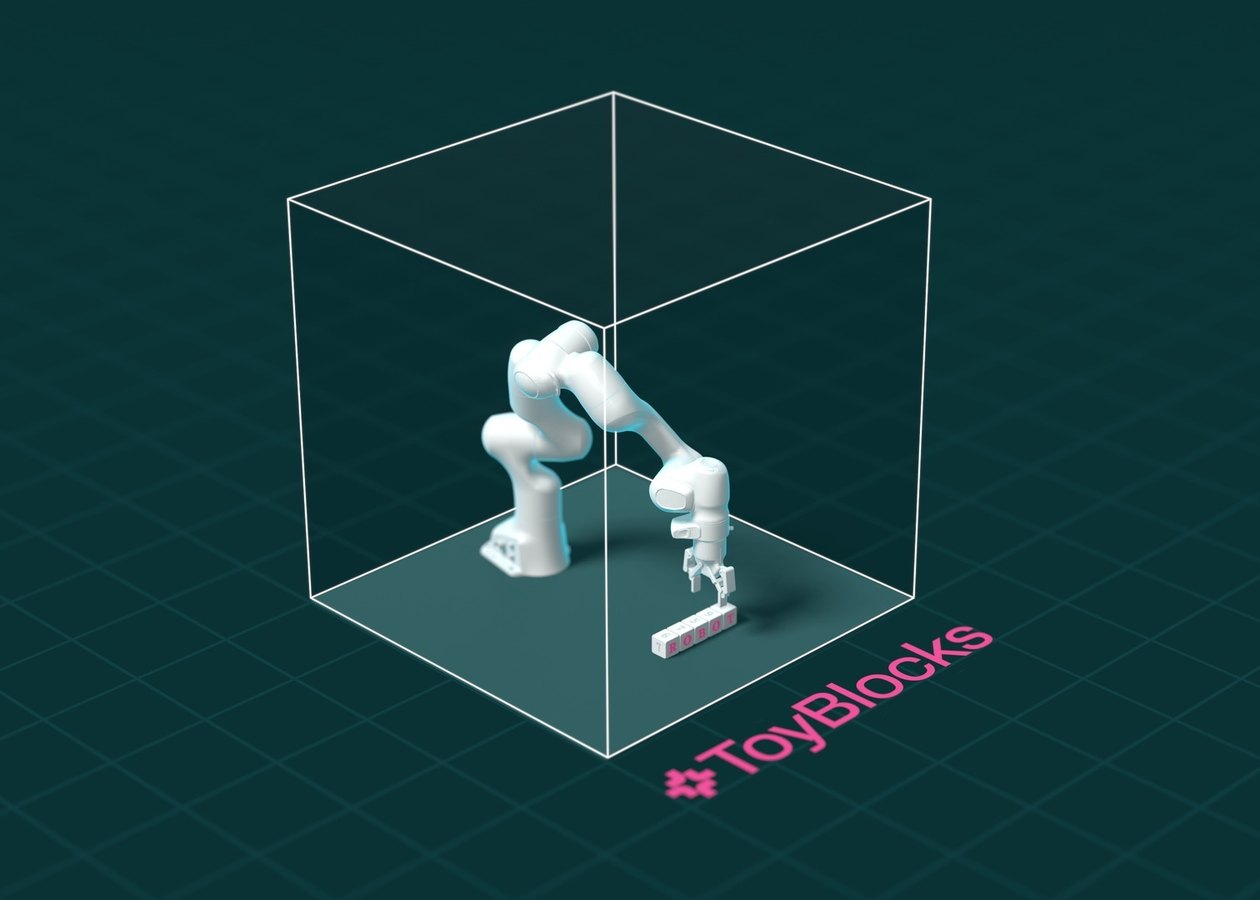
At its operational foundation, ToyBlocks builds upon earlier open robotic frameworks developed by the Allen Institute for AI, including MolmoAct 2, MolmoBot, and MolmoSpaces. The operational pipeline splits control into two tiers: a high-level cognitive model that plans the sequence of actions and a low-level execution policy that drives the mechanical joints of the arm. In a representative deployment, the high-level Molmo 2 model analyzes the tabletop, selects required actions such as rotating or flipping, and designates the target block through a coordinate pointing interface. The low-level ManiFlow model then consumes those commands, translating target coordinates and raw visual observations into joint actions that manipulate the simulated arm.
The environment challenges models by stamping images and letters onto the faces of the blocks, requiring robots to perform visual search, alphabet sorting, and deliberate spatial arrangement. If a required letter is turned away from the overhead camera, the robot must turn the block to inspect the hidden face before selecting a target placement. To prevent models from memorizing static configurations, ToyBlocks applies domain randomization across block dimensions, table elevations, and physical properties. To test systems without robotics hardware, the platform includes a browser interface connecting frontier models like Claude directly through natural language instructions. When assessing performance, ToyBlocks extracts granular telemetry beyond basic task completion rates, logging physical force applied to objects, execution speed, and incremental goal progress directly from planning specifications.
Advertisement
Tech Pulse Daily
Get tomorrow's pulse first
Join engineers who read Tech Pulse before stand-up. Free, weekday mornings.
A controlled world for robot learning: why it matters
Machine learning researchers have long encountered conflicting empirical claims regarding the spatial generalization capabilities of vision-language-action models. Some academic studies suggest that large-scale pre-training allows models to adapt across varied workspaces, while other benchmarks reveal extreme brittleness when scene lighting or item coordinates change slightly. The Allen Institute for AI attributes this contradictory evidence to existing real-world datasets, which offer limited flexibility for controlled spatial variation. ToyBlocks provides a standardized, reproducible benchmark where researchers can isolate the exact limits of spatial generalization by systematically separating interpolation within a known training distribution from extrapolation into unobserved workspace coordinates.
The system gives engineering teams precise control over training mixtures, allowing them to measure data scaling laws and diagnose missing skills. A team can construct training sets that intentionally withhold four-block stacks or specific spatial quadrants, such as spawning objects strictly in a left-hand workspace region. When the trained models are tested on unstacking, stacking, rotating, or flipping in the right-hand region, researchers can observe directly whether the network extrapolates successfully or fails at the geometric boundary. This controlled experimental design replaces speculative post-hoc evaluations with concrete metrics on how data volume, object appearances, and prompt styles alter physical execution.
A controlled world for robot learning: who is affected
Robotics research laboratories and machine learning engineers developing embodied foundation models are the primary groups affected by the ToyBlocks release. Teams that previously spent hours operating physical robot rigs or collecting teleoperation trajectories can substitute simulated demonstration synthesis for early-stage prototyping. The availability of Isaac Lab integration allows teams to generate non-prehensile interaction datasets without owning physical robot workcells. Furthermore, software engineers working on visual reasoning models can use the platform's API and web interface to inspect how general-purpose vision models interpret spatial relationships without needing specialized kinematics libraries or hardware setups.
The framework also influences developers designing dual-model robotic architectures that bridge vision-language models with low-level motor controllers. Researchers investigating whether a high-level model should direct a physical manipulator through textual prompts or coordinate-based pointing interfaces can run reproducible head-to-head comparisons. By standardizing the communication interface between high-level planners like Molmo 2 and low-level controllers like ManiFlow, ToyBlocks establishes a reference design for teams evaluating how semantic instructions map to physical forces. Academic institutions with limited computing resources also gain access to data synthesis pipelines capable of generating hundreds of demonstrations on a single GPU.
A controlled world for robot learning: what to watch
Moving forward, the Allen Institute for AI plans to expand the FoundationWorlds concept beyond the ToyBlocks tabletop into increasingly complex operational environments. Observers should watch for new environments that introduce deformable objects, articulated tools, and expanded multi-room workspaces that test whether foundation worlds can scale beyond rigid wooden blocks. Another key development to monitor is the transfer performance of policies trained in ToyBlocks when deployed onto physical robot arms. While the simulation uses domain randomization to bridge the reality gap, real-world deployment data will determine whether synthetic skills translate directly to physical hardware without degradation.
Researchers should also monitor how the platform is used to evaluate frontier models acting as robotic agents. Because ToyBlocks supports natural language integration with frontier models, upcoming studies will likely measure how commercial models like Claude sequence tools and reason about geometric constraints over extended multi-step tasks. Additional benchmark results across the four baseline manipulation tasks—Stack, Unstack, Flip, and Rotate—will establish concrete bounds on how far vision-language-action architectures can extrapolate outside their training coordinate frames. The project's open codebase, public datasets, and model checkpoints on Hugging Face provide the baseline against which future FoundationWorld environments will be judged.
Developer Action Items
- ☐ Diff the official changelog for Nvidia / Framework before you bump — APIs, defaults, and removed flags only.
- ☐ Install through the vendor's documented channel in staging; keep a one-command rollback and time-box the canary.
- ☐ Grep your repo for old flag names, lockfile pins, and plugin versions that the notes mark as breaking.
- ☐ Prefer the first patch cut over the day-zero tag unless you have a reason to be on the leading edge.
- ☐ If Hugging Face Blog did not name a region, plan, or SKU, screenshot the official availability line before you promise it to users.
A controlled world for robot learning FAQ
What is ToyBlocks?
ToyBlocks is an open-source simulation framework and foundation world developed by the Allen Institute for AI that uses a tabletop robot arm and wooden blocks to study robotic learning and spatial reasoning.
How does ToyBlocks generate training demonstrations without human teleoperation?
The framework uses reinforcement learning in Nvidia's Isaac Lab to learn primitive skills from privileged simulation data, then employs a task-and-motion planner to sequence those skills into multi-step demonstrations at up to 24 times real-time speed on a single GPU.
Which models are demonstrated within the ToyBlocks architecture?
The system demonstrates a two-level control setup pairing the high-level Molmo 2 model for task planning and block selection with the low-level ManiFlow model for simulated arm motor execution, alongside web-based natural language control using Claude.
Sources

Author
Dillip Chowdary
Writes Tech Bytes coverage of AI, engineering, and the tools that actually ship. Editor of Tech Pulse Daily.
Related on Tech Bytes
Advertisement