The Arduino UNO Q is an almost perfect Hermes Agent host
Developer etoxin deployed the Hermes AI agent on an Arduino UNO Q with 4GB of RAM and 32GB storage to run low-power physical hardware automation.
By Dillip Chowdary • Oct 10, 2026 • Source: HN AI Agents
Developer and hardware enthusiast etoxin deployed the Hermes AI agent onto an Arduino UNO Q board to build a dedicated, low-power automation host without relying on personal desktop hardware or paid virtual private servers, according to HN AI Agents's report. The dual-architecture board features a Linux system operating alongside traditional microcontroller hardware, allowing developers to execute agent client logic on a physical device while isolating execution from primary workstations.
This breakdown covers how the Arduino UNO Q serves as an edge host for autonomous software agents, detailing hardware setup, peripheral control capabilities, and potential Internet of Things integrations. It is intended for embedded systems engineers, software developers, and robotics hobbyists evaluating compact ARM and Linux single-board computers for lightweight agentic workloads.
Arduino UNO Q is an almost perfect Hermes: what actually changed
The Arduino UNO Q provides a hybrid processing architecture that pairs a conventional microcontroller with a Linux-capable processor on a single circuit board. The specific unit used for the deployment carries 4GB of system memory alongside 32GB of internal storage, providing sufficient compute capacity to execute the Hermes agent client locally while offloading language model inference to external API endpoints. Communication channels linking the Linux environment to the onboard microcontroller enable software agents to issue hardware commands directly from the main operating system.
By selecting this dual-processor configuration, the deployment bypasses two common edge computing constraints: the recurring subscription fees associated with cloud-hosted virtual private servers and the security risks of running autonomous code interpreters on primary workstation operating systems. The board operates as a low-power, isolated hardware node that maintains continuous network connectivity while drawing minimal wattage from power supplies.
Arduino UNO Q is an almost perfect Hermes: how it works
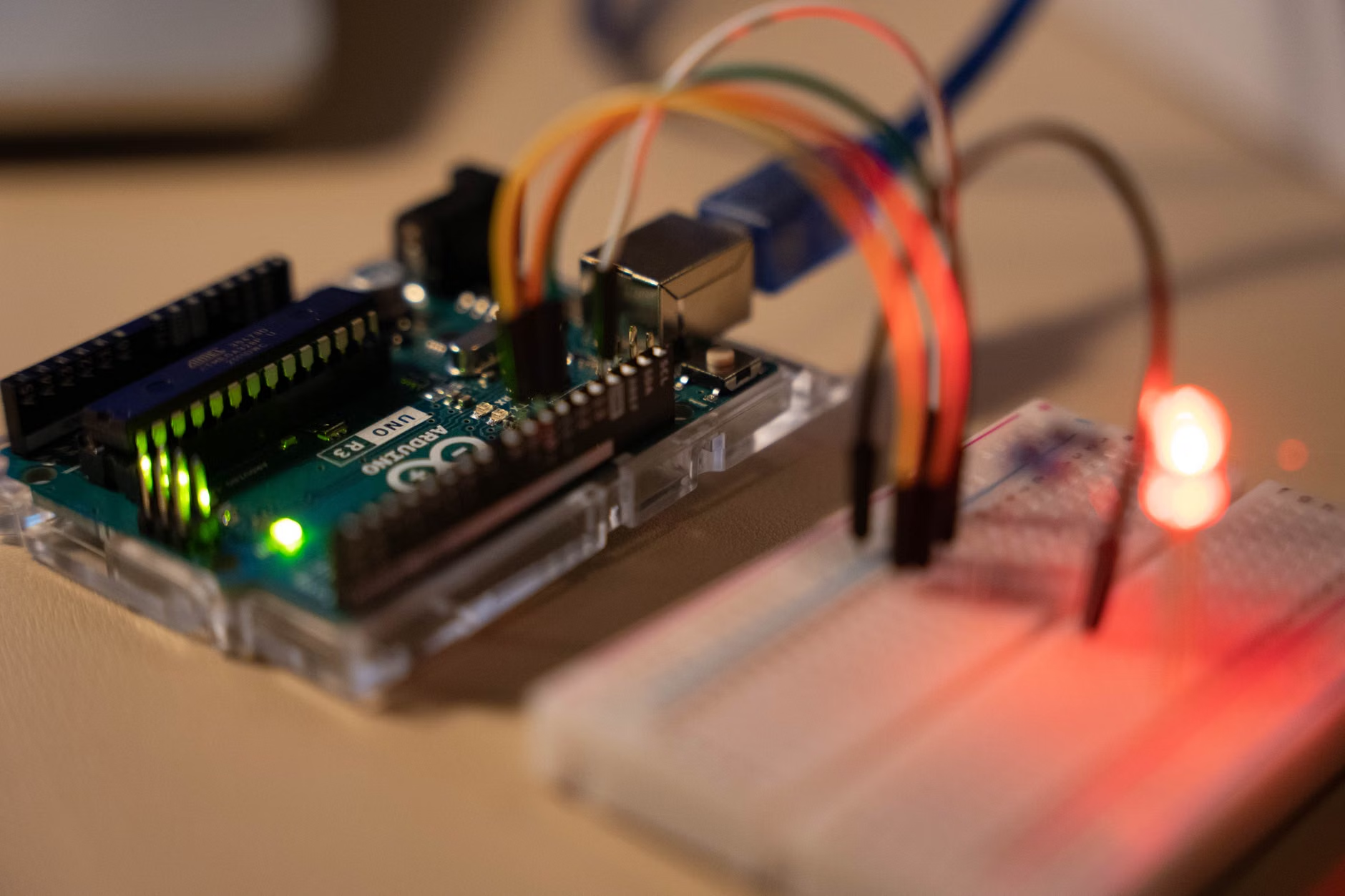
Installation begins by provisioning standard Secure Shell access to the board's Linux environment over a local network connection. Once authenticated, the developer installed the Hermes agent client software and connected the application to a OpenAI ChatGPT subscription to handle higher-level decision making and command generation. The Hermes client parses user requests within the Linux shell, translating high-level natural language prompts into executable scripts that interact with local device drivers and system utilities.
During initial testing, the agent successfully illuminated an onboard light-emitting diode upon receiving a direct natural language instruction. To test complex hardware interactions, the developer instructed the agent to execute Conway's Game of Life across the board's integrated 8x13 LED matrix display. The Hermes agent queried local documentation resources independently, identified the proper hardware interfaces connecting the Linux subsystem to the microcontroller, compiled the necessary control logic, and outputted the active cellular automaton state onto the physical display grid.
Advertisement
Tech Pulse Daily
Get tomorrow's pulse first
Join engineers who read Tech Pulse before stand-up. Free, weekday mornings.
Arduino UNO Q is an almost perfect Hermes: why it matters now
Integrating software agents with hybrid microcontroller boards creates a direct bridge between conversational artificial intelligence models and physical hardware control interfaces. Conventional agent deployments remain confined to digital environments like web browsers, local filesystems, or software development environments. By giving an agent direct programmatic access to an onboard microcontroller, developers can automate hardware testing, monitor physical environments, and interact with electronic components without writing manual driver code for every peripheral.
The project demonstrates that low-cost single-board computers possess adequate memory and storage capacity to run full agent orchestration stacks without hosting local large language models. Offloading heavy inference workloads to remote cloud APIs allows edge hardware to focus exclusively on tool usage, documentation lookup, and hardware signal processing, establishing a practical template for affordable physical computing projects.
Arduino UNO Q is an almost perfect Hermes: who is affected
Embedded software engineers, IoT developers, and hardware prototyping teams gain a scalable blueprint for building autonomous physical devices. Individual developers seeking dedicated agent testbeds can deploy edge nodes that run continuous tasks without maintaining active server instances or consuming main desktop computer resources. The setup provides a secure sandboxed environment where experimental agents can run code, execute terminal commands, and modify physical hardware states without threatening primary personal files or network infrastructure.
Makers working with peripheral ecosystems also gain expanded automation options. The Arduino UNO Q supports Modulino expansion modules, which allow users to daisy-chain electronic components like temperature sensors, humidity detectors, and relay switches directly from the main board headers. Combining Modulino hardware chains with an autonomous agent enables developers to build context-aware IoT systems that monitor physical sensors and trigger electronic actuators based on real-time natural language reasoning.
Arduino UNO Q is an almost perfect Hermes: what to watch
Future developments depend on expanding the agent's ability to inspect complex hardware schematics and interface with additional sensor buses automatically. Developers are tracking how effectively agent frameworks navigate physical component libraries, handle real-time sensor interrupts, and manage power consumption across extended deployment periods. As component ecosystems like Modulino expand, agents may soon configure multi-sensor industrial monitoring arrays or automated environmental controls with minimal human supervision.
Key factors to monitor include long-term system stability on embedded Linux storage drives, latency times when routing hardware instructions through cloud LLM APIs, and security protocols for network-connected agent hosts. Observers are also watching whether similar dual-processor single-board computers adopt standardized agent interfaces, which could simplify edge deployment across diverse robotics and home automation hardware platforms.
Developer Action Items
- ☐ Verify the claim on the official OpenAI / ChatGPT / Linux page (or HN AI Agents), not from this recap alone.
- ☐ Name the surface that moved — API, policy, model, hardware, or commercial terms — before you Slack the thread.
- ☐ Assign one owner a day to read the primary material and decide: this-sprint, this-quarter, or noise.
- ☐ Do not change production on day-one coverage. Watch the vendor changelog and one independent write-up first.
Arduino UNO Q is an almost perfect Hermes FAQ
What hardware specs were used to run the Hermes agent on the Arduino UNO Q?
The deployment used an Arduino UNO Q board equipped with 4GB of RAM and 32GB of internal storage alongside its dual Linux and microcontroller architecture.
Did the Arduino UNO Q run the LLM locally on the board?
No, the board ran the Hermes agent client locally to handle hardware operations while connecting to an external ChatGPT subscription for language model processing.
How did the Hermes agent control the board's 8x13 LED matrix?
The agent searched local documentation independently to learn the hardware interface connecting the Linux side to the microcontroller side, then executed Conway's Game of Life on the display.
Sources

Author
Dillip Chowdary
Writes Tech Bytes coverage of AI, engineering, and the tools that actually ship. Editor of Tech Pulse Daily.
Related on Tech Bytes
Unlocking hidden revenue streams with market models
Read →
Astropad Workbench 1.3 adds faster streaming, privacy curtain, and more
Read →
Camera-equipped AirPods reportedly won’t launch in 2026, despite demo video leak
Read →
The Open-Sourcing of DeepSeek Harness Opens the Door to Modular, Unbundled AI Agent…
Read →
Today's Tech Pulse briefing
Full briefing →
Advertisement